Showing posts with label marine monitoring. Show all posts

Wednesday, December 19, 2018

Eyes Under Puget Sound: Critter of the month — dove snails

Left: White Dove by Sander van der Wel (Netherlands).  Center: Alia carinata collected from Puget Sound.
Right: Close-up of the shell of Astyris gausapata, showing microscopic vertical lines called axial striations.


The holidays are in full swing – and what could capture the spirit of the season better than the dove – the universal symbol for peace, love, and goodwill? You might not know it, but a different kind of beautiful dove lives under the wintry waters of Puget Sound.

Birds of a feather?

Dove snails don’t look much like their avian namesake – except for the teardrop shape of their shells (and the opening, or aperture, might be able to pass for a wing if you’re feeling creative). Perhaps the diverse patterns of sculpture and color on their shells reminded some naturalist long ago of a dove’s mottled feathers.

Taxonomists can’t always trust these color patterns when trying to distinguish similar-looking species. For example, the two species of dove snails we encounter most commonly in Puget Sound are the nearly identical Alia carinata (the carinate dove snail) and Astyris gausapata (the shaggy dovesnail). Both species have white, orange, and brown markings, so it’s their shell texture that gives them away. A. carinata has a smooth shell, while A. gausapata has fine vertical raised lines called axial striations.


Lip reading

Did you know that snails have lips? Well, maybe not true lips like we have, but the flared part of the opening in a snail’s shell is called the outer lip, and it can be another clue for a taxonomist trying to tell similar species apart. A. carinata has a carinate shoulder, meaning that the top part of the upper lip is pronounced and sticks out. In addition, A. carinata’s outer lip is much thicker and darker in color with heavier, more noticeable “teeth” on the interior edge. 

Left: Aperture (opening) of Astyris gausapata. Center: Aperture of Alia carinata. Right: Gastropod radula: Hershler R. & Liu, H.P. (2011).

Sharp-tongued

Dove snails don’t use the teeth on their shells for chewing – like most mollusks, they have a much more specialized feeding tool. A tongue-like projection called the radula helps the snail scrape up food before it swallows. The dove snail’s radula is covered in tiny serrations that are replaced as they wear down. Puget Sound’s dove snails are carnivores; they use their radulas to chew up marine worms and crustaceans, or to grind down the shells of other mollusks. So much for peace on Earth!  If they can’t find enough prey, detritus (decomposing organic material) is their second choice.

Shut the front door

This shaggy dove snail has its operculum
 pulled closed for protection.
Like all mollusks, dove snails build their shells around themselves using calcium carbonate found in the environment. The coiled shell allows the animal to withdraw inside when it is threatened. It even has a “front door” it can open and close. As the snail retracts, it pulls the soft tissue of its muscular foot behind it. Attached to the end of the foot is a protective plate called the operculum that seals the aperture up tight.

When doves cry

Sometimes a hard shell and an operculum aren’t enough to protect from predators. In some parts of the world, humans collect dove snails for their colorful shells, making them into souvenir necklaces or even using them as a food source.

The Puget Sound species are too tiny for people to eat, but shore birds and fish eat them by picking them off intertidal rocks, kelp, and eelgrass. The empty shells of the unlucky snails make perfect dwellings for tiny hermit crabs – so even after they are gone, the dove snails are able to give other animals the precious gift of a home.


By: Dany Burgess & Angela Eagleston, Environmental Assessment Program
Our benthic taxonomists, Dany and Angela, identify and count sediment-dwelling organisms as part of the Marine Sediment Monitoring Program. They track the numbers and types of species they see in order to understand the health of Puget Sound and detect changes over time.

Dany and Angela share their discoveries by bringing us a benthic Critter of the Month. These posts will give you a peek into the life of Puget Sound’s least known inhabitants. Can't get enough benthos? See photos from our Eyes Under Puget Sound collection on Flickr.


Monday, October 29, 2018

Eyes Under Puget Sound: critter of the month – the skeleton shrimp


Skeleton shrimp on sea grass
A female skeleton shrimp sways spookily with the ocean current.

This Halloween, we’d like to introduce you to one of the most bizarre groups of crustaceans in Puget Sound – the skeleton shrimp. From their spindly skeletal bodies to their creepy waving movements, these otherworldly critters are bound to make your skin crawl!

Skeleton crew

Kingdom: Animalia; Phylum: Athropoda; Class: Malacostraca; Order: Amphipoda; Family: Caprellidae.
If you can put aside their alien appearance, skeleton shrimp are fascinating creatures. Unlike most of their cousins in the order Amphipoda (which actually do resemble tiny shrimp), the skeleton shrimps (or “caprellids”) are specialized for clinging rather than swimming in marine habitats. If they want to move, they have to crawl along like inchworms. They also have adaptations for camouflage, changing colors to blend in with their surroundings. You can find them hiding among other invertebrate critters on docks and pilings, using their hook-like back legs to hang on to the plant-like fronds of colonial hydroids and bryozoans. They can also be found in beds of seaweed and eelgrass, their lanky bodies waving about in the water current.

Skeleton shrimp microscope images
Left: Caprella mendax.
Center: A female Tritella pilimana broods her eggs in a special pouch. Image courtesy of Dave Cowles, wallawalla.edu.
Right: Tritella pilimana.

Skeleton at the feast

Skeleton shrimp have varied feeding methods – some species are filter feeders that wait for food to come to them, while others are predators, hunting for worms and crustacean larvae. Some eat detritus (dead particulate material), and some species like to munch on tiny microalgae called diatoms. In fact, skeleton shrimp are so good at grazing on diatoms that their presence is thought to keep eelgrass beds healthier by removing diatoms that encrust the blades. Fish and larger invertebrates pass these nutrients up to the higher trophic levels when they eat the skeleton shrimp.


Poison punch

Gnathopod (claw) of the male skeleton shrimp

The male gnathopod of Caprella cf californica.
A skeleton shrimp’s unusually large claws, called gnathopods, play an important role in their mating behavior. In some species (including species of Caprella found in Puget Sound), the male’s gnathopods are armed with a poison-producing gland. The toxins they make aren’t harmful to humans, but when two males fight over a mate, the outcome can be deadly.


Naked truth

Mating can be tricky for these critters because their window of opportunity is short. Like all arthropods, they shed their exoskeletons to grow in a process called molting. The female is only able to mate right after molting, when her new exoskeleton is still soft. She carries her eggs in special flaps called brood pouches, and the young hatch out looking just like miniature adults, immediately inching away to find their own little branches to attach to.


Skeleton key

For taxonomists, the scariest thing about skeleton shrimp is identifying them! We encounter over half a dozen species in Puget Sound, and telling them apart can be quite the daunting task. We look for key features such as the length of the antennae, whether or not the animal has a spine on its head, and the shape of its gnathopods. Despite the taxonomic challenges, we do enjoy seeing these weird little beasts in our samples, although the swaying and claw-waving of the live ones can be a bit unnerving. So if you really want to get spooked on Halloween, head down to a dock, peer into the murky water, and hunt for tiny skeletons!

By: Dany Burgess & Angela Eagleston, Environmental Assessment Program


Dany Burgess and Angela Eagleston on Ecology's field research boat

Our benthic taxonomists, Dany and Angela, identify and count sediment-dwelling organisms as part of the Marine Sediment Monitoring Program. They track the numbers and types of species they see in order to understand the health of Puget Sound and detect changes over time.

Dany and Angela share their discoveries by bringing us a benthic
Critter of the Month. These posts will give you a peek into the life of Puget Sound’s least known inhabitants. Can't get enough benthos? See photos from our Eyes Under Puget Sound collection on Flickr.

Friday, September 8, 2017

Eyes Over Puget Sound: Sunny, warm and colorful

Late summer brings warm air temperatures, abundant sunshine and drier conditions throughout Puget Sound. Stream flows in the region’s northern rivers are lower than our rivers in south Puget Sound.

Click here to see this month's report


Yet, the combination of abundant spring rain and weak upwelling from the Pacific Ocean means Puget Sound waters are still fresher than at any time in the past 17 years.

While the abundance of jellyfish is lower this year, our warm water temperatures, especially in central Puget Sound, are accompanied by large rafts of drifting macroalgae. What else did we see on our Eyes Over Puget Sound overflight? Diverse blooms in colors of green, orange and red-brown in many our inlets.

We are also checking to see how if our benthic invertebrate community is changing. We are monitoring and measuring samples of these critters that live in the sediments of Puget Sound at our long-term monitoring stations. We’re gathering information so we have baselines to see if any long-term change is occurring among this sensitive part of the Puget Sound ecosystem.

This year, we’re getting great hands-on assistance from our Washington Conservation Corps intern, Nicole Marks. To see more about the project, check out the great poster Nicole has created.

Friday, June 9, 2017

Eyes Over Puget Sound: River flows above normal

Cooler and wetter conditions earlier this year have set the stage for a favorable supply of freshwater. River flows are all above normal due to warm May temperatures melting our abundant snow pack. These conditions are creating significantly fresher conditions in Puget Sound surface waters. 

Click here to see this month's report.


Algae blooms are limited but there are some yellow-green blooms growing in bays near the Kitsap Peninsula and in the Puyallup, Skagit and Stillaguamish river estuaries. Red algae blooms are present in the rivers feeding into Willapa Bay. Also see what is “blooming” in the sediments of Puget Sound.

What's Eyes Over Puget Sound?

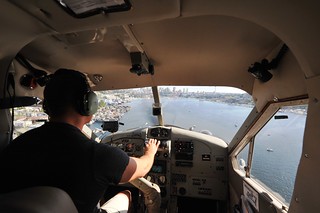
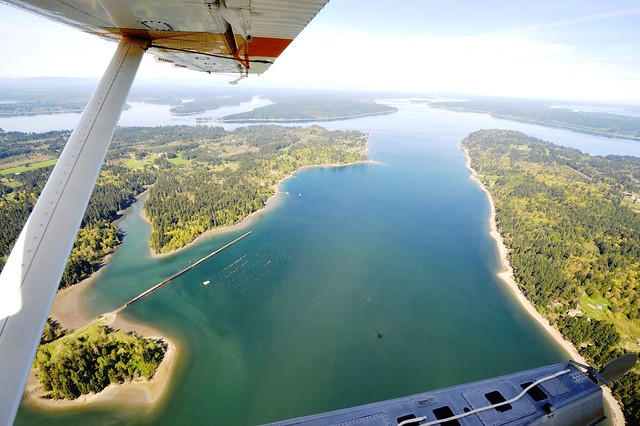
Eyes Over Puget Sound combines high-resolution photo observations with satellite images, ferry data from travel between Seattle and Victoria BC, and measurements from our moored instruments. We use a seaplane to travel between our monitoring stations because they are so far apart. Once a month, we take photos of Puget Sound water conditions and turn those out, along with data from our stations, in the monthly Eyes Over Puget Sound report.

Wednesday, January 18, 2017

Eyes Over Puget Sound: A look at 2016 in photos

After two years of very warm air and record-high water temperatures, Puget Sound is close to normal. Between the Blob warming our waters in 2015 and the past year of El Niño, we're still a bit warmer than usual, but we're in better shape than we've seen in some time.


Learn about how the global climate affects water quality, see the impacts warmer waters had on the Sound and compare photos from flights throughout 2016 in this year-end summary.

Nov. 2016 - Squaxin Passage
Feb. 2016 - Willipa Bay


We had some major rains this year! They sent mud and runoff into our rivers, downstream and out into the Sound. 2016 began and ended with sediment dynamically painting our waters.

Sept. 2016 - Liberty Bay


The very low summer river flows we experienced last year reflected climate predictions for the northwest. Our rivers are like a cold faucet: turned up high, their flow keeps waters cool, moving and full of oxygen. With the river taps turned way down, marine waters don't get mixed as much which causes warmer temperatures and higher salinities. As a result, we saw abundant jellyfish, floating macro-algae and Noctiluca blooms.

Sept. 2016 - Budd Inlet
Aug. 2016 - Eld Inlet


Surprisingly, only south Puget Sound developed very low summer oxygen levels in 2016. By fall, La Niña came with a punch! This brought more rain and cool air temperatures. But the question remains: will this be an unusual La Niña?

July 2016 - Edmonds Underwater Park

What's Eyes Over Puget Sound?


Eyes Over Puget Sound combines high-resolution photo observations with data from our monthly monitoring stations, from our regional partners and from instruments we have on ferries. We use a seaplane to travel between many of our monitoring stations because they are so far apart.

Once a month, we take photos of Puget Sound water conditions and turn those out, along with data from our stations, in the monthly Eyes Over Puget Sound report.

Tuesday, December 6, 2016

Eyes Over Puget Sound: La Niña is here!

With La Niña present we are seeing wetter and warmer conditions. Heavy rains in October swelled Puget Sound rivers and streams to above normal levels. As a result, water temperatures, salinities and oxygen in Puget Sound are returning to normal.

EOPS report cover and text for Nov. 22, 2016 report
Click here to read the November report.


While surface water in Puget Sound has cooled, it is still warmer than in the Straits.

I can see clearly now

We continue to see large groups of jellyfish in finger Inlets of South Sound and slowly fading red-brown blooms in Eld and Budd Inlets. A lot of suspended sediment was observed east of Steamboat Island and south of Squaxin Island. Otherwise, we have clear water.

What is Eyes Over Puget Sound?

Eyes Over Puget Sound combines high-resolution photo observations with data from our monthly monitoring stations, from our regional partners and from instruments we have on ferries. We use a seaplane to travel between many of our monitoring stations because they are so far apart.

Once a month, we take photos of Puget Sound water conditions and turn those out, along with data from our stations, in the monthly Eyes Over Puget Sound report.

Friday, August 19, 2016

Eyes Under Puget Sound: Critter of the Month – The Pea Crabs

Eat your peas

Imagine yourself in a nice restaurant with a delicious-looking batch of steamed oysters in front of you. You insert your knife, pop open the shell, and right before you devour your prize, you discover that your oyster has a tiny crab as a houseguest!

Male Fabia subquadrata, a species of pea crab found in Puget Sound

These little stowaways are called pea crabs, so named because many of them are small (most are less than a cm wide) and round. In the southeastern US, pea crabs are a common sight inside oysters, even considered by some to be a delicacy. This is a sight you won’t often see on the west coast, although plenty of pea crabs are found here. Scientists hypothesize that cold water temperatures or the way shellfish are grown on the west coast might play a role in controlling the number of oysters inhabited by crabs.

Hostess with the mostest

Pinnixa schmitti, the most common Puget Sound pea crab
The pea crabs of the Pacific Northwest have a wide range of hosts – each species has one (or several) favorite organisms that it prefers to shack up with, and they aren’t just bivalves. Mating pairs of Pinnixa tubicola, for example, are often found in the tubes of certain species of polychaetes (marine segmented worms).

The most common Puget Sound pea crab, Pinnixa schmitti, likes to hang out in the burrows of ghost shrimp and echiurans (spoon worms), where it feeds on detritus and leftovers from its host. Many pea crabs can also filter feed if needed, but why pass up a free meal?

Two (or more) peas in a pod

Scleroplax granulata, another Puget Sound species, also chooses ghost shrimp as one of its hosts. Up to six crabs can squeeze into a single ghost shrimp burrow but the crab usually prefers just its host as a roommate. It can also move from burrow to burrow if it finds that the accommodations are better elsewhere. S. granulata may play host to its own freeloading organism as well - a bryozoan (tiny colonial invertebrate) that grows on its shell or lives inside its gill cavity.


Wearing out your welcome

These types of relationships are symbiotic, or an association between two organisms. In the case of pea crabs, many of them are not well understood. In most cases, the symbiosis seems to be commensal; that is, one animal (the crab) benefits from the shelter and food provided by its host, and the host is not affected one way or another by the crab’s tenancy.

Fabia subquadrata inside the mussel Mytilus sp.
Photo courtesy of Aaron Baldwin,
Alaska Department of Fish and Game
In some cases, however, it appears that pea crabs do have a harmful effect on their hosts in a form of unintentional parasitism. Fabia subquadrata, the grooved mussel crab, lives the majority of its life inside a mussel or other bivalve, only leaving its host to find a mate. The female then re-enters the host and produces an egg mass that is almost the size of her body.

Over time, the presence of this sharp-clawed foreign object is thought to erode the gills of the mussel. Eventually the crab larvae will hatch out, each finding a mussel of its own to squat in.

Rule of thumb

The chelipeds of Pinnixa schmitti (left) and P. occidentalis (right)
 have a different shape that helps taxonomists distinguish the two species.
Identifying pea crabs can be tricky because they are so small, and they often don’t have a lot of distinct features to examine. Some of the more reliable characters that taxonomists use to determine the species are the shape of the carapace (shell), the size of the walking legs, and the shape and dentition of the chelipeds (claws).

For example, Pinnixa schmitti has a cheliped with a straight fixed “finger” while the similar-looking P. occidentalis has a finger that is deflexed in a sort of permanent “thumbs down.”

P. schmitti male (top) and female (bottom).
Arrows indicate the abdomen, which can be used to
differentiate between the sexes.

Peas and love

Telling male and female crabs apart may seem like an impossible task when they are so tiny, but there is an easy trick that applies to many crab species. If you turn a crab over and look at the bottom side, you will see where its abdomen wraps around under its carapace. The female crab has a wide, rounded abdomen, because she uses it to carry her egg mass. Males have a much narrower abdomen.

Critter of the Month

Our benthic taxonomists, Dany and Angela, share their discoveries by bringing us a Benthic Critter of the Month. Dany and Angela are scientists who work for the Marine Sediment Monitoring Program. These posts will give you a peek into the life of Puget Sound’s least-known inhabitants.

In each issue we will highlight one of the Sound’s many fascinating invertebrates. We’ll share details on identification, habitat, life history, and the role this critter plays in the sediment community. Can't get enough benthos? See photos from our Eyes Under Puget Sound collection on Flickr. Look for the Critter of the Month on our blog.


By: Dany Burgess & Angela Eagleston, Environmental Assessment Program

Tuesday, July 5, 2016

Eyes Over Puget Sound: Diving into warmer waters

Summer is officially here, and it is bringing record-breaking Puget Sound water temperatures along for the ride. What could this mean for you? First, join us for the BEACH program kick-off in the June Eyes Over Puget Sound report.

Click to view the June report here


Is my beach safe for swimming?

Each year between Memorial Day and Labor Day, the Washington State BEACH Program monitors saltwater beaches to make sure conditions are safe for swimming and other recreational activities.

Media joined the monitoring teams last month for a kick-off to find out more about the condition of our favorite beaches and how to help keep them healthy.

Follow us on Facebook and Twitter for beach water quality updates, or visit our BEACH Program website for more information on beaches near you.

Visibility conditions for divers

Our monitoring team brings you a new feature: water visibility at different locations around Puget Sound. If you’re thinking of grabbing your scuba gear this weekend, take a look at our map to find out where underwater visibility is highest or lowest.

Visibility might be lower than in previous months. This new section will eventually deliver present conditions. We’d love to hear your feedback on it!

What does recent rain mean for water quality in Puget Sound?

Fortunately, rivers are now flowing at higher levels compared to last year’s drought. Still, we are missing a lot of the snow to support summer flows.

Visit our Flickr album for more photos from this month's Eyes Over Puget Sound report.

Despite recent rainfall the Fraser River has not been flowing nearly as high as last year, a year of drought. Why does this matter? The Fraser River, the longest river within British Columbia, is also the largest freshwater source for the Salish Sea.

Low flow in Fraser River means the water isn’t circulating as much as the Salish Sea does in normal years. Stagnant, or motionless, water means warm temperatures will continue, pollution will increase, and jellyfish could continue to appear in large numbers.

What about the jellies?

During sea plane flights over Puget Sound, we also observed many “smacks,” or groups of jellyfish. You can see high numbers of them in Eld and Totten Inlets in the South Sound region.

Phytoplankton blooms and large mats of floating organic material also showed up east of Bainbridge Island and Port Madison, as well as Quartermaster Harbor near Vashon Island.

Ew…what’s that smell?

Plug your nose before meeting our latest Critter of the Month! The Pacific Stinkworm, Travisia pupa, smells like rotting garlic when disturbed. 

Though not as easy on the eyes as last month’s critter, Travisia pupa plays an important role on the muddy ocean bottom. The Pacific Stinkworm, also known as the Pupa Utility Worm, helps aerate material on the ocean floor by burrowing and turning over sediment as it feeds. Visit our Critter of the Month blog series for more.

What's Eyes Over Puget Sound?

Eyes Over Puget Sound combines high-resolution photo observations with satellite images, ferry data from travel between Seattle and Victoria BC, and measurements from our moored instruments. We use a seaplane to travel between our monitoring stations because they are so far apart. Once a month, we take photos of Puget Sound water conditions and turn those out, along with data from our stations, in the monthly Eyes Over Puget Sound report.

Friday, May 6, 2016

Eyes Over Puget Sound: How's the water? And what's under it??

Click to view the May report here


Our marine monitoring team goes out several times a month to check the pulse of Puget Sound and Washington's coastal bays. Once a month, we bring you Eyes over Puget Sound. Because of their work, it's common for them to get the question:

How's the water quality in Puget Sound?

This seems like a simple question, but it can mean many different things. When you wonder about water quality in Puget Sound, what are you really interested in? Is it safe to go swimming? How will El Niño impact our water? Is it safe to harvest shellfish? Should I be worried about about pollution and toxins?

Visit the field impressions section of this month's Eyes Over Puget Sound report to learn answers to these questions and dive deeper into the discussion.

But really, how's the water?

May 2016 Eyes Over Puget Sound
Scroll through to see images from the flight, or
follow the link to Flickr to view the entire album.
Water temperatures are still higher than normal and groups of jellyfish are already going strong in southern inlets. Normally, we don't start seeing jellyfish "smacks," or schools of jellyfish, popping up around Puget Sound until later in the season. After last year's Year of the Jellyfish and observing populations holding steady throughout winter, we expect another summer full of jellies.

Our sunny and dry spring means air temperatures are higher than usual for this time of year. We're seeing these temps 7 °F warmer than typical in the mountains, which means the snowpack we built over the winter is quickly disappearing. Our rivers that are fed by snow-melt are running very high.

How does warm weather affect water quality in Puget Sound? 

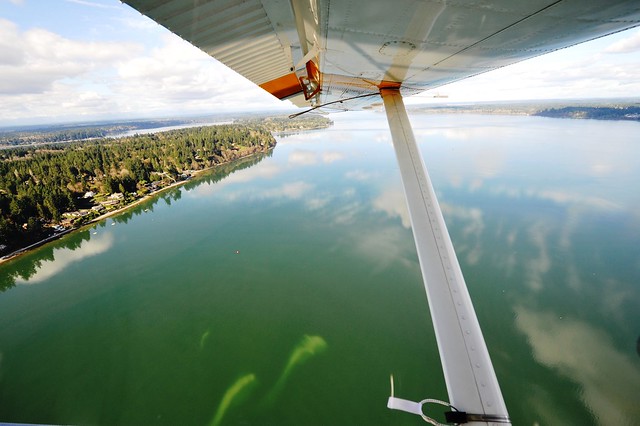
Sunny weather means lots of growth! We observed a strong spring phytoplankton bloom extend across Puget Sound and through the Strait of Juan de Fuca. This high growth of plankton, algae and plant matter was evident across the Sound in large floating mats of organic debris.


Often, this material ends up on our beaches looking like strange waves of seaweed and muck. Sometimes, these mats of plants begin to decompose on beaches and cause a stinky mess.

What's underwater? A Sand Star!

This month, our Eyes Under Puget Sound taxonomists have featured a familiar creature for the Critter of the Month: The Sand Star. Did you know the Sand Star can move up to nine feet per minute?

Learn more in our field impressions section of the report. Read about marine sediment animals monthly by following our Critter of the Month blog series.

What's Eyes Over Puget Sound?

Eyes Over Puget Sound combines high-resolution photo observations with satellite images, ferry data from travel between Seattle and Victoria BC, and measurements from our moored instruments. We use a seaplane to travel between our monitoring stations because they are so far apart. Once a month, we take photos of Puget Sound water conditions and turn those out, along with data from our stations, in the monthly Eyes Over Puget Sound report.

Tuesday, April 12, 2016

Eyes Over Puget Sound: More snow means more flow!

April has kicked off with warm weather and sunshine! Plankton blooms are spreading across Puget Sound and we still see white snow up on the mountains.

Click to view this month's report

It's been snowing a lot in the mountains this winter. Our passes currently have 80-90% of the snow that's expected for this time of year, and some areas are closer to 100%.

This suggests that our summer freshwater flows into Puget Sound may be higher than last year, and much closer to normal. However, warm weather could cause an early thaw, leading to high river flows early in the summer that reduce to a mere trickle by mid-summer.

Only time will tell what the next couple months have in store for Puget Sound. We will be watching and keep you included in what we see.

The many colors of Puget Sound

As of April, the spring plankton bloom has extended across central and south Puget Sound. Our ferry data shows that chlorophyll has been increasing since March 25 and expanding across these stretches of the Sound. Many areas of Puget Sound are starting to darken to a reddish brown as they bloom with life.

April 2016 Eyes Over Puget Sound
Click through the arrows to scan photos from April's flight, or follow the link to Flickr to see them all.


Will jellies retake the stage?

Water temperatures are still warmer than usual, just as they were throughout last year. Do you remember what species flourished in the warm waters of 2015? The jellies! We saw numerous jellyfish patches in the inlets of southern Puget Sound and Sinclair Inlet, which is unusual this early in the year.

Our WCC Individual Placement intern Mattie Michalek
ready to collect water samples in the field.

More in this issue:
Seed Shrimp and oxygen

Check out a feature from our Eyes Under Puget Sound team: the Seed Shrimp! These tiny burrowing ostracods are about the size of a sesame seed and they're April's Critter of the Month.

Also in this issue, our Washington Conservation Corps (WCC) Intern Mattie explains how we take the samples we collect in Puget Sound to the lab to analyze oxygen in seawater.


What's Eyes Over Puget Sound?

Eyes Over Puget Sound combines high-resolution photo observations with satellite images, ferry data from travel between Seattle and Victoria BC, and measurements from our moored instruments. We use a seaplane to travel between our monitoring stations because they are so far apart. Once a month, we take photos of Puget Sound water conditions and turn those out, along with data from our stations, in the monthly Eyes Over Puget Sound report.

Friday, April 1, 2016

Eyes Under Puget Sound: Critter of the Month - The Seed Shrimp

By: Dany Burgess & Angela Eagleston, Environmental Assessment Program


Close-up of an ostracod's caudal furca, an appendage
used for locomotion and/or feeding. The length
and number of claws helps us identify the species.

More than meets the eye

This month we bring you an entire group of nifty little critters collectively known as the ostracods, or seed shrimp.

Ostracods are crustaceans, but you would never know it – their crustacean appendages (such as the foot-like caudal furca, pictured to the right) are hidden inside a clam-like “shell,” or carapace, made up of two hinged valves.

Here, there and everywhere

With over 8,000 living species worldwide (more than any other crustacean group), we should be bumping into ostracods everywhere—at the beach, in fishing nets, or on the menu at local seafood restaurants.

In reality, most people will never see an ostracod, because the majority of species (including those that live in Puget Sound) are only about the size of a sesame seed. They spend most of their time buried in the mud or sand, filtering food out of the water with their feathery antennae.  

Driven to drink (water)

Ostracods need water to live, but that doesn’t restrict them to oceanic habitats or even aquatic ones. In addition to extreme environments like the deep sea, caves and polar regions, ostracods can survive where water is scarce because they have unique strategies for dealing with drought. 

One type of ostracod can trap water in its shell and move over land until its reservoir runs dry. Other types can be carried from place to place on the feet of birds or even on the backs of toads. 

When all else fails, their amazing eggs remain viable for years even after drying out, hatching as soon as they are exposed to water. In fact, if you have a fish tank, you might have acquired some of these tiny stowaways in your aquarium gravel!

The ostracod female on the left, looks quite different
from the males on the right.

He said, she said

The ornamentation of the carapace can vary from species to species – some are smooth, while others have ridges, bumps or pits.

They also display sexual dimorphism in carapace size and shape, meaning that males and females of the same species might look drastically different from one another (see the photo to the right.) A few species don’t need the opposite sex at all – they can reproduce asexually by cloning themselves.

Seeds of change

Just like oysters, ostracods use minerals in the surrounding water to build their shells.

Ostracod shells contain low-magnesium calcite, a substance that fossilizes so well that they have the most complete fossil record of any animal, dating back 425 million years to the Cambrian period! Scientists can use these ostracod fossils to help figure out how our planet and its climate have changed through time.

Critter of the Month

Our benthic taxonomists, Dany and Angela, share their discoveries by bringing us a Benthic Critter of the Month. Dany and Angela are scientists who work for the Marine Sediment Monitoring Program. These posts will give you a peek into the life of Puget Sound’s least-known inhabitants.

In each issue we will highlight one of the Sound’s many fascinating invertebrates. We’ll share details on identification, habitat, life history, and the role this critter plays in the sediment community. Can't get enough benthos? See photos from our Eyes Under Puget Sound collection on Flickr. Look for the Critter of the Month on our blog.

Monday, March 28, 2016

Eyes Over Puget Sound: Below cool surfaces, temps still run high

Every month since fall 2014, our data shows that water temperatures in Puget Sound have been running high. This month, as record rains have filled the Sound with cool freshwater from our rivers, our surface waters appear normal again. Look deeper, however, and we find this cool surface water is covering those same warm temps we've been seeing for over a year. We found that water temps remain especially high in Hood Canal.

View this month's report

What do warm waters mean for Puget Sound?

Puget Sound is running hot. The Blob that made national headlines last summer continues to lurk deep in the Pacific Ocean and remnants are still being felt here. Puget Sound is a small player in our global climate, but we are feeling the impacts.

We caught a nice view of downtown Seattle on this clear blue day.
Last year, we saw warm water temperatures that fostered algae blooms, disease and stressful conditions for cold-loving species like salmon.

We also observed these conditions boosting less desirable species that do not support fish, like jellyfish and macro-algae. We're curious to see how this unusual pattern unfolds in the coming summer, and we'll keep you included in what we see.

High flows dilute salt concentrations

Another result of this warm, wet March is that salinity in Puget Sound is notably lower than usual for this time of year. Luckily, our marine wildlife are able to adjust to fluctuating levels of salt dissolved in the Sound. Some species will even move to a different depth to find salinity levels that are more comfortable for them.

The view from the air

We saw more patches of jellyfish hanging out in the inlets of Puget Sound on this flight. Brown-red phytoplankton blooms are going strong in Hood Canal and Henderson Inlet, and picking up in many other areas around the Sound.
March 2016 Eyes Over Puget Sound
Scroll through to see images from the flight, or follow the link to Flickr to view the entire album.
 
Many places showed long stretches of suspended sediments along the shoreline, which could be a sign of shore erosion.

Meet this Critter of the Month, the cactus worm, and many
others in our special Eyes Under Puget Sound feature.

Feature: Critter of the Month

Our benthic taxonomists have been sharing their discoveries from the bottom of Puget Sound by bringing us Benthic Critter of the Month blogs. These posts are part of Eyes Under Puget Sound for our Marine Sediment Monitoring Program.

These fun species profiles will give you a peek into the life of Puget Sound’s least-known inhabitants. See the feature in this month's Eyes Over Puget Sound report and read the blogs to learn more.


What's Eyes Over Puget Sound?

Eyes Over Puget Sound combines high-resolution photo observations with satellite images, ferry data from travel between Seattle and Victoria BC, and measurements from our moored instruments. We use a seaplane to travel between our monitoring stations because they are so far apart. Once a month, we take photos of Puget Sound water conditions and turn those out, along with data from our stations, in the monthly Eyes Over Puget Sound report.