Showing posts with label #pugetsound. Show all posts

Wednesday, December 11, 2019

Brighten your holiday season with the northern opalescent nudibranch


Eyes Under Puget Sound — Critter of the Month

This month’s aquatic critter looks like a luminous holiday spirit carrying dozens of flickering candles. Definitely don’t try this at home, no matter how festive the effect might be!

Glow your own way

A translucent white and orange sea slug with tentacles extended crawls towards the camera across a pink and black background.

Hermissenda crassicornis from Hurst Island,
British Columbia. Photo courtesy
of Kevin Lee,
diverkevin.com.
The northern opalescent nudibranch has been called the most beautiful invertebrate in Puget Sound, and it’s easy to see why. Outshining its drab land slug cousins, this “sea slug” seems to radiate its own glowing light. With variable blue, orange, and snow-white markings, it’s ready for a holiday party! However, it’s more of a warm-weather fan, commonly found during spring and summer on intertidal and shallow subtidal habitats. These include mud flats, eelgrass, dock pilings, and rocky pools.

Mistaken identity

Kingdom Animalia, Phylum Mollusca, Class Gastropoda, Order Nudibranchia, Family Myrrhinidae, Genus Hermissenda, Species H. crassicornisThe northern opalescent nudibranch, or Hermissenda crassicornis, was once thought to occur all over the west coast. But in 2016, genetic analyses revealed that there were actually two west coast species: H. crassicornis, occurring from Alaska to northern California, and H. opalescens, occurring from northern California to Mexico. The southern species appears the same, but it doesn’t have white lines running down the cerata — those candle-like projections along the animal’s back, used for respiration.

To avoid confusion, the northern opalescent nudibranch is sometimes referred to as the “thick-horned nudibranch” in the area where the two species overlap. The “horns” are actually a pair of large tentacles, each with a tiny eye at the base. Behind the tentacles are a pair of sensory organs called rhinophores, used to “smell” prey. This species is so good at smelling that it can use the unique chemical signatures of its favorite prey species to pinpoint their locations — a skill known as chemotaxis.

Top view of a translucent white sea slug sitting atop a round patch of bright orange bryozoan encrusting a dark gray rock.

Photo of Hermissenda crassicornis
by
Minette Layne, Seattle, Washington.
This file was downloaded from Wikipedia
and is licensed under the Creative Commons
Attribution-Share Alike 2.0 Generic license.

Movable feast

A white slug with its tentacles and pointed tail extended. On one side, the rounded edge of the glass dish curves across the dark gray background.
Dorsal (top) view of a northern opalescent nudibranch crawling in a glass petri dish.
Photo courtesy of Dave Cowles,
wallawalla.edu
At a holiday buffet, this nudibranch would certainly be a member of the Clean Plate Club. In lab tests, it eats pretty much anything offered, including tunicates, worms, crustaceans, small clams, and even dead things. However, its prey items of choice are cnidarians such as hydroids, sea anemones, and sea pens (in Puget Sound, it is a main predator of the orange sea pen, Ptilosarcus gurneyi). These cnidarian prey contain a secret ingredient that is at the top of the nudibranch’s wish list — stinging cells called nematocysts. The nematocysts don’t hurt the sea slug, but pass directly through to its cerata, making it toxic and distasteful to potential predators. For this reason, it doesn’t have camouflage and doesn’t need it…the bright colors warn predators to nibble at their own risk!
Head-on view of a white and orange sea slug on a green and pink background.

A northern opalescent nudibranch crawls across
an encrusted rocky habitat amongst snails and chitons.
Photo by Kirt Onthank, August 2007,
wallawalla.edu.


Naughty or nice?

Beneath the northern opalescent nudibranch’s cheery exterior lies the heart of a true humbug. When one nudibranch touches another of the same species, a fight is imminent, complete with lunging and biting (including biting off chunks of the other’s head — ouch)! In some cases, the winner of the altercation eats the loser.

Despite their violent tendencies, these feisty critters can have a positive impact on human lives by sacrificing their own. They are easily reared in labs and have been used extensively for biomedical and behavioral research, including learning and memory studies and studies on lead toxicity. Maybe every grinch has a softer side after all.

By Dany Burgess, Taxonomist, Environmental Assessment Program

Tuesday, July 30, 2019

The striped nudibranch: Don’t mess with this ferocious sea slug!

Eyes Under Puget Sound’s Critter of the Month


Microscope footage of the sea slug, Armina califorica.
A striped nudibranch, Armina californica,
collected from Nisqually Reach,
Washington, March 2019.
July’s critter may be cute as a button, but don’t let the squishy sea slug face fool you. This voracious hunter strikes fear into the hearts of tiny invertebrates everywhere!

Slug of the sea

Genus: Armina; Species: Armina californica.Nudibranchs, or sea slugs, are the more elegant, marine-dwelling cousins of the slimy brown slugs you find in your garden. The striped nudibranch can get fairly large (up to 8 cm) and should be easy to spot. You won’t find one on a beach walk or tidepooling session though. They prefer the sandy or muddy seafloor anywhere from the low intertidal zone to 80 meters deep. We collect them in our Puget Sound sediment samples from Nisqually Reach, Everett, and Sinclair Inlet … often co-occurring with their favorite food, sea pens.

The pen is NOT mightier than the slug

Striped nudibranchs feed primarily on colonial animals called sea pens. In Puget Sound, their two main prey species are the orange sea pen, Ptilosarcus gurneyi and the slender sea pen, Stylatula elongata

In the southern part of their range (California to Panama), they also feed on the sea pansy, Renilla koellikeri. These species can bioluminesce, or give off light, when disturbed, so munching by sea slugs can set off a tiny underwater fireworks display!

Night terrors

Four sea slugs eating an orange sea pen.
Striped nudibranchs swarm and consume an orange sea pen until
only the white skeletal rod remains (visible in upper right corner).
Photo by Neil McDaniel.* 
Striped nudibranchs cleverly let the routine of their prey determine their activity schedule. Instead of wasting time crawling around during the day when sea pens are buried in the sand, they stay buried too, with only their rhinophores, or sensory structures, protruding. 

The rhinophores help the nudibranchs “smell” chemicals in the water that indicate food is nearby, and they can detect changes in light with a pair of tiny eyes. When night falls they emerge, searching for fleshy victims to devour. The nudibranchs use suction to ingest pieces of the sea pen’s tender polyps, pulling the tissue off and leaving only the hard white rachis, or skeleton, behind.

Microscope image of sea slug.Pretty with poison

You would think plenty of animals would be happy to give the striped nudibranch a taste of its own medicine in the predation department, but even the ravenous sun star, which eats pretty much everything in its path, gives this little nudibranch a wide berth. In fact, the striped nudibranch has very few natural predators. So, what makes this slow-moving nudibranch so unappetizing? It can incorporate chemicals from the tissue of its sea pen prey into its own body, making it toxic to consume.
The underbelly of the sea slug.
This lateral (side) view shows the groove on the right side of
the animal, with the anus to the left (posterior) and the gonopore
(reproductive opening) to the right (anterior). Image courtesy of
Dave Cowles, wallawalla.edu.

In the groove

While the striped nudibranch may be the stuff of nightmares to a sea pen, it’s a daydream for a mollusk taxonomist. Most nudibranchs are difficult to identify, but the distinct long white ridges and dark background of this species are very distinct. It has no appendages on its top surface except for the rhinophores, which project out of a notch on its head; everything else is tucked away in a groove running down the side of the animal’s body. Hidden away in these folds are flap-like gills, the anus, and the reproductive opening.

Doing it all

Like other sea slugs, striped nudibranchs are hermaphroditic (possessing both male and female sex organs). Any two individuals can mate by connecting the reproductive “ports” on the right sides of their bodies. Eggs are laid in brownish spirals, and larvae hatch out into the water column to eventually settle and become tiny striped terrors in their own right!

By: Dany Burgess & Angela Eagleston, Environmental Assessment Program


Critter of the Month

Dany and Angela out on a research vessel. Our benthic taxonomists, Dany and Angela, are scientists who identify and count the benthic (sediment-dwelling) organisms in our samples as part of the Marine Sediment Monitoring Program. We track the numbers and types of species we see in order to understand the health of Puget Sound and detect changes over time.
Dany and Angela share their discoveries by bringing us a Benthic Critter of the Month. These posts will give you a peek into the life of Puget Sound’s least-known inhabitants. We’ll share details on identification, habitat, life history, and the role each critter plays in the sediment community. Can't get enough benthos? See photos from our Eyes Under Puget Sound collection on Flickr.

This work is licensed under a Creative Commons Attribution-Noncommercial-Share Alike 4.0 License.

Tuesday, July 16, 2019

New Tacoma park emerges from Superfund site

Aerial view of Dune Peninsula showing Puget Sound, walking paths, and the Tacoma Yacht Club.
Tacoma's new Dune Peninsula at Point Defiance Park.
Image courtesy Metro Parks Tacoma
Since the 1980s, we have been working in partnership with the City of Tacoma and the EPA to clean up the blight and contamination left behind by the former Asarco smelter.

On Saturday, July 6, 2019, a beautiful new park was born from the smelter’s slag heap after decades of hard work, and millions of dollars in cleanup. The Dune Peninsula at Point Defiance Park is now open to the public with walking paths, a public amphitheater, and sweeping views of Puget Sound and Vashon Island.

History of the site

Aerial view of former Tacoma Smelter Plant showing industrial buildings, docks, and smokestack next to Puget Sound
The former Asarco smelter plant and smokestack
After operating for nearly 100 years, the Asarco smelter was designated as a Superfund cleanup site in 1987. While the smelter provided local jobs and valuable metal resources for the nation, it also left a toxic legacy in the soil, groundwater, and sediments in Puget Sound.

The once-iconic Asarco smokestack – the tallest in the world at 571 feet – vented heavy metals and arsenic that drifted along the winds to contaminate an estimated 1,000 square miles of land from Seattle to Olympia. Even the peninsula that the 11-acre park is built on was created from slag waste that Asarco dumped into Puget Sound over a period of decades.

Since the smelter was closed and its smokestack imploded in spectacular fashion, the site has been undergoing a remarkable physical and economic transformation. This includes the development of Point Ruston, with theaters, restaurants, shopping, and condominiums with spectacular views – and now this beautiful park.

Funding from the ashes

In 2009, Washington state was awarded a $188.5 million settlement during Asarco’s bankruptcy. $95 million of these funds were set aside for the Tacoma smelter. In 2013, the state legislature granted Ecology $5 million of these funds for the Metro Parks Trails Project. This funding was used to permanently cap 400,000 cubic yards of contaminated soil on the peninsula — enough to fill 120 Olympic-sized swimming pools — and allowed the new park to be built over the top.

Many agencies provided funds for additional improvements around the new park including:
  • $36.6 million from Metro Parks' 2014 voter-approved park bond
  • $25.4 million from the EPA
  • $3.5 million from the Washington State Recreation and Conservation Office to create a 20-foot wide trail, and a pedestrian bridge over Pearl Street.
  • $2.5 million from the Washington State Department of Transportation to create a new roundabout entrance to Point Defiance Park
  • $1 million from Ecology to create a regional stormwater facility that can handle 8 million gallons of water daily from a 754 acre watershed

Naming the park

Back in the 1950s, the Asarco smelter and its pervasive pollution inspired local author Frank Herbert to draft an award-winning ecologically-inspired science fiction novel titled “Dune.” The Dune Peninsula Park is named after this novel, and Frank Herbert’s name is emblazoned on the new trail winding through it.

Cleanup continues

While the Dunes Peninsula is now open to the public, Ecology is still cleaning properties in nearby neighborhoods within the Tacoma Smelter Plume. To date, these cleanups have removed contaminated soil from homes, schools, daycares, parks, and camps in the surrounding area. Nearly 1,200 homes in the smelter plume qualify for cleanup.

Around 300 homes have already had their soil replaced, along with nearby city parks, schools and even Fort Nisqually at Point Defiance. Homeowners whose properties may be contaminated can contact us to learn more about the options available. For more information on all of our cleanup programs around the Asarco smelter, visit our Tacoma Smelter Plume Project page.

By Marcus Humberg, Communications Specialist, Toxics Cleanup Program.

Thursday, June 27, 2019

Celebrate Pride! The Ornate Tube Worm sports all the colors of the rainbow

Eyes Under Puget Sound's "Critter of the Month"

June is LGBTQ+ Pride Month, and in the spirit of celebrating diversity—both invertebrate and human—we’re featuring a critter that wears its rainbow colors with pride every day of the year. Meet one of Puget Sound’s most beautiful creatures: the ornate tube worm, Diopatra ornata.

Ornate Tube Worm under the microscope.
Diopatra ornata collected from subtidal sediments at Nisqually Reach.

Breathe with me

Like many other species of polychaetes, or marine segmented worms, D. ornata has gill structures called branchiae on each segment, which help pull oxygen from the surrounding water and sediment. In D. ornata, the branchiae are distinctly spiraled and look like frilly trees or ferns running down either side of its iridescent body. The bright red color of the branchiae comes from the blood vessels inside—if you look closely at the live worm, you can see them expanding and contracting to help circulate blood throughout the body.

Family: Onuphidae, Genus: Diopatra, Species: Diopatra ornata.

Fancy digs

The “ornate” parchment-like tube of a Diopatra worm gets its name, and decorative appearance, from the bits of shells and algae attached to the hook-shaped top end, which projects from the sediment surface. Although only a few centimeters of tube are exposed above the sand, the buried portion may extend down as much as a meter!
Photo courtesy of Jeff Adams, Washington SeaGrant.

The tube’s adornments, which the worm sticks on with mucus, not only serve as camouflage from predators, but also encourage small animals to colonize the outside. In some parts of D. ornata’s range, especially off the central California coast, the tubes occur in great densities, forming mats that provide complex habitat for macroalgae (seaweed) and other animals. The little communities of organisms on the outside of the tubes may also serve as a built-in snack bar when the worms get hungry.

Left: Shell-covered tube worm protruding from the sand. Right: Shell-covered tube worm removed from the sand.

Left: A shell-covered Diopatra ornata tube protrudes from sandy sediment (photo courtesy of Kevin Lee, www.diverkevin.com). Right: This tube has been dug up, showing the bare end that stays buried in the sand (photo courtesy of Jeff Adams, Washington SeaGrant).

Jaw-dropping

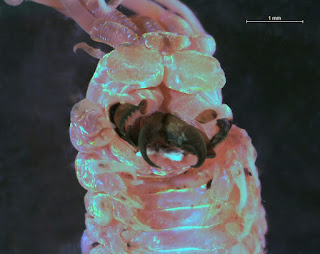
Close-up of the Ornate Tube Worm's jaws under a microscope.

Ventral (bottom) close-up of a preserved
Diopatra ornata specimen
with its jaws extended.
Scientists disagree on what D. ornata’s favorite food is—perhaps because it likes them all! It is perfectly happy munching on detritus (organic matter), but can also grab pieces of seaweed or small invertebrate prey in its rather fearsome black jaws. It has no eyes, but can sense the world with five long antennae attached to its head.

Diopatra like to build their tubes in sand rather than fine mud, so in Puget Sound, we see them most frequently where the sediment is coarse, such as around Nisqually Reach and East Anderson Island. So next time you’re walking on the beach at low tide and spot a large debris-covered tube sticking out of the sand, chances are you’ve encountered the home of one of these ornate beauties!

By Dany Burgess & Angela Eagleston, Environmental Assessment Program


Critter of the Month

Our benthic taxonomists, Dany and Angela, are scientists who identify and count the benthic (sediment-dwelling) organisms in our samples as part of our Marine Sediment Monitoring Program. We track the numbers and types of species we see in order to understand the health of Puget Sound and detect changes over time. 

Dany and Angela share their discoveries by bringing us a Benthic Critter of the Month. These posts will give you a peek into the life of Puget Sound’s least-known inhabitants. We’ll share details on identification, habitat, life history, and the role each critter plays in the sediment community. Can't get enough benthos? See photos from our Eyes Under Puget Sound collection on Flickr.

Thursday, May 9, 2019

Kicking off American Wetlands Month by securing $4.5 million in federal conservation grants

Skookum Valley wetland aquisition site in Mason County. A federal grant will help the Squaxin Island Tribe acquire, restore and permanently protect wetlands and shorelines at the site.
Skookum Valley wetland acquisition site in Mason County. We secured a $564,000 federal grant to help our Squaxin Island Tribe partner acquire, restore and permanently protect wetlands and shorelines along Skookum Creek that drains to Puget Sound. Photo courtesy Doug Ridenour.
To help celebrate Washington’s wetlands during May—American Wetlands Month—we’re delighted to share we have secured five National Coastal Wetlands Conservation grants worth $4.5 million.

This year, the federal grant program will help local partners including tribal governments and nonprofit land trusts acquire, restore, and enhance about 400 acres of coastal wetlands in Clallam, Mason, Pierce, and Thurston counties. All five projects will help recover salmon that Washington’s endangered Southern Resident orca whales depend on for survival.

The program is managed by the U.S. Fish and Wildlife Service (USFWS) and funded in part through taxes paid on equipment and fuel purchases by recreational anglers and boaters. Established in 1990, the federal conservation program provides up to $1 million for individual wetland projects in coastal and Great Lake states as well as U.S. territories.

Wetlands essential for Washington economic, environmental health

Washington’s wetlands are essential for sustaining the state’s economic and environmental health. Wetlands act as a natural sponge, helping control flooding and erosion by catching and slowing down melting snow and surface water runoff from storms. They purify water by filtering sediments and trapping excess nutrients and pollutants such as heavy metals. Wetlands also hold much of the surface water that trickles through the soil and recharges our underground drinking water aquifers.

If communities had to replace the flood control and water treatment functions Washington’s wetlands naturally provide, the costs could far outweigh the expense of preserving them. A 2008 independent study by Earth Economics found fresh water wetlands in the Puget Sound regional alone could be worth more than $10 billion to the state economy.

Productive ecosystems rivaling rain forests and coral reefs

Our wetlands also offer important refuge for wildlife and fish, including salmon, and places for people to boat, fish, and enjoy other recreation activities. Wetlands bordering or close to the marine waters of Puget Sound and Pacific Ocean can be among the most productive ecosystems in the world, rivaling rain forests and coral reefs. Wetlands also help mitigate climate change by absorbing greenhouse gases.

Although only states can apply for National Coastal Wetlands Conservation grants, we work closely with land trusts, local and tribal governments, and other entities to identify conservation projects in Washington and develop wetland restoration and protection proposals for consideration by USFWS.

Since 2008, we have helped secure federal funding and provided technical assistance for acquisition and restoration projects totaling more than $100 million to conserve more than 11,000 acres of Washington’s coastal wetlands.

This year, Ecology received 22 percent of the total $20.3 million in coastal wetlands grants USFWS awarded nationally. The Washington Department of Fish and Wildlife also received a $1 million USFWS grant to restore a coastal wetland in lower Hood Canal.

Washington’s 2019 coastal wetland conservation projects

Working with local partners, the 2019 federal grants Ecology secured will be used to help fund the following coastal wetland enhancement and restoration projects:


Baird Cove site in Thurston County. Photo courtesy Eric Erler.
Baird Cove Acquisition ($995,000)—Working in partnership with the Nisqually Land Trust to acquire an 88-acre estuarine complex in Thurston County on the east side of Johnson Point in southern Puget Sound, including more than 4,200 feet of intact estuarine shoreline, pristine coastal wetlands and mature forest.


Elwha Estuary Place site, Clallam County.
Elwha Estuary Place site, Clallam County. Photo by John Gussman.
 Elwha Estuary Place Acquisition ($1 million)—This collaborative project with the Coastal Watershed Institute will conserve historic Elwha River estuary wetlands and restore marine shoreline along the river delta in Clallam County.


Skookum Valley Wetland Acquisition ($564,000)—Working in partnership with the Squaxin Island Tribe, the funding will be used to help acquire and permanently protect 158 acres of wetlands and shorelines along Skookum Creek that flows directly to Puget Sound in Mason County.


Sound View Camp property in Pierce County.
Sound View Camp Conservation Easement ($950,000)—We are working with our Nisqually Land Trust partner to acquire a permanent conservation easement to protect Sound View Camp, a 93-acre waterfront property on Drayton Passage in southern Puget Sound in Pierce County.


West Oakland Bay restoration site in Mason County
West Oakland Bay restoration site, Mason County.
Photo courtesy Anchor Environmental.


West Oakland Bay Restoration Phase 2 ($1 million)—Working with our Squaxin Island Tribe partner to put the second phase of restoring critical coastal wetlands in place in West Oakland Bay in Mason County. The project will restore 28 acres of saltmarsh, lost when an industrial harbor was created more than a century ago.


Wetlands tools and resources 

Want to know more? We provide technical assistance and development tools for local governments, consultants, and developers regarding the responsible management, regulation, and stewardship of state wetlands.

Tuesday, March 19, 2019

Puget Sound Nutrient Watch: What we're learning from other states

Nutrient management from coast to coast

Across the country, many states are dealing with similar environmental issues. This month, thanks to funding from the EPA’s National Estuary Program Grant, we invited experts from Long Island Sound, Chesapeake Bay and the San Francisco Bay to speak to the Puget Sound Nutrient Forum and share their work on reducing nutrients in estuaries. Puget Sound is the country’s second largest estuary, an area where saltwater from the ocean meets freshwater from rivers. Our state shares similar challenges as other coastal estuary states.

Many coastal areas need to reduce the amount of nutrients coming into the waterway. Excess nutrients can come from humans and cause low dissolved oxygen conditions, a problem for aquatic species and food webs. Long Island Sound and Chesapeake Bay were experiencing extremely low levels of oxygen, called hypoxia, due to excess nutrients from humans. Through state-run clean-up plans, each state was able to reduce human nutrient sources and improve water quality.  

There’s nothing like a good success story to keep us inspired in our nutrient reduction strategies. Check out some highlights from their work:

Tricks of the trade from Long Island Sound

The Long Island Sound’s largest source of nutrients, according to Rowland Denny of the Connecticut Department of Energy and Environmental Protection, was discharges from wastewater treatment plants (WWTPs). Connecticut’s cleanup plan focused solely on reducing nutrients at WWTPs. 

Because treatment technologies can be costly and require long-term planning, Connecticut set out to create a cost-effective plan in the 1990’s to restore a healthy Long Island Sound.  
To start their cleanup plan, Connecticut first established a cleanup goal: reduce nutrients from WWTPs by 58.5%. Their plan has three main elements:
Changes in hypoxia in Long Island Sound from 1994-2018. 
Extreme hypoxia (red) is entirely gone and the Sound 
is much healthier.
  • Require equal nutrient reductions at WWTPs: This means all WWTPs in Connecticut were given the same minimum nutrient reduction requirement and were on the same compliance schedule. 
  • Give the WWTPs time to transition: Requirements ramped up in three stages: a first reduction goal by 2004, a second reduction by 2009, and finally the total 58.5% reduction by 2014. This gave WWTPs time to make strategic upgrades to their facilities 
  • Allow trading: If WWTPs reduce nutrients beyond the requirement, they can sell excess “credits” to WWTPs unable to meet their requirement that year. The state manages the trading program providing a financial incentive to reduce more nutrients than required. It also gives flexibility for WWTPs to buy credits when they have difficulty meeting their requirement. Total nutrients from all WWTPs that enter the Sound must meet the reduction requirement, ensuring the Sound is still healthy even if a few WWTPs don’t meet their exact targets.  

Result: Success! Long Island Sound was able to meet required reductions by the 2014 deadline. The plan was cost-effective and flexible for WWTP treatment upgrades, and 61 facilities upgraded their treatment technologies.

For more info, visit the Long Island Sound Nitrogen Trading Program webpage.

Chesapeake Bay: the grass is greener

Allan Brockenbrough, Virginia Department of Environmental 
Quality, speaking at the Puget Sound Nutrient Forum.
To clean up the Chesapeake Bay, Allan Brockenbrough from Virginia Department of Environmental Quality, explained the need to reduce nutrients from all human sources to meet their bay cleanup goals. Allan described Virginia’s nutrient management plan as “everyone doing everything, everywhere.” The most significant source of nutrients to the Bay was WWTPs, but other human sources were also quite high, including agriculture, runoff from urban areas, forestry, and septic systems. 

Similar to the Long Island Sound cleanup, Chesapeake Bay used a nitrogen reduction requirement for WWTPs and allowed trading. They also created technology requirements so that any new facilities or planned upgrades must meet minimum reductions set by the cleanup plan. 

Virginia included reduction for non-point sources, or sources that don’t directly discharge into the Bay. This includes fertilizer run-off from agriculture, stormwater pollution, and failing septic systems. Virginia allowed non-point sources that met nutrient reduction goals to trade with WWTPs. They also did outreach to involve all residents in cleaning up the Bay.

Recovered eelgrass provides habitat for the famous 
Chesapeake Bay Blue Crab.
Result: Success! Chesapeake Bay is on its way to meeting the nutrient reduction goal and you can literally see the improvements. Eelgrass and other aquatic vegetation is recovering and providing habitat for fish and aquatic species. Eelgrass also protects shorelines by lessening wave impact and keeping water clear by rooting down seafloor sediment. 

For more info, visit the Chesapeake Bay water cleanup plan webpage.

San Francisco Bay: Same, same, but different

San Francisco Bay, seen here, is also concerned about 
a growing human population.
Our West Coast estuary neighbor, San Francisco Bay, is planning for future population growth and climate change impacts on their waterways. Nutrient issues have been kept at bay here, due to the strong tides. But, there are concerns about the effects of algal blooms from excess nutrients. 

David Senn, from the San Francisco Estuary Institute, explained that just because excess nutrients aren’t obvious now, it doesn’t mean it won’t be an issue as the human population grows in the surrounding area. That’s why San Francisco wastewater treatment plants and other stakeholders are investing in monitoring and science. 

Puget Sound is also a quickly growing region and is not immune to the impacts of climate change. That’s why we use our sharpest tool in the (water)shed, the Salish Sea Model, to help us understand the impacts of future growth and climate change on the health of Puget Sound. You can explore our recent modeling results evaluating nutrient reductions in Puget Sound on our Salish Sea Model webmap

Sharing is Caring

We plan to stay connected with other nutrient management plans around the U.S., because we all benefit from each other’s successes and lessons learned. Managing excess nutrients is a global issue, especially in coastal estuaries near growing populations. 

If you’re interested in what’s being done to reduce nutrients in Puget Sound, please visit our project page for resources and to sign up for email updates. All Forum meetings are open to the public. 

Funding for guest speakers’ travel to the Puget Sound Forum was provided by the EPA’s National Estuary Program. 

By: Kelly Ferron, Water Quality Program

Wednesday, March 13, 2019

Washington litter czars welcome viral #Trashtag Challenge – but advise safety first

Teens encouraged to join Ecology Youth Corps to clean up roadways

Do you remember the Harlem Shake? What about planking? Most social media phenomena are little more than silly time wasters, but a new viral challenge aims to leave the world a little cleaner than we found it: Thousands of people around the world are joining the #Trashtag Challenge on social media by posting photos of themselves ridding their roadsides, beaches, and parks of garbage.

Ecology Youth Crews is 2018 cleared more than 1 million
pounds of litter from Washington roadways. Here a crew
from the Puyallup area poses with a one-day haul of
picked litter last year.
The Washington Department of Ecology, which oversees litter prevention and pickup programs in our state, commends the efforts of #Trashtag volunteers. But everyone cleaning up litter should put safety first, particularly when working near traffic or dealing with potentially dangerous trash like needles, biomedical waste and weapons.

“Litterers annually dump more than 12 million pounds of junk in our beautiful state,” said Peter Christiansen, manager for Ecology’s roadside litter crews. “We’ll take all the help we can get picking up that trash – but make sure you take a few commonsense precautions. And consider helping out your community by picking up garbage at a park or a school.”

Christiansen advises Trashtaggers to stick to safe places like parks and beaches, and to wear high-visibility clothing and puncture-resistant boots and gloves, and stay away from roadways. If Trashtaggers choose to pick up litter from a roadway make sure it is legal, always face traffic, and be sure to have an escape route from out-of-control vehicles.

Social media fads fade over time, but litter never ends. If cleaning up your community means more to you than just a selfie for a few likes, sign up with the Washington Department of Transportation’s Adopt-a-Highway program by contacting a local coordinator.

And if you know a teenager inspired to clean up, let them know they can do more than volunteer. The Department of Ecology plans to hire 300 teenagers throughout Washington this summer as part of the Ecology Youth Corps. Teens chosen for the Ecology Youth Corps will earn $12 per hour and work up to 32 hours per week.

In 2018, Ecology Youth Corps crews picked up over 1 million pounds of litter and cleaned about 4,500 miles of roads statewide. Since 1975, the program has hired more than 12,000 Washington teens, offering them work experience, a summer job, and the chance to preserve Washington’s natural beauty and protect our state’s environment.

Applicants must be ages 14-17 as of July 1. The first deadline for applications in the Central and Eastern regions is April 1. Deadlines for applications in our Southwest and Northwest regions are April 12 and April 16, respectively.  Applications are available through area school counselors and at www.ecology.wa.gov/EYC.

Contact one of our EYC coordinators for more information:

Central Region
Ellensburg, Goldendale, Richland, Sunnyside, Toppenish, and Union Gap.

Rod Hankinson
rodney.hankinson@ecy.wa.gov
509-454-7209

Monica Martinez
monica.martinez@ecy.wa.gov
509-454-7873

Eastern Region
Chewelah, Colville, Moses Lake, Othello, Pasco, Spokane, Deer Park, Pasco

Laurie Dahmen
laurie.dahmen@ecy.wa.gov
509-329-3506

Lynette Kuehl
lynette.kuehl@ecy.wa.gov
509-329-3434

Northwest Region
South King County, North King County, South/Central Snohomish County, North Snohomish/Skagit Counties, Kitsap County, and Whatcom County.

Steven Williams
steven.williams@ecy.wa.gov
425-649-7048

Sarah Elledge
sarah.elledge@ecy.wa.gov
425-649-7029

Southwest Region
Aberdeen/Montesano, Chehalis, Olympia, Puyallup, Tacoma, and Vancouver

Lexi Ehresmann
lexi.ehresmann@ecy.wa.gov
360-407-6391

Ariona
Southwest Region Litter Administrator
ariona@ecy.wa.gov
360-407-6351

Thursday, November 29, 2018

Oak Harbor has Puget Sound’s future in mind


The city of Oak Harbor is about to bring Puget Sound’s newest wastewater treatment plant online. It’s designed to fit alongside a revitalized downtown park, service the community’s needs for many years, and contribute to continuing efforts to restore and protect water quality in the Sound.  

The administration building at Oak Harbor's new wastewater treatment
plant will include an interpretive center and multi purpose space. 
Oak Harbor dedicated its new plant, located on the Whidbey Island city’s namesake inlet, today. We couldn’t be happier to be part of the celebration. 

We’ve provided over $105 million dollars in financial assistance, through low interest loans and grants, for design and construction of the $128 million dollar project.

New capacity

The plant will be able to treat up to 5 million gallons of wastewater per day. The city’s current daily volume is about 1.5 million gallons, serving about 22,300 people.

“I want to commend the city for its early and ongoing proactive community outreach and communication. The city went to great lengths to ensure that information was shared with its citizens from planning through construction,” said Jeff Nejedly, who oversees Ecology’s Water Quality grants and loans, at the ribbon-cutting event.

Jeff Nejedly, financial assistance supervisor, and Shawn McKone,
municipal wastewater treatment plant permit manager, were among
Ecology's staff who helped the city develop the new facility.
The new all-indoor plant replaces two outdated facilities. One was a smaller city-owned plant that was located near the new plant site. The other is a large wastewater lagoon plant located at Naval Air Station Whidbey – Seaplane Base.

Advanced technology

Oak Harbor’s new system treats wastewater with membrane bioreactors, or “MBRs.” The advanced technology uses ultra-filtration membranes to remove solids left over after beneficial microbes digest the city’s sewage. The result is water that has had most of its impurities removed and residual solids that can be further processed for beneficial use as a fertilizer.

“This advanced wastewater treatment system is capable of producing high-quality “Class A” reclaimed water that can be used for irrigation in parks and in other public areas. This can reduce dependence on drinking water sources for activities that don’t require drinkable water,” said Nejedly.

Oak Harbor's new treatment plant, upper right, nears completion
next to Windjammer Park, center, undergoing its own upgrade.

Re-usable water

The first planned use for the plant’s reclaimed water will be irrigation for the adjacent Windjammer Park, which the city is redeveloping in tandem with the treatment plant project.  The city is in the process of finalizing a proposal to divert a portion of the water produced at the facility for these purposes.

The MBR technology is capable of producing water that contains lower levels of nutrients, such as nitrogen and phosphorus, than conventional wastewater treatment systems. Excess nitrogen can cause conditions that upset the Puget Sound food web. Maintaining healthy conditions promotes the recovery of salmon, which are the natural prey of Puget Sound’s southern resident orcas.

Oak Harbor’s work on the new plant dates back to 2010 and earlier, when city staff and elected officials determined that the city’s growth would exceed the existing treatment plants’ capacity. Staff from our Water Quality Program provided technical review and assistance on sizing and designing the new system, in addition to the financial assistance.

 Get more information from Oak Harbor’s Clean Water Facility Project website.

By Larry Altose, communications manager, Northwest Regional Office