Showing posts with label climate. Show all posts

Friday, August 17, 2018

Ecology researchers study climate effects on Puget Sound food web

Unusual phytoplankton blooms caused by warm ocean water give scientists a glimpse into the future of marine life, from shellfish to whales.

By studying the effects of warmer marine water on the tiny plant-like organisms called phytoplankton, scientists at Ecology are learning how the Puget Sound ecosystem responds to climate change.
They did so when a mass of warm water nicknamed “the Blob” made its way to the Puget Sound in 2015. This unusually warm water gave scientists the opportunity to see what a world with warmer oceans might look like.
The Blob changed the timing and size of phytoplankton blooms significantly; spring blooms happened earlier than usual, and summer blooms were dramatically larger than in previous years.
2015 Blooms from Eyes Over Puget Sound
Most of the marine food web depends on phytoplankton blooms happening at certain times. Because phytoplankton are a key source of energy, their availability affects the life cycles of marine creatures.
Ecology’s Senior Oceanographer, Dr. Christopher Krembs, tells us more.
Krembs: “A lot of life cycles of invertebrates and fish are triggered by temperature. . . . for little larvae that come out of their eggs and for juvenile fish and other species, it is important that they find their food early on in their life cycle because most of the juveniles die if they don’t find optimal conditions.”
If phytoplankton blooms don’t align with critical developmental stages of marine creatures like small fish and krill, the entire food web can suffer. A healthy marine food web is essential to regional efforts to recover salmon and Southern Resident Killer Whale populations, as well as to support the commercial, tribal, and recreational shellfish industries.
Krembs says that the data from 2015 will help scientists model climate change more accurately.
Krembs: “When you see a scenario, you become much better at predicting the future, because now you have environmental data that you can calibrate your models with. And so our predictions become better.”
More research on how a warming climate may affect Puget Sound ecosystems has already begun. To learn more, visit Ecology’s webpage about the Salish Sea Model.


By Ruth Froese, Environmental Assessment Program Communications

Friday, January 6, 2017

Watching the water supply

Snow is piling up at Paradise on Mt. Rainier. Photo: National Park Service webcam

This blog post is part of an ongoing series about water supply. Please click here to read the previous post. If you want to learn more, visit our Washington water supply information page.


It’s a new year and a good time to check in on our statewide water supply. Winter usually puts less pressure on our water supply because of reduced demand for water in homes and less agricultural irrigation. But communities and farms are already starting to plan for the drier and warmer months -- and experts are watching the conditions closely.

Looking back at 2016

For Washington state as a whole, 2016 was a slightly warmer, wetter-than-normal year. Temperature-wise, the state was 1 to 2 degrees warmer than average annually, and March through May tied 1992 for record warmth.

The balmy spring caused our snowpack to melt at record rates. In early April, the state snowpack was slightly above normal. By late May, it was less than 50 percent of normal. This raised some concern that water supplies might be pinched later in the summer, but a switch to wetter conditions and more moderate temperatures in June and July made things manageable. Still, there were some watersheds in southwest Washington where dry conditions caused total runoff during the spring and summer to be even lower than 2015 – a drought year.

This fall, the warmth returned along with long stretches of rainy days. Averaged statewide, October and November were the second-warmest on record (3.3 degrees above normal) and wettest on record (6.61 inches above normal). The pattern changed in December, though, when cooler, drier weather swept in. Most of the state was chilly – with many areas a few degrees below normal – for the first few weeks of the month.

Status of our supplies

We’re starting 2017 with good snowpack. Let’s take a closer look at water supply as of Jan. 5 and forecasts for the future:

The sun peeks out over a snowy scene on Hurricane Ridge. 
The Olympic Mountains have 126 percent of normal snowpack
for this time of year. 
Photo: National Park Service webcam
Weather and outlook | Looking ahead, state climatologists are expecting La Niña conditions (cool and wet) to shape our regional climate, but there’s a good chance we’ll switch into neutral conditions (neither La Niña nor El Niño) later this winter. Forecast models aren’t clear on temperature heading into spring, but they are predicting wetter-than-normal weather. Beyond spring, the forecast models aren’t saying much.

Mountain snowpack | Mountain snow is critical because it serves as a reservoir during spring and summer, gradually melting and feeding rivers and streams. Our mountain snowpack got a late start this year but is currently looking good. The lower Columbia, central Puget Sound and Olympic regions, in particular, are doing great with more than 125 percent of normal snowpack for this time of year. The mountains near Spokane are somewhat behind schedule, but they’re still looking decent with 77 percent of normal snowpack.

Rivers and streams | Experts are seeing typical conditions for our state’s rivers and streams. Daily streamflows are mostly in the normal range. Flows are dropping below normal during cold snaps, when snowmelt stops.

Agriculture | The U.S. Bureau of Reclamation reports that storage levels at the five reservoirs in the Yakima River basin, a major agricultural center, are at 107 percent of normal. Precipitation from October to the end of December is about 94 percent of normal in the Yakima region.

Drinking water | Drinking water supplies in our state’s big cities are in good shape. At the beginning of September, Everett’s water storage was 110 percent of normal for that time of year. Seattle’s combined reservoir storage is also above normal for this time of year. Tacoma reports that both precipitation and snowpack levels are above normal at the Lynn Lake monitoring site near the Howard Hanson Reservoir.

How you can help

We all have a role to play in conserving water, even in winter! Here one way you can make a difference:

  • Insulate outdoor spigots to prevent them from freezing and bursting. If you have an outdoor garden hose, remove and drain it. This video from the Saving Water Partnership has more information.

For more tips, visit our water conservation page.

By Kristin Johnson-Waggoner, Water Resources Program communications manager

Tuesday, October 18, 2016

Reynolds Smelter Cleanup/Millennium Bulk Terminals - Longview Update


There’s a lot happening at the former Reynolds smelter site in Cowlitz County’s industrial area this autumn. Some of it will be tangible, boots-on-the-ground work, but there’s also a tremendous amount going on behind the scenes. Although cleanup of the site and redevelopment are on separate regulatory paths, parallel progress is being made.

First an overview of what’s up with the site cleanup, then an outline of what’s happening with environmental reviews related to coal export proposed by Millennium Bulk Terminals – Longview.

Cleanup Action Plan

For almost three-quarters of a century, the site of the former Reynolds Metals Reduction Plant in Longview has hosted intense industrial activity. For 70 years, this property was an active aluminum smelter and continued to receive bulk shipments of alumina after the smelter closed in 2001. The ore continued on to a Wenatchee smelter.

For the past decade, most of activity at the site has centered on understanding and developing options for cleaning up the chemical contamination and waste byproducts left behind by the operations of the first 70 years. While working alongside the local community, property owners and Cowlitz County, the Department of Ecology has carried out a regulatory oversight role ensuring future cleanup will meet strict legal standards that protect people and the environment.

Rigorous studies and sampling of the site identified soils with elevated levels of fluoride, polycyclic aromatic hydrocarbons (PAHs) and total petroleum hydrocarbons. Testing has shown that the shallow groundwater at the site contains fluoride and PAHs.

The importance of cleaning up this site to the local community is reflected by the robust public engagement during the cleanup process. This includes local leaders, community members, tribal governments, the property owner Northwest Alloys, Inc., and Millennium, which leases the property. As a result, this complex cleanup is well-informed and comprehensive, as outlined in the draft Cleanup Action Plan, which Ecology expects to finalize later this year.

A thorough cleanup of this site is a high priority for everyone. Northwest Alloys, Inc., and Millennium are responsible for funding the cleanup. Once the final Cleanup Action Plan is issued and a legal Consent Decree is signed, cleanup can begin.

Columbia River Sediment Dredging

While investigating the site, Ecology found contamination in nearby Columbia River sediments. A small area of sediment is contaminated with PAHs.

In November, this pocket of pollution is scheduled to be dredged and sent to a landfill licensed to accept contaminated sediments. More information about the early dredging action is outlined in an approved interim cleanup work plan.

Clean, sandy backfill will replace the material that is removed.

Millennium Bulk Terminals-Longview Environmental Review

Separate and distinct from the site cleanup, Millennium is proposing to build and operate a coal export terminal on a portion of the site. Before any permit decisions can be made, Cowlitz County, Ecology and the U.S. Army Corps of Engineers must complete federal and local environmental studies.

The federal study is led by the Army Corps of Engineers and follows the National Environmental Policy Act (NEPA). The local study is being co-led by Cowlitz County and Ecology and follows the State Environmental Policy Act (SEPA). The two studies are on different timelines and both are required before local, state and federal permit decisions can be made.

Final SEPA EIS planned for Spring

The SEPA final Environmental Impact Statement (EIS) is a much-anticipated project milestone. After three public hearings that drew hundreds of people and an unprecedented 267,000 public comments, the draft study requires significant additional work before issuing it in a final form.

Cowlitz County and Ecology announced that they plan to release the final SEPA EIS on April 29, 2017, four months ahead of schedule.

NEPA Draft EIS Out for Public Review

On Sept. 30, the U.S. Army Corps of Engineers issued its draft EIS for the federal review required by NEPA. The 60-day public comment period on the federal draft study continues until Nov. 29. More information is available at the Millennium Bulk Terminals NEPA Draft EIS webpage.

There are also public comment periods for two federal permits related to the proposed coal export terminal that continue through Nov. 29. Read the joint public notice.

Recap

Cleaning up legacy pollution from large industrial sites is a big deal for any Washington community. For the Longview-Kelso region, the cleanup and redevelopment of the old Reynolds smelter offers important economic opportunities, and a chance to reclaim a contaminated site.

Cowlitz County and Ecology continue to ensure activities at the site, whether they are related to cleanup or a future use, are meeting local and state requirements.

Back in 1941, when the Reynolds smelter was manufacturing aluminum to build aircraft for the war effort, it’s unlikely that anyone imagined what the future of this site held; both the immense effort required to clean up the site, and the equally immense efforts from people of all walks of life to influence its future.

One thing is for sure: there is a lot of activity on the site. It’s a flurry of activity and it’s not even winter, and there’s much more happening in the months ahead.

By: Dave Bennett, Southwest Region communications manager


Tuesday, July 5, 2016

Eyes Over Puget Sound: Diving into warmer waters

Summer is officially here, and it is bringing record-breaking Puget Sound water temperatures along for the ride. What could this mean for you? First, join us for the BEACH program kick-off in the June Eyes Over Puget Sound report.

Click to view the June report here


Is my beach safe for swimming?

Each year between Memorial Day and Labor Day, the Washington State BEACH Program monitors saltwater beaches to make sure conditions are safe for swimming and other recreational activities.

Media joined the monitoring teams last month for a kick-off to find out more about the condition of our favorite beaches and how to help keep them healthy.

Follow us on Facebook and Twitter for beach water quality updates, or visit our BEACH Program website for more information on beaches near you.

Visibility conditions for divers

Our monitoring team brings you a new feature: water visibility at different locations around Puget Sound. If you’re thinking of grabbing your scuba gear this weekend, take a look at our map to find out where underwater visibility is highest or lowest.

Visibility might be lower than in previous months. This new section will eventually deliver present conditions. We’d love to hear your feedback on it!

What does recent rain mean for water quality in Puget Sound?

Fortunately, rivers are now flowing at higher levels compared to last year’s drought. Still, we are missing a lot of the snow to support summer flows.

Visit our Flickr album for more photos from this month's Eyes Over Puget Sound report.

Despite recent rainfall the Fraser River has not been flowing nearly as high as last year, a year of drought. Why does this matter? The Fraser River, the longest river within British Columbia, is also the largest freshwater source for the Salish Sea.

Low flow in Fraser River means the water isn’t circulating as much as the Salish Sea does in normal years. Stagnant, or motionless, water means warm temperatures will continue, pollution will increase, and jellyfish could continue to appear in large numbers.

What about the jellies?

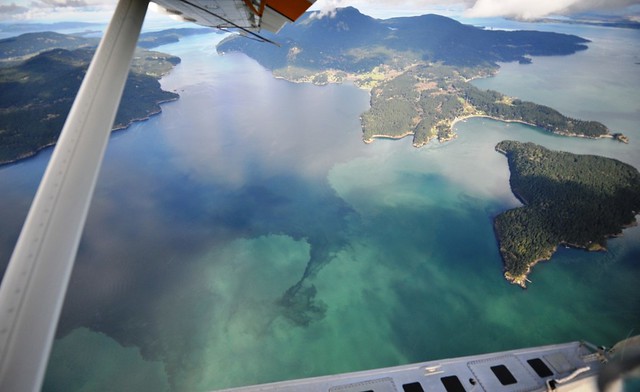
During sea plane flights over Puget Sound, we also observed many “smacks,” or groups of jellyfish. You can see high numbers of them in Eld and Totten Inlets in the South Sound region.

Phytoplankton blooms and large mats of floating organic material also showed up east of Bainbridge Island and Port Madison, as well as Quartermaster Harbor near Vashon Island.

Ew…what’s that smell?

Plug your nose before meeting our latest Critter of the Month! The Pacific Stinkworm, Travisia pupa, smells like rotting garlic when disturbed. 

Though not as easy on the eyes as last month’s critter, Travisia pupa plays an important role on the muddy ocean bottom. The Pacific Stinkworm, also known as the Pupa Utility Worm, helps aerate material on the ocean floor by burrowing and turning over sediment as it feeds. Visit our Critter of the Month blog series for more.

What's Eyes Over Puget Sound?

Eyes Over Puget Sound combines high-resolution photo observations with satellite images, ferry data from travel between Seattle and Victoria BC, and measurements from our moored instruments. We use a seaplane to travel between our monitoring stations because they are so far apart. Once a month, we take photos of Puget Sound water conditions and turn those out, along with data from our stations, in the monthly Eyes Over Puget Sound report.