Showing posts with label benthic invertebrates. Show all posts

Thursday, September 26, 2019

The spiny pink scallop: Ready for sweater weather


Eyes Under Puget Sound's Critter of the Month


Mmmm….scallops. It’s amazing how just one word can conjure up the taste and smell of pan-seared, buttery deliciousness. If you’ve ever been to a fancy seafood restaurant or watched the show, “Top Chef,” you know the important role that scallops play in the culinary world. But do you know what role they play in the sediment ecosystem at the bottom of Puget Sound?

Pretty in pink

The spiny pink scallop spends its days doing what most scallops do: lying on its right side on the sea floor with its fan-shaped shell open, filtering microscopic algae from the water that passes over its gills. This particular scallop is known for its bright color and the prominent spines that adorn the ribs running down its shell.

What’s interesting about this species is that the type of sea floor it lives on can influence what it looks like! Individuals found on rocky or shelly bottoms (the more typical habitat) generally have the pink and spiny characteristics. However, individuals found on the muddy sea floor in more protected areas are drab in color, with less pronounced spines. The difference can be so drastic that taxonomists once thought these two “morphotypes” were actually different species.

Sweater weather

The spiny pink scallop on the right has the sponge (Myxilla
incrustans
) covering; the one on the left doesn't. Photo
courtesy of Dave Cowles, wallawalla.edu.
Spiny pink scallops that live on the hard, rocky sea floor also tend to be covered with a layer of yellow sponge on their upper (left) valve. This is a symbiotic relationship that benefits both parties — the sponge gets a comfy place to live, and the scallop uses its sponge “sweater” as protection from predators.

Imagine you are a sea star, sensing a tasty scallop lunch nearby. You reach out and touch… a slimy, unappealing sponge! It’s no surprise that sea stars have been observed rejecting the sponge-covered scallops. This benefit makes carrying the extra weight of the sponge worthwhile, even if the burden may impact the scallop’s growth rate.

Just keep swimming

Spiny pink scallops also have to worry about predation by sea otters, octopuses, and humans — creatures not so easily fooled by the sponge disguise. This is where its “swimming” ability, used by many mobile scallop species, comes into play. When the scallop senses a predator approaching, it can quickly clap the two valves of its shell together, squeezing water out and causing a jet propulsion effect that allows it to swim to safety.

How does the scallop know when danger is near? It can detect predators by smell using chemoreceptors in the margins of the fleshy body wall membrane known as the mantle.
At 1 cm across, this little spiny pink scallop is already big enough to
 fall into the "hundreds of eyes" category! I stood it up on its side in
 a petri dish to get a better look at them as the valves slowly opened.

The eyes have it

If you look closely at the mantle, you will see the scallop has another sense as well — sight. Those bright blue-green dots scattered around the mantle are actually tiny, adorable eyes! These eyes can’t see images, but they can detect changes in light that might mean a predator approaching. A baby scallop might have just a few, but an older individual can have hundreds.

Coming to a plate near you?

This spiny pink scallop rests on the sea
floor, valves fully open in feeding mode.
Photo by Jim Nestler, July 2005 (from
wallawalla.edu).
The spiny pink scallop has somehow managed to avoid being a target of commercial fisheries (although some are harvested each year by diver or trawl in Canada). This is partially due to its small size; maxing out at about 6 cm, the spiny pink scallop barely makes a mouthful compared to the giant Pacific scallop or weathervane scallop (Patinopecten caurinus) found on Pacific Northwest dinner menus. However, its smaller (and less common) cousin Chlamys rubida, the Pacific pink scallop or smooth pink scallop, has made a comeback in Seattle restaurants in recent years. Perhaps the smooth pink scallop is prized over the spiny pink scallop for its delicate flavor? Someone needs to do a taste test — I’ll volunteer to be the judge!


By: Dany Burgess, Environmental Assessment Program


Critter of the Month
Dany is a benthic taxonomist: a scientist who identifies and counts the benthic (sediment-dwelling) organisms in our samples as part of our Marine Sediment Monitoring Program. We track the numbers and types of species we see in order to understand the health of Puget Sound and detect changes over time.

Dany shares her discoveries by bringing us a Benthic Critter of the Month. These posts will give you a peek into the life of Puget Sound’s least-known inhabitants. We’ll share details on identification, habitat, life history, and the role each critter plays in the sediment community. Can't get enough benthos? See photos from our Eyes Under Puget Sound collection on Flickr. 

Friday, August 30, 2019

Our scientists contribute to “global biodiversity library”

Eyes Under Puget Sound

Video provided by www.hakai.org.

Last week I was in sunny Los Angeles for the third and final west coast invertebrate “bioblitz” of the summer — the LA Urban Ocean Expedition (LAUOE). While the LA scenery was certainly different from home, the work I did there was a continuation of my previous work helping other marine scientists catalog invertebrate biodiversity! This work is crucial for documenting species before they disappear. The event also gives us an opportunity to communicate to the public just how important invertebrates are to the healthy function of marine ecosystems.

Bioblitz selfie! I had just settled in at my microscope station.  Working alongside some of the West Coast’s expert taxonomists
for a week was an incredible experience.

Crack the code

Our marine scientists held a similar bioblitz this past spring, where we collected and identified as many live sediment-dwelling invertebrates as possible from Puget Sound. “DNA barcoding” events like these are happening all over the U.S. and worldwide. Washington, Oregon, and California are just the latest to join in the effort.

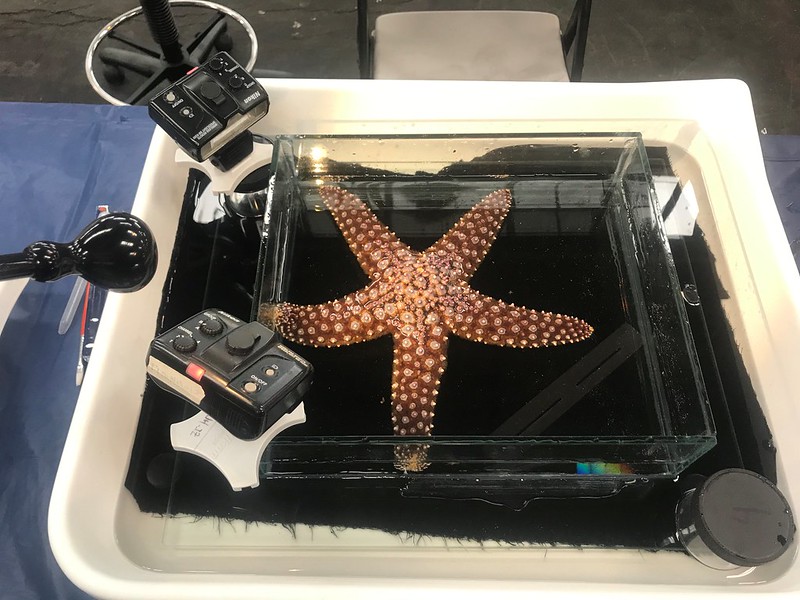
During a bioblitz, tiny pieces of tissue are taken from each animal collected. These tissue samples will be sent to the Smithsonian Institute, where DNA will be extracted and analyzed to determine a unique genetic sequence for each species. The resulting DNA barcodes will be added to a global biodiversity library that taxonomists like me can use to identify species and determine if species are new to science — including undescribed species from Puget Sound! We can use this information to better understand how invertebrate communities respond to environmental stressors, like those associated with climate change.


Under the microscope

Daily operations are continuing for the rest of this week at the AltaSea facility at the Port of LA, where a pop-up lab is staged with flow-through saltwater systems, microscope stations, and docks for dive boats to pull up with fresh specimens. Taxonomists from all over the country were invited to participate, so I felt very fortunate for the opportunity to learn from them about the intertidal invertebrates of Southern California. Some species were familiar, but many aren’t found as far north as Washington, so this gave me a bit of a challenge. One of the highlights was having a worm I identified — the Sandcastle Worm, Phragmatopoma californica — win a “Species of the Day” contest!

Los Angeles BioBlitz Critters

Reaching out


LAUOE is sponsored and organized by staff from the Natural History Museum of Los Angeles County. They invited school groups, community members, and business professionals to meet ocean scientists, tour the lab, and even touch and sort live critters.

Many people living in urban environments don’t realize how many amazing animals live right at their doorstep. Engaging the public in these types of events fosters an appreciation for the natural world that can later translate into more successful conservation efforts.


By: Dany Burgess, Environmental Assessment Program

Critter of the Month

Our benthic taxonomists, Dany and Angela, are scientists who identify and count the benthic (sediment-dwelling) organisms in our samples as part of our Marine Sediment Monitoring Program. We track the numbers and types of species we see in order to understand the health of Puget Sound and detect changes over time.

Dany and Angela share their discoveries by bringing us a Benthic Critter of the Month. These posts will give you a peek into the life of Puget Sound’s least-known inhabitants. We’ll share details on identification, habitat, life history, and the role each critter plays in the sediment community. Can't get enough benthos? See photos from our Eyes Under Puget Sound collection on Flickr.

Tuesday, July 30, 2019

The striped nudibranch: Don’t mess with this ferocious sea slug!

Eyes Under Puget Sound’s Critter of the Month


Microscope footage of the sea slug, Armina califorica.
A striped nudibranch, Armina californica,
collected from Nisqually Reach,
Washington, March 2019.
July’s critter may be cute as a button, but don’t let the squishy sea slug face fool you. This voracious hunter strikes fear into the hearts of tiny invertebrates everywhere!

Slug of the sea

Genus: Armina; Species: Armina californica.Nudibranchs, or sea slugs, are the more elegant, marine-dwelling cousins of the slimy brown slugs you find in your garden. The striped nudibranch can get fairly large (up to 8 cm) and should be easy to spot. You won’t find one on a beach walk or tidepooling session though. They prefer the sandy or muddy seafloor anywhere from the low intertidal zone to 80 meters deep. We collect them in our Puget Sound sediment samples from Nisqually Reach, Everett, and Sinclair Inlet … often co-occurring with their favorite food, sea pens.

The pen is NOT mightier than the slug

Striped nudibranchs feed primarily on colonial animals called sea pens. In Puget Sound, their two main prey species are the orange sea pen, Ptilosarcus gurneyi and the slender sea pen, Stylatula elongata

In the southern part of their range (California to Panama), they also feed on the sea pansy, Renilla koellikeri. These species can bioluminesce, or give off light, when disturbed, so munching by sea slugs can set off a tiny underwater fireworks display!

Night terrors

Four sea slugs eating an orange sea pen.
Striped nudibranchs swarm and consume an orange sea pen until
only the white skeletal rod remains (visible in upper right corner).
Photo by Neil McDaniel.* 
Striped nudibranchs cleverly let the routine of their prey determine their activity schedule. Instead of wasting time crawling around during the day when sea pens are buried in the sand, they stay buried too, with only their rhinophores, or sensory structures, protruding. 

The rhinophores help the nudibranchs “smell” chemicals in the water that indicate food is nearby, and they can detect changes in light with a pair of tiny eyes. When night falls they emerge, searching for fleshy victims to devour. The nudibranchs use suction to ingest pieces of the sea pen’s tender polyps, pulling the tissue off and leaving only the hard white rachis, or skeleton, behind.

Microscope image of sea slug.Pretty with poison

You would think plenty of animals would be happy to give the striped nudibranch a taste of its own medicine in the predation department, but even the ravenous sun star, which eats pretty much everything in its path, gives this little nudibranch a wide berth. In fact, the striped nudibranch has very few natural predators. So, what makes this slow-moving nudibranch so unappetizing? It can incorporate chemicals from the tissue of its sea pen prey into its own body, making it toxic to consume.
The underbelly of the sea slug.
This lateral (side) view shows the groove on the right side of
the animal, with the anus to the left (posterior) and the gonopore
(reproductive opening) to the right (anterior). Image courtesy of
Dave Cowles, wallawalla.edu.

In the groove

While the striped nudibranch may be the stuff of nightmares to a sea pen, it’s a daydream for a mollusk taxonomist. Most nudibranchs are difficult to identify, but the distinct long white ridges and dark background of this species are very distinct. It has no appendages on its top surface except for the rhinophores, which project out of a notch on its head; everything else is tucked away in a groove running down the side of the animal’s body. Hidden away in these folds are flap-like gills, the anus, and the reproductive opening.

Doing it all

Like other sea slugs, striped nudibranchs are hermaphroditic (possessing both male and female sex organs). Any two individuals can mate by connecting the reproductive “ports” on the right sides of their bodies. Eggs are laid in brownish spirals, and larvae hatch out into the water column to eventually settle and become tiny striped terrors in their own right!

By: Dany Burgess & Angela Eagleston, Environmental Assessment Program


Critter of the Month

Dany and Angela out on a research vessel. Our benthic taxonomists, Dany and Angela, are scientists who identify and count the benthic (sediment-dwelling) organisms in our samples as part of the Marine Sediment Monitoring Program. We track the numbers and types of species we see in order to understand the health of Puget Sound and detect changes over time.
Dany and Angela share their discoveries by bringing us a Benthic Critter of the Month. These posts will give you a peek into the life of Puget Sound’s least-known inhabitants. We’ll share details on identification, habitat, life history, and the role each critter plays in the sediment community. Can't get enough benthos? See photos from our Eyes Under Puget Sound collection on Flickr.
This work is licensed under a Creative Commons Attribution-Noncommercial-Share Alike 4.0 License.

Thursday, April 25, 2019

Our sediment monitoring team contributes to the Smithsonian’s Global Genome Initiative

Eyes Under Puget Sound


It's alive!

These beautiful specimens were photographed live in our lab.
Clockwise from top left: Pista brevibranchiata, a marine worm;
Nassarius mendicus, a marine snail; Pentamera, a sea cucumber;
Iphimedia rickettsi, a marine amphipod.


We are out on the waters of Puget Sound this month for our annual sediment quality survey. 
As the boat work winds down each day and we return to the dock, live samples are transported back to the lab where a new frenzy of activity begins! What is that, you ask? Let us tell you about DNA barcoding in the benthic lab!

Wave of the future

DNA barcoding is a taxonomic method that uses part of a specific gene or genes to identify an organism to its species. The emerging science of DNA barcoding may one day change the way taxonomists like us identify animals … or at least make our jobs a little easier. Each species has a unique DNA sequence that can be read in a tiny piece of tissue, kind of like scanning barcodes at the grocery store. DNA barcoding still has limitations for everyday use, but when combined with the traditional methods of identifying critters with books and microscopes, it can be a powerful tool for cataloguing biodiversity, assigning names to unknown specimens, and discovering new species.

A fresh perspective


Calocarides spinulicauda, a marine shrimp freshly collected from Puget Sound sediments.
DNA barcoding requires tissue from fresh animals, so as soon as our field crew collects critters from Puget Sound sediments, we immediately rush them back to the lab to identify, photograph, and collect tissue samples from each one. It’s hard work that often goes late into the night, but our reward is getting to see our Puget Sound benthic critters alive and full of color … and knowing that they will be a part of some cutting-edge genomic research.

Partners in grime

Dr. Gustav Paulay from Friday Harbor Marine Laboratories and Curator of Mollusca at the Florida Museum of Natural History has joined us to help out with this project, and we are extremely grateful for his expertise. The samples we collect are cataloged and sent to the Smithsonian National Museum of Natural History for the “Invertebrate Genomics Initiative,” part of the larger Global Genome Initiative. We collaborate with other marine labs with the goal of sequencing DNA from benthic invertebrates that live along the west coast of North America, from Southern California to Alaska. As the largest sediment monitoring program in Puget Sound, our team gets to represent Washington in this effort by providing plenty of valuable mud-dwelling critters to sequence!


Tiny live animals from sediment
samples get sorted into dishes ...
      
        ... the animals are then photographed
by Dr. Paulay...
... and then subsampled for DNA tissue by Maggie Dutch.

Tracking change

Identifying organisms has grown in importance as scientists monitor the biological effects of both local human impacts as well as global climate change. The DNA barcode information and photographs of the species we collect will be added to a global library as a resource for researchers around the world.

We are excited about the opportunity to contribute to the body of DNA knowledge for our Puget Sound benthic invertebrates, and to collaborate with other scientists to better track regional biodiversity over time!

By: Dany Burgess & Angela Eagleston, Environmental Assessment Program

Our benthic taxonomists, Dany and Angela, are scientists who identify and count the benthic (sediment-dwelling) organisms in our samples as part of our Marine Sediment Monitoring Program. We are tracking the numbers and types of species we see in order to understand the health of Puget Sound and to detect any changes over time. Can't get enough benthos? See photos from our Eyes Under Puget Sound collection on Flickr.

Wednesday, December 19, 2018

Eyes Under Puget Sound: Critter of the month — dove snails

Left: White Dove by Sander van der Wel (Netherlands).  Center: Alia carinata collected from Puget Sound.
Right: Close-up of the shell of Astyris gausapata, showing microscopic vertical lines called axial striations.


The holidays are in full swing – and what could capture the spirit of the season better than the dove – the universal symbol for peace, love, and goodwill? You might not know it, but a different kind of beautiful dove lives under the wintry waters of Puget Sound.

Birds of a feather?

Dove snails don’t look much like their avian namesake – except for the teardrop shape of their shells (and the opening, or aperture, might be able to pass for a wing if you’re feeling creative). Perhaps the diverse patterns of sculpture and color on their shells reminded some naturalist long ago of a dove’s mottled feathers.

Taxonomists can’t always trust these color patterns when trying to distinguish similar-looking species. For example, the two species of dove snails we encounter most commonly in Puget Sound are the nearly identical Alia carinata (the carinate dove snail) and Astyris gausapata (the shaggy dovesnail). Both species have white, orange, and brown markings, so it’s their shell texture that gives them away. A. carinata has a smooth shell, while A. gausapata has fine vertical raised lines called axial striations.


Lip reading

Did you know that snails have lips? Well, maybe not true lips like we have, but the flared part of the opening in a snail’s shell is called the outer lip, and it can be another clue for a taxonomist trying to tell similar species apart. A. carinata has a carinate shoulder, meaning that the top part of the upper lip is pronounced and sticks out. In addition, A. carinata’s outer lip is much thicker and darker in color with heavier, more noticeable “teeth” on the interior edge. 

Left: Aperture (opening) of Astyris gausapata. Center: Aperture of Alia carinata. Right: Gastropod radula: Hershler R. & Liu, H.P. (2011).

Sharp-tongued

Dove snails don’t use the teeth on their shells for chewing – like most mollusks, they have a much more specialized feeding tool. A tongue-like projection called the radula helps the snail scrape up food before it swallows. The dove snail’s radula is covered in tiny serrations that are replaced as they wear down. Puget Sound’s dove snails are carnivores; they use their radulas to chew up marine worms and crustaceans, or to grind down the shells of other mollusks. So much for peace on Earth!  If they can’t find enough prey, detritus (decomposing organic material) is their second choice.

Shut the front door

This shaggy dove snail has its operculum
 pulled closed for protection.
Like all mollusks, dove snails build their shells around themselves using calcium carbonate found in the environment. The coiled shell allows the animal to withdraw inside when it is threatened. It even has a “front door” it can open and close. As the snail retracts, it pulls the soft tissue of its muscular foot behind it. Attached to the end of the foot is a protective plate called the operculum that seals the aperture up tight.

When doves cry

Sometimes a hard shell and an operculum aren’t enough to protect from predators. In some parts of the world, humans collect dove snails for their colorful shells, making them into souvenir necklaces or even using them as a food source.

The Puget Sound species are too tiny for people to eat, but shore birds and fish eat them by picking them off intertidal rocks, kelp, and eelgrass. The empty shells of the unlucky snails make perfect dwellings for tiny hermit crabs – so even after they are gone, the dove snails are able to give other animals the precious gift of a home.


By: Dany Burgess & Angela Eagleston, Environmental Assessment Program
Our benthic taxonomists, Dany and Angela, identify and count sediment-dwelling organisms as part of the Marine Sediment Monitoring Program. They track the numbers and types of species they see in order to understand the health of Puget Sound and detect changes over time.

Dany and Angela share their discoveries by bringing us a benthic Critter of the Month. These posts will give you a peek into the life of Puget Sound’s least known inhabitants. Can't get enough benthos? See photos from our Eyes Under Puget Sound collection on Flickr.


Thursday, July 19, 2018

Eyes Under Puget Sound: Size matters—What can we learn from biomass and size classification?


Eyes Under Puget Sound
For the first time, benthic invertebrate biomass is being studied on a large scale in Puget Sound. What does this mean? Sediment-dwelling benthic invertebrates (benthos) live in the mud or sand at the bottom of Puget Sound; their abundance and diversity can help us assess the health of the sediment ecosystem. As it turns out, the size of the animals is also critical when evaluating ecosystem health. Recording these biomass trends over time will help us learn more about how organisms respond to environmental stressors linked to climate change.

Sediment sampling photos
LEFT: A sediment sample is collected using a double Van Veen grab. CENTER: Angela rinses a benthic sample though a 1 mm mesh screen. RIGHT: A benthic sample containing Molpadia intermedia, the Sweet Potato Sea Cucumber.


Making it count

Our Marine Sediment Monitoring Program has been identifying and counting Puget Sound benthos since 1989. Although a few studies have examined the biomass of particular invertebrate species on a smaller scale, large-scale monitoring wasn’t put in place until 2016, when we added a biomass and size-classification component to our program. This is important because we want to know how organisms respond to environmental stressors associated with climate change and nutrient enrichment. These stressors include changes in temperature and salinity, decreasing dissolved oxygen levels, and changes in food quality.


That’s about the size of it


Biomass is a measure of the amount of living biological tissue in a system, which can tell us about productivity, or how animals use and cycle nutrients as they grow. Calculating biomass is no small feat. It means weighing many individual animals in the lab, most of them very tiny. We have weighed over 6,500 creatures so far! After an animal is weighed, we categorize it into one of five species-specific size classes (small, medium, large, extra-large, and megafauna) based on its length. Megafauna are large animals like sea cucumber and crabs that weigh 2 grams or more; when we analyze our data, we look at these animals separately, since just one of them can greatly outweigh all the small animals in a sample.

Measuring benthos in the lab

LEFT: A marine worm is weighed to the nearest thousandth of a gram. CENTER: A tiny pectinariid (also know as the Ice Cream Cone Worm) is measured under a microscope. RIGHT: Size series of Astyris gausapata, the Shaggy Dovesnail.


Sneak peek

Map of benthic biomass based on water depth
Total benthic invertebrate biomass (in grams per 0.1 meters²) at 22
 Puget Sound stations sampled in April 2016. 
Shallow areas are indicated by lighter blue, 
while deeper areas are darker blue.
 Although it will take a few years before we can look at trends in biomass and size class over time in Puget Sound, we’ve already observed some interesting results from our 2016 data. These preliminary results were presented as a poster at the 2018 Salish Sea Conference in Seattle, and are now available online as an Ecology publication.

Some of the major findings include higher biomass in shallow areas like Bellingham Bay and terminal inlets, and generally lower biomass in deep basins (see map, right).
Communities with high biomass tended to have lower numbers of individuals and low diversity (meaning that a few large animals dominated, but there were not a lot of different species). Communities with the lowest biomass had the greatest numbers of individuals and were the most diverse (meaning there were many smaller animals of many different species). This shows that high biomass alone is not necessarily an indicator of a healthy benthic community. Overall, the top contributors to total biomass were stress-tolerant species of marine worms and small clams.

The sizes of animals and how they change over time may shed light on the effects that stressors have on the development of individual organisms, and how that relates to the long-term stability of benthic communities. We certainly have much more to learn from this exciting new dataset, so stay tuned!


By: Dany Burgess & Angela Eagleston, Environmental Assessment Program

Our benthic taxonomists, Dany and Angela.
Pictured left, Angela Eagleston;
right, Dany Burgess.

Our benthic taxonomists, Dany and Angela, are scientists who identify, count, and weigh the benthic (sediment-dwelling) organisms. They work as part of our Marine Sediment Monitoring Program team. Together, they track the numbers and types of species we see in order to understand the health of Puget Sound and detect changes over time.


Can't get enough benthos? See photos from our Eyes Under Puget Sound collection on Flickr.

Friday, February 9, 2018

Eyes Under Puget Sound: Critter of the Month – The Sea Mouse

A Sea Mouse from above, labelling the head, setae and elytra. The latter two are visible because part of the body covering is removed.
This juvenile Aphrodita specimen has
had some of its dorsal (top) covering
removed, exposing the elytra beneath.
This month, love is in the air – and in the mud! With a scientific name that originates from Aphrodite, the ancient Greek goddess of love, we think the Sea Mouse is a perfectly lovable addition to the fauna of Puget Sound.

Worm and fuzzy

Kingdom Animalia; Phylim Annelida; Class Polychaeta; Order Phyllodocida; Family Aphroditidae; Genus Asphrodita
The Sea Mouse may be brown and fuzzy, but that is about all it shares with its mammalian namesake. Believe it or not, the Sea Mouse is actually a marine segmented worm, or polychaete! This is more obvious if you flip it over on its back, exposing its segmented underside.

Sea Mice are members of the family Aphroditidae - one of several families of scale worms, characterized by elytra (scale-like plates running down their backs). However, the Sea Mouse’s elytra are completely hidden under a tangled mat of hair-like setae and mucus that cover the worm’s dorsal (top) surface.

Pulling the wool over your eyes


Two views of a sea mouse. One from above, shows the body covered in what looks like fur. The other shows the fleshy, segmented underside.
TOP: Aphrodita japonica captured at 70 me-
ter depth, west of Yellow Island, WA. Photo
courtesy of Dave Cowles, wallawalla.edu.
BOTTOM: A juvenile Aphrodita sp., showing
its fleshy, segmented underside.
As the Sea Mouse crawls along in the sediment, its setae pick up mud and silt particles and other debris, adding to its woolly appearance. In fact, you can barely make out any features under this dorsal covering, but if you look underneath the hairs at the worm’s front end, you can see a tiny head with a single antenna, a pair of sensory appendages called palps, and two pairs of eyespots.

The Puget Sound species of Aphrodita are typically scavengers, using their palps to search around in the mud for delicious dead things to munch on. However, some species of Sea Mice found elsewhere in the world are predators, eating other polychaetes and small crabs.


Mouse trap

On the polychaete size scale, the Sea Mouse is actually pretty hefty, with some growing to about 15 cm (6 inches) long. They live in soft sediments, like mud or sand, generally in shallow depths (to about 120 meters in Puget Sound). Although we sample in these areas, we rarely see sea mice in our benthic grabs. However, when we do, we have to examine them closely under a microscope to make sure we identify them correctly. We look at the number of segments, the length of the antennae and the type of setae to distinguish the three species we see in Puget Sound: Aphrodita japonica, A. negligens, and A. parva.

Of mice and men


The head is shown, with palps on either side labeled.

Head of an Aphrodita specimen, dorsal
(top) view.
The Sea Mouse has two kinds of setae:
  1. Long, soft hairs that cover its back.
  1. Tough, hollow bristles made of chitin that stick out of its parapodia, or feet.
In the Shimmering Sea Mouse, Aphrodita aculeata (which does not occur in Puget Sound, but, rather, in the Atlantic), these bristles are bright iridescent colors, which may be a defense mechanism to scare away potential predators.

A close-up view of Sea Mouse bristles.
Close-up of bristles around the
bottom of Aphrodita negligens
A. aculeata’s amazing bristles may have other uses too – for humans! Researchers in Norway have found that the properties which give the worms’ hairs their iridescence also lend themselves very well to nanotechnology – the science of studying and controlling very small things, like atoms. The Sea Mouse’s bristles can be used as tiny wires (called nanowires) to conduct charged ions, making them potentially useful for building miniature electronic devices such as in-vitro health sensors and computer processors. Talk about a mighty mouse!

By: Dany Burgess & Angela Eagleston, Environmental Assessment Program


Critter of the Month

Our benthic taxonomists, Dany and Angela, are scientists who identify and count the benthic (sediment-dwelling) organisms in our samples as part of our Marine Sediment Monitoring Program. We are tracking the numbers and types of species we see in order to understand the health of Puget Sound and to detect any changes over time.

Dany and Angela share their discoveries by bringing us a Benthic Critter of the Month. These posts will give you a peek into the life of Puget Sound’s least-known inhabitants. We’ll share details on identification, habitat, life history, and the role each critter plays in the sediment community. Can't get enough benthos? See photos from our Eyes Under Puget Sound collection on Flickr.