Showing posts with label marine monitoring program. Show all posts

Monday, October 29, 2018

Eyes Under Puget Sound: critter of the month – the skeleton shrimp


Skeleton shrimp on sea grass
A female skeleton shrimp sways spookily with the ocean current.

This Halloween, we’d like to introduce you to one of the most bizarre groups of crustaceans in Puget Sound – the skeleton shrimp. From their spindly skeletal bodies to their creepy waving movements, these otherworldly critters are bound to make your skin crawl!

Skeleton crew

Kingdom: Animalia; Phylum: Athropoda; Class: Malacostraca; Order: Amphipoda; Family: Caprellidae.
If you can put aside their alien appearance, skeleton shrimp are fascinating creatures. Unlike most of their cousins in the order Amphipoda (which actually do resemble tiny shrimp), the skeleton shrimps (or “caprellids”) are specialized for clinging rather than swimming in marine habitats. If they want to move, they have to crawl along like inchworms. They also have adaptations for camouflage, changing colors to blend in with their surroundings. You can find them hiding among other invertebrate critters on docks and pilings, using their hook-like back legs to hang on to the plant-like fronds of colonial hydroids and bryozoans. They can also be found in beds of seaweed and eelgrass, their lanky bodies waving about in the water current.

Skeleton shrimp microscope images
Left: Caprella mendax.
Center: A female Tritella pilimana broods her eggs in a special pouch. Image courtesy of Dave Cowles, wallawalla.edu.
Right: Tritella pilimana.

Skeleton at the feast

Skeleton shrimp have varied feeding methods – some species are filter feeders that wait for food to come to them, while others are predators, hunting for worms and crustacean larvae. Some eat detritus (dead particulate material), and some species like to munch on tiny microalgae called diatoms. In fact, skeleton shrimp are so good at grazing on diatoms that their presence is thought to keep eelgrass beds healthier by removing diatoms that encrust the blades. Fish and larger invertebrates pass these nutrients up to the higher trophic levels when they eat the skeleton shrimp.


Poison punch

Gnathopod (claw) of the male skeleton shrimp

The male gnathopod of Caprella cf californica.
A skeleton shrimp’s unusually large claws, called gnathopods, play an important role in their mating behavior. In some species (including species of Caprella found in Puget Sound), the male’s gnathopods are armed with a poison-producing gland. The toxins they make aren’t harmful to humans, but when two males fight over a mate, the outcome can be deadly.


Naked truth

Mating can be tricky for these critters because their window of opportunity is short. Like all arthropods, they shed their exoskeletons to grow in a process called molting. The female is only able to mate right after molting, when her new exoskeleton is still soft. She carries her eggs in special flaps called brood pouches, and the young hatch out looking just like miniature adults, immediately inching away to find their own little branches to attach to.


Skeleton key

For taxonomists, the scariest thing about skeleton shrimp is identifying them! We encounter over half a dozen species in Puget Sound, and telling them apart can be quite the daunting task. We look for key features such as the length of the antennae, whether or not the animal has a spine on its head, and the shape of its gnathopods. Despite the taxonomic challenges, we do enjoy seeing these weird little beasts in our samples, although the swaying and claw-waving of the live ones can be a bit unnerving. So if you really want to get spooked on Halloween, head down to a dock, peer into the murky water, and hunt for tiny skeletons!

By: Dany Burgess & Angela Eagleston, Environmental Assessment Program


Dany Burgess and Angela Eagleston on Ecology's field research boat

Our benthic taxonomists, Dany and Angela, identify and count sediment-dwelling organisms as part of the Marine Sediment Monitoring Program. They track the numbers and types of species they see in order to understand the health of Puget Sound and detect changes over time.

Dany and Angela share their discoveries by bringing us a benthic
Critter of the Month. These posts will give you a peek into the life of Puget Sound’s least known inhabitants. Can't get enough benthos? See photos from our Eyes Under Puget Sound collection on Flickr.

Friday, February 9, 2018

Eyes Under Puget Sound: Critter of the Month – The Sea Mouse

A Sea Mouse from above, labelling the head, setae and elytra. The latter two are visible because part of the body covering is removed.
This juvenile Aphrodita specimen has
had some of its dorsal (top) covering
removed, exposing the elytra beneath.
This month, love is in the air – and in the mud! With a scientific name that originates from Aphrodite, the ancient Greek goddess of love, we think the Sea Mouse is a perfectly lovable addition to the fauna of Puget Sound.

Worm and fuzzy

Kingdom Animalia; Phylim Annelida; Class Polychaeta; Order Phyllodocida; Family Aphroditidae; Genus Asphrodita
The Sea Mouse may be brown and fuzzy, but that is about all it shares with its mammalian namesake. Believe it or not, the Sea Mouse is actually a marine segmented worm, or polychaete! This is more obvious if you flip it over on its back, exposing its segmented underside.

Sea Mice are members of the family Aphroditidae - one of several families of scale worms, characterized by elytra (scale-like plates running down their backs). However, the Sea Mouse’s elytra are completely hidden under a tangled mat of hair-like setae and mucus that cover the worm’s dorsal (top) surface.

Pulling the wool over your eyes


Two views of a sea mouse. One from above, shows the body covered in what looks like fur. The other shows the fleshy, segmented underside.
TOP: Aphrodita japonica captured at 70 me-
ter depth, west of Yellow Island, WA. Photo
courtesy of Dave Cowles, wallawalla.edu.
BOTTOM: A juvenile Aphrodita sp., showing
its fleshy, segmented underside.
As the Sea Mouse crawls along in the sediment, its setae pick up mud and silt particles and other debris, adding to its woolly appearance. In fact, you can barely make out any features under this dorsal covering, but if you look underneath the hairs at the worm’s front end, you can see a tiny head with a single antenna, a pair of sensory appendages called palps, and two pairs of eyespots.

The Puget Sound species of Aphrodita are typically scavengers, using their palps to search around in the mud for delicious dead things to munch on. However, some species of Sea Mice found elsewhere in the world are predators, eating other polychaetes and small crabs.


Mouse trap

On the polychaete size scale, the Sea Mouse is actually pretty hefty, with some growing to about 15 cm (6 inches) long. They live in soft sediments, like mud or sand, generally in shallow depths (to about 120 meters in Puget Sound). Although we sample in these areas, we rarely see sea mice in our benthic grabs. However, when we do, we have to examine them closely under a microscope to make sure we identify them correctly. We look at the number of segments, the length of the antennae and the type of setae to distinguish the three species we see in Puget Sound: Aphrodita japonica, A. negligens, and A. parva.

Of mice and men


The head is shown, with palps on either side labeled.

Head of an Aphrodita specimen, dorsal
(top) view.
The Sea Mouse has two kinds of setae:
  1. Long, soft hairs that cover its back.
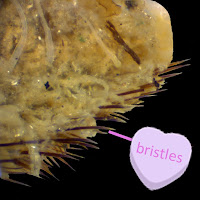
  1. Tough, hollow bristles made of chitin that stick out of its parapodia, or feet.
In the Shimmering Sea Mouse, Aphrodita aculeata (which does not occur in Puget Sound, but, rather, in the Atlantic), these bristles are bright iridescent colors, which may be a defense mechanism to scare away potential predators.

A close-up view of Sea Mouse bristles.
Close-up of bristles around the
bottom of Aphrodita negligens
A. aculeata’s amazing bristles may have other uses too – for humans! Researchers in Norway have found that the properties which give the worms’ hairs their iridescence also lend themselves very well to nanotechnology – the science of studying and controlling very small things, like atoms. The Sea Mouse’s bristles can be used as tiny wires (called nanowires) to conduct charged ions, making them potentially useful for building miniature electronic devices such as in-vitro health sensors and computer processors. Talk about a mighty mouse!

By: Dany Burgess & Angela Eagleston, Environmental Assessment Program


Critter of the Month

Our benthic taxonomists, Dany and Angela, are scientists who identify and count the benthic (sediment-dwelling) organisms in our samples as part of our Marine Sediment Monitoring Program. We are tracking the numbers and types of species we see in order to understand the health of Puget Sound and to detect any changes over time.

Dany and Angela share their discoveries by bringing us a Benthic Critter of the Month. These posts will give you a peek into the life of Puget Sound’s least-known inhabitants. We’ll share details on identification, habitat, life history, and the role each critter plays in the sediment community. Can't get enough benthos? See photos from our Eyes Under Puget Sound collection on Flickr.

Thursday, January 18, 2018

Eyes Under Puget Sound: Critter of the Month - The Peanut Worms

The juvenile peanut worm with its introvert retracted has a peanut shape.
A peanut-shaped juvenile
Golfingia sp. with introvert 
retracted.
Sometimes you feel like a nut, sometimes you don’t! We hope you’re hungry, because we are just nuts about this month’s group of critters – the Peanut Worms.

Unsolved mysteries

These animals are commonly called “peanut worms” because some have the general shape of peanuts (although we think cashew worms would be more fitting). They actually aren’t considered worms at all, at least not like the marine segmented worms (polychaetes) in the phylum Annelida.

Kingdom Animalia, Phylum SpiunculaPeanut Worms belong to the phylum Sipuncula (sy-PUN-kyoo-lah), meaning "little tube or siphon.” Recent genetic work, however, suggests that they might actually belong within, or closely related to, annelids. Like many taxonomic mysteries, this one remains to be solved!

Trunk and the retractable introvert, the worm's two main sections. Body language

Peanut Worms have simple bodies with few outside characteristics, so identifying them requires dissection under a microscope. Their unsegmented bodies consist of 2 parts: a leathery, bulbous trunk and a long, narrow portion called an introvert that has tentacles (and sometimes hooks) at the tip.
Microsopic dissection shows intestines and muscles in the body.
A dissected Thysanocardia nigra
specimen with internal structures
exposed

The Peanut Worms are also pretty simple inside their bodies too, with no circulatory or respiratory systems: Fluid in the body cavity, or coelom, takes care of these important functions. The rest of the coelom is taken up by a coiled intestinal tract, and some long muscles that extend and retract the introvert. We count these muscles to help determine the species.

Peanut worms found in a shell are about three times as long as the diameter of a penny placed there for size reference.
Phascolosoma agassizii (A-
gassiz's Peanut Worm) in an
abalone shell off California.
Photo courtesy of  Dave
Cowles, wallawalla.edu.

A good nut is hard to find

Sipunculans are exclusively marine, with most species living in shallow water (we have collected them from depths ranging from 2-270 meters). Our Puget Sound species grow to be just a few centimeters long, but some species can reach half a meter in length. Now that’s one big peanut!

Although over 300 species have been described worldwide, the diversity of this group has been poorly studied, so there could potentially be more out there just waiting to be discovered. Before you decide to go out sipunculan-hunting, be warned: their drab colors blend in with their surroundings, and most of them live in burrows or tubes made by other organisms, so they can be hard to spot.

Working for peanuts

Close microscopic view of the tentacales at the tip of a Peanut Worm introvert.
Tentacles at the tip of the introvert of Thysanocardia nigra,
the Smooth Brown Peanut Worm.
Some species of sipunculans turn their noses up at pre-made burrows and prefer to build their own by boring into hard substrate (although scientists aren’t sure how they accomplish this with their soft squishy bodies). We might say this makes these sipunculans boring brown blobs (see what we did there?!), but they are actually very important to the ecosystems they inhabit. All this boring and burrow-making helps to break down rocks and reefs into rubble which is used as a habitat by other organisms.

Sipunculans also play a crucial role in marine food webs. Some species use their tentacles for filter feeding, some ingest sediment and prey collected with their tentacles, and some species use their introvert hooks to scrape organisms off rocks. However, most are deposit feeders, eating detritus (particles of organic matter from decomposing plants and animals) and passing those nutrients back up the food chain as they are eaten by predators.

Tough nut to crack

Speaking of predators, there are plenty of fish out there that might like to eat a nice juicy peanut-shaped critter! Fishermen have been known to use sipunculan worms as bait, though mostly the larger sand-dwelling species. Sipunculans don’t have a lot of defensive strategies to protect themselves from a fish attack, but they can retract their introvert when disturbed. This is when they most resemble peanut shells, and how they look when we first see them in the grab samples on the boat.

A bowl of sea worm jelly. Photo courtesy of Frank Kasell,
www.chinesestreetfood.com.
Peanut butter jelly time

Although sipunculans probably don’t taste anything like peanuts, there are parts of the world where they are considered a delicacy. In the Philippines, sipunculans are cooked with vinegar and spices, and in the town of Xiamen in the Fujian province of China, peanut worms are harvested on beaches and made into a street food called “sea worm jelly.”

Sea worm jelly is prepared by boiling the sipunculans, which releases a gelatin-like goo into the water. The whole concoction is then poured into molds and allowed to set. Apparently the jelly doesn’t have much flavor besides the soy sauce, oils, and spices added to it – but we’re happy to remain blissfully ignorant on that point!

By: Dany Burgess & Angela Eagleston, Environmental Assessment Program


Critter of the Month

Our benthic taxonomists, Dany and Angela, are scientists who identify and count the benthic (sediment-dwelling) organisms in our samples as part of our Marine Sediment Monitoring Program. We are tracking the numbers and types of species we see in order to understand the health of Puget Sound and to detect any changes over time.

Dany and Angela share their discoveries by bringing us a Benthic Critter of the Month. These posts give you a peek into the life of Puget Sound’s least-known inhabitants. We share details on identification, habitat, life history, and the role each critter plays in the sediment community. Can't get enough benthos? See photos from our Eyes Under Puget Sound collection on Flickr.

Friday, July 14, 2017

Eyes Under Puget Sound: Critter of the Month – The Ice Cream Cone Worms

I scream, you scream, 
we all scream for ice cream!  
(Don't worry, worm shown above is not
actual size; ice cream cone 
worms
are only about an inch long!)
Summer is here, and what better way to beat the heat than to cool off with a nice refreshing frozen treat? We think this month’s group of critters, the Ice Cream Cone Worms, are some of the coolest creatures around…although maybe not quite so delicious as the real thing!

Ice ice baby

Ice cream cone worms (belonging to the family Pectinariidae) are easily recognized by their distinct
cone-shaped tubes that can be up to 5 cm (2 inches) long. Here in Puget Sound we find two species of these ice cold beauties - Pectinaria californiensis and Pectinaria granulata.

Although both of these species are widespread throughout the Sound in depths up to 230 meters, Hood Canal is where we encounter them in the highest abundances - we can sometimes get over 30 of these critters in a single benthic sample!

Lashing out

Another distinct feature that sets pectinariids apart is a pair of glistening “eyelashes” protruding from the tops of their cones. These spiky eyelashes are actually hardened hairs, called paleae.


The paleae may look pretty and delicate, but they serve a practical purpose – to help the worm burrow head-first into the sediment.

Everybody poops


A Pectinaria granulata specimen, removed from its tube
 to reveal its translucent body with visible sediment inside.
Ice cream cone worms spend most of their time face-down in the mud, with the pointy ends of their tubes turned upright sticking out just above the sediment’s surface. This allows them to use their tentacles (located near the paleae) to search around in the mud for large particles of sediment to ingest.

This strategy of picky eating is called selective deposit feeding. Anything the critter can digest that attaches to the particles gets absorbed by the worm’s gut.

The sediment grains they can't digest basically go in one end and out the other. The passed material is called pseudofeces - meaning “false poop”. It can take up to six hours to make its way through the worm’s body and out the open end of the cone. If you were to observe a living ice cream cone worm without its cone, you would be able to see this whole process through its translucent body wall.

Go your cone way

If you’re looking for ice cream cone worms, chances are you can find them in areas with a higher sand content (versus rock or fine clay). This makes sense when you think about how they build their cones.

Pectinariids construct their cones by reaching out with their tentacles to collect sand grains, shell pieces, or other small particles. These grains are tightly placed together in layers, giving the cone a smooth but speckled appearance, almost like a colorful stained glass window or a tile mosaic. The cone protects the critter, housing the animal’s soft, fleshy body in a speckled coat of armor.

A worm’s place is in the cone


A comparison of the tubes of P. granulata and P. californiensis shows the 
difference in preferred grain size between the two species.
Some pectinariids prefer large grains over small grains for tube-building, which makes it easy to tell those species apart if the cone is still intact. This is quite convenient for us taxonomists!

For example, P. californiensis chooses fine sediment granules for its straight, delicate tube, while P. granulata prefers coarser sediment for its robust, slightly curved tube. If the worm doesn’t have an intact cone, it can still be identified by the color and shape of its paleae – P. californiensis has copper-colored paleae with fine tips, and P. granulata’s are golden-colored, with blunt tips.


P. granulata (left) has blunt-tipped, golden paleae while P. californiensis (right) has fine-tipped, copper-colored paleae.

 By: Dany Burgess & Angela Eagleston, Environmental Assessment Program

Critter of the Month

Our benthic taxonomists, Dany and Angela, are scientists who identify and count the benthic (sediment-dwelling) organisms in our samples as part of our Marine Sediment Monitoring Program. We are tracking the numbers and types of species we see in order to understand the health of Puget Sound and to detect any changes over time.

Dany and Angela share their discoveries by bringing us a benthic Critter of the Month. These posts will give you a peek into the life of Puget Sound’s least-known inhabitants. We’ll share details on identification, habitat, life history, and the role each critter plays in the sediment community.

Can't get enough benthos? See photos from our Eyes Under Puget Sound collection on Flickr.