Showing posts with label ecology for educators. Show all posts

Friday, September 8, 2017

Eyes Over Puget Sound: Sunny, warm and colorful

Late summer brings warm air temperatures, abundant sunshine and drier conditions throughout Puget Sound. Stream flows in the region’s northern rivers are lower than our rivers in south Puget Sound.

Click here to see this month's report


Yet, the combination of abundant spring rain and weak upwelling from the Pacific Ocean means Puget Sound waters are still fresher than at any time in the past 17 years.

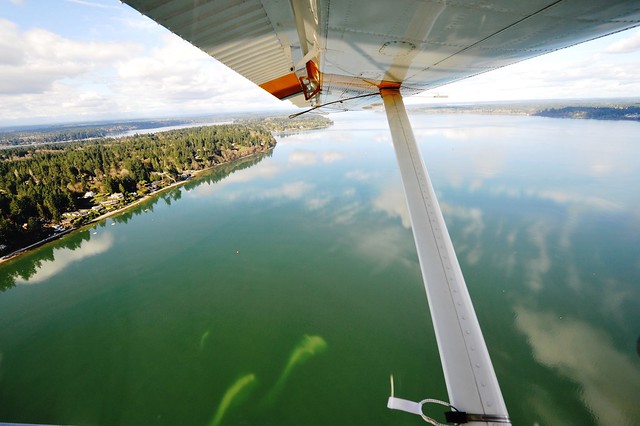
While the abundance of jellyfish is lower this year, our warm water temperatures, especially in central Puget Sound, are accompanied by large rafts of drifting macroalgae. What else did we see on our Eyes Over Puget Sound overflight? Diverse blooms in colors of green, orange and red-brown in many our inlets.

We are also checking to see how if our benthic invertebrate community is changing. We are monitoring and measuring samples of these critters that live in the sediments of Puget Sound at our long-term monitoring stations. We’re gathering information so we have baselines to see if any long-term change is occurring among this sensitive part of the Puget Sound ecosystem.

This year, we’re getting great hands-on assistance from our Washington Conservation Corps intern, Nicole Marks. To see more about the project, check out the great poster Nicole has created.

Friday, June 9, 2017

Eyes Over Puget Sound: River flows above normal

Cooler and wetter conditions earlier this year have set the stage for a favorable supply of freshwater. River flows are all above normal due to warm May temperatures melting our abundant snow pack. These conditions are creating significantly fresher conditions in Puget Sound surface waters. 

Click here to see this month's report.


Algae blooms are limited but there are some yellow-green blooms growing in bays near the Kitsap Peninsula and in the Puyallup, Skagit and Stillaguamish river estuaries. Red algae blooms are present in the rivers feeding into Willapa Bay. Also see what is “blooming” in the sediments of Puget Sound.

What's Eyes Over Puget Sound?

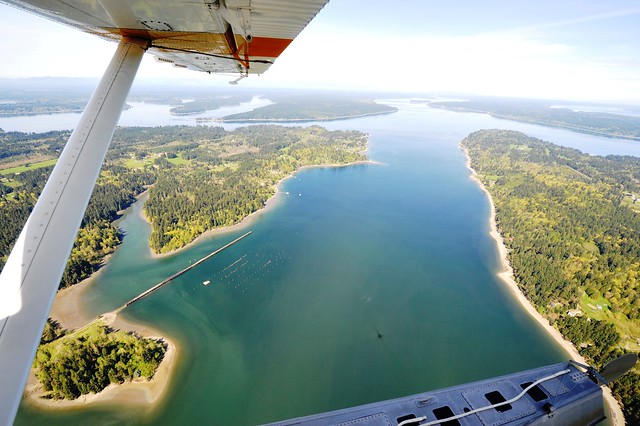
Eyes Over Puget Sound combines high-resolution photo observations with satellite images, ferry data from travel between Seattle and Victoria BC, and measurements from our moored instruments. We use a seaplane to travel between our monitoring stations because they are so far apart. Once a month, we take photos of Puget Sound water conditions and turn those out, along with data from our stations, in the monthly Eyes Over Puget Sound report.

Wednesday, January 18, 2017

Eyes Over Puget Sound: A look at 2016 in photos

After two years of very warm air and record-high water temperatures, Puget Sound is close to normal. Between the Blob warming our waters in 2015 and the past year of El Niño, we're still a bit warmer than usual, but we're in better shape than we've seen in some time.


Learn about how the global climate affects water quality, see the impacts warmer waters had on the Sound and compare photos from flights throughout 2016 in this year-end summary.

Nov. 2016 - Squaxin Passage
Feb. 2016 - Willipa Bay


We had some major rains this year! They sent mud and runoff into our rivers, downstream and out into the Sound. 2016 began and ended with sediment dynamically painting our waters.

Sept. 2016 - Liberty Bay


The very low summer river flows we experienced last year reflected climate predictions for the northwest. Our rivers are like a cold faucet: turned up high, their flow keeps waters cool, moving and full of oxygen. With the river taps turned way down, marine waters don't get mixed as much which causes warmer temperatures and higher salinities. As a result, we saw abundant jellyfish, floating macro-algae and Noctiluca blooms.

Sept. 2016 - Budd Inlet
Aug. 2016 - Eld Inlet


Surprisingly, only south Puget Sound developed very low summer oxygen levels in 2016. By fall, La Niña came with a punch! This brought more rain and cool air temperatures. But the question remains: will this be an unusual La Niña?

July 2016 - Edmonds Underwater Park

What's Eyes Over Puget Sound?


Eyes Over Puget Sound combines high-resolution photo observations with data from our monthly monitoring stations, from our regional partners and from instruments we have on ferries. We use a seaplane to travel between many of our monitoring stations because they are so far apart.

Once a month, we take photos of Puget Sound water conditions and turn those out, along with data from our stations, in the monthly Eyes Over Puget Sound report.

Tuesday, December 6, 2016

Eyes Over Puget Sound: La Niña is here!

With La Niña present we are seeing wetter and warmer conditions. Heavy rains in October swelled Puget Sound rivers and streams to above normal levels. As a result, water temperatures, salinities and oxygen in Puget Sound are returning to normal.

EOPS report cover and text for Nov. 22, 2016 report
Click here to read the November report.


While surface water in Puget Sound has cooled, it is still warmer than in the Straits.

I can see clearly now

We continue to see large groups of jellyfish in finger Inlets of South Sound and slowly fading red-brown blooms in Eld and Budd Inlets. A lot of suspended sediment was observed east of Steamboat Island and south of Squaxin Island. Otherwise, we have clear water.

What is Eyes Over Puget Sound?

Eyes Over Puget Sound combines high-resolution photo observations with data from our monthly monitoring stations, from our regional partners and from instruments we have on ferries. We use a seaplane to travel between many of our monitoring stations because they are so far apart.

Once a month, we take photos of Puget Sound water conditions and turn those out, along with data from our stations, in the monthly Eyes Over Puget Sound report.

Tuesday, July 5, 2016

Eyes Over Puget Sound: Diving into warmer waters

Summer is officially here, and it is bringing record-breaking Puget Sound water temperatures along for the ride. What could this mean for you? First, join us for the BEACH program kick-off in the June Eyes Over Puget Sound report.

Click to view the June report here


Is my beach safe for swimming?

Each year between Memorial Day and Labor Day, the Washington State BEACH Program monitors saltwater beaches to make sure conditions are safe for swimming and other recreational activities.

Media joined the monitoring teams last month for a kick-off to find out more about the condition of our favorite beaches and how to help keep them healthy.

Follow us on Facebook and Twitter for beach water quality updates, or visit our BEACH Program website for more information on beaches near you.

Visibility conditions for divers

Our monitoring team brings you a new feature: water visibility at different locations around Puget Sound. If you’re thinking of grabbing your scuba gear this weekend, take a look at our map to find out where underwater visibility is highest or lowest.

Visibility might be lower than in previous months. This new section will eventually deliver present conditions. We’d love to hear your feedback on it!

What does recent rain mean for water quality in Puget Sound?

Fortunately, rivers are now flowing at higher levels compared to last year’s drought. Still, we are missing a lot of the snow to support summer flows.

Visit our Flickr album for more photos from this month's Eyes Over Puget Sound report.

Despite recent rainfall the Fraser River has not been flowing nearly as high as last year, a year of drought. Why does this matter? The Fraser River, the longest river within British Columbia, is also the largest freshwater source for the Salish Sea.

Low flow in Fraser River means the water isn’t circulating as much as the Salish Sea does in normal years. Stagnant, or motionless, water means warm temperatures will continue, pollution will increase, and jellyfish could continue to appear in large numbers.

What about the jellies?

During sea plane flights over Puget Sound, we also observed many “smacks,” or groups of jellyfish. You can see high numbers of them in Eld and Totten Inlets in the South Sound region.

Phytoplankton blooms and large mats of floating organic material also showed up east of Bainbridge Island and Port Madison, as well as Quartermaster Harbor near Vashon Island.

Ew…what’s that smell?

Plug your nose before meeting our latest Critter of the Month! The Pacific Stinkworm, Travisia pupa, smells like rotting garlic when disturbed. 

Though not as easy on the eyes as last month’s critter, Travisia pupa plays an important role on the muddy ocean bottom. The Pacific Stinkworm, also known as the Pupa Utility Worm, helps aerate material on the ocean floor by burrowing and turning over sediment as it feeds. Visit our Critter of the Month blog series for more.

What's Eyes Over Puget Sound?

Eyes Over Puget Sound combines high-resolution photo observations with satellite images, ferry data from travel between Seattle and Victoria BC, and measurements from our moored instruments. We use a seaplane to travel between our monitoring stations because they are so far apart. Once a month, we take photos of Puget Sound water conditions and turn those out, along with data from our stations, in the monthly Eyes Over Puget Sound report.

Monday, May 9, 2016

Is Puget Sound healthy? Join us May 10 to find out!

By: Jessie Payne, Environmental Assessment communications manager


A big question has been on everyone's mind lately: 

Is Puget Sound healthy? 

This may seem like a simple question, but talk to our scientists, and you'll hear that the answer can be quite complicated. The answer depends on the situation and what aspect of health you're interested in. 

Today in Ecology's podcast, we sit down with our Scientific Environmental Modeling Engineer Mindy Roberts to discuss this question and learn about a talk she'll give tomorrow evening in Tacoma for the Pacific Science Center Science Café. 


Join Mindy at the Science Café event

Describing the health of Puget Sound is as complicated as describing your own personal health. At the Science Cafe, Mindy will dive into some of the latest water quality findings and discuss ways that everyone can help improve the health of Puget Sound.

Join Mindy in Tacoma to learn about some of the latest science we have on Puget Sound. Bring friends who want to understand the different ways we measure its health.

What?
Pacific Science Center
Tacoma Science Café
“Is Puget Sound Healthy?”
When?
Tuesday, May 10 at 6:30 p.m.
Where?
The Swiss Restaurant & Pub
1904 Jefferson Avenue, Tacoma

Science Cafés are open to all ages. No science background is required, and no question is too basic. Learn more about the Pacific Science Center Science Café event.

Puget Sound science at Ecology

Scientists at Ecology collect, research, and provide credible data to guide our agency's environmental choices for Washington. They work to help us track our environmental health, and to ensure the actions we've taken are working. Learn about our Puget Sound science.

Friday, May 6, 2016

Eyes Over Puget Sound: How's the water? And what's under it??

Click to view the May report here


Our marine monitoring team goes out several times a month to check the pulse of Puget Sound and Washington's coastal bays. Once a month, we bring you Eyes over Puget Sound. Because of their work, it's common for them to get the question:

How's the water quality in Puget Sound?

This seems like a simple question, but it can mean many different things. When you wonder about water quality in Puget Sound, what are you really interested in? Is it safe to go swimming? How will El Niño impact our water? Is it safe to harvest shellfish? Should I be worried about about pollution and toxins?

Visit the field impressions section of this month's Eyes Over Puget Sound report to learn answers to these questions and dive deeper into the discussion.

But really, how's the water?

May 2016 Eyes Over Puget Sound
Scroll through to see images from the flight, or
follow the link to Flickr to view the entire album.
Water temperatures are still higher than normal and groups of jellyfish are already going strong in southern inlets. Normally, we don't start seeing jellyfish "smacks," or schools of jellyfish, popping up around Puget Sound until later in the season. After last year's Year of the Jellyfish and observing populations holding steady throughout winter, we expect another summer full of jellies.

Our sunny and dry spring means air temperatures are higher than usual for this time of year. We're seeing these temps 7 °F warmer than typical in the mountains, which means the snowpack we built over the winter is quickly disappearing. Our rivers that are fed by snow-melt are running very high.

How does warm weather affect water quality in Puget Sound? 

Sunny weather means lots of growth! We observed a strong spring phytoplankton bloom extend across Puget Sound and through the Strait of Juan de Fuca. This high growth of plankton, algae and plant matter was evident across the Sound in large floating mats of organic debris.


Often, this material ends up on our beaches looking like strange waves of seaweed and muck. Sometimes, these mats of plants begin to decompose on beaches and cause a stinky mess.

What's underwater? A Sand Star!

This month, our Eyes Under Puget Sound taxonomists have featured a familiar creature for the Critter of the Month: The Sand Star. Did you know the Sand Star can move up to nine feet per minute?

Learn more in our field impressions section of the report. Read about marine sediment animals monthly by following our Critter of the Month blog series.

What's Eyes Over Puget Sound?

Eyes Over Puget Sound combines high-resolution photo observations with satellite images, ferry data from travel between Seattle and Victoria BC, and measurements from our moored instruments. We use a seaplane to travel between our monitoring stations because they are so far apart. Once a month, we take photos of Puget Sound water conditions and turn those out, along with data from our stations, in the monthly Eyes Over Puget Sound report.

Tuesday, April 12, 2016

Eyes Over Puget Sound: More snow means more flow!

April has kicked off with warm weather and sunshine! Plankton blooms are spreading across Puget Sound and we still see white snow up on the mountains.

Click to view this month's report

It's been snowing a lot in the mountains this winter. Our passes currently have 80-90% of the snow that's expected for this time of year, and some areas are closer to 100%.

This suggests that our summer freshwater flows into Puget Sound may be higher than last year, and much closer to normal. However, warm weather could cause an early thaw, leading to high river flows early in the summer that reduce to a mere trickle by mid-summer.

Only time will tell what the next couple months have in store for Puget Sound. We will be watching and keep you included in what we see.

The many colors of Puget Sound

As of April, the spring plankton bloom has extended across central and south Puget Sound. Our ferry data shows that chlorophyll has been increasing since March 25 and expanding across these stretches of the Sound. Many areas of Puget Sound are starting to darken to a reddish brown as they bloom with life.

April 2016 Eyes Over Puget Sound
Click through the arrows to scan photos from April's flight, or follow the link to Flickr to see them all.


Will jellies retake the stage?

Water temperatures are still warmer than usual, just as they were throughout last year. Do you remember what species flourished in the warm waters of 2015? The jellies! We saw numerous jellyfish patches in the inlets of southern Puget Sound and Sinclair Inlet, which is unusual this early in the year.

Our WCC Individual Placement intern Mattie Michalek
ready to collect water samples in the field.

More in this issue:
Seed Shrimp and oxygen

Check out a feature from our Eyes Under Puget Sound team: the Seed Shrimp! These tiny burrowing ostracods are about the size of a sesame seed and they're April's Critter of the Month.

Also in this issue, our Washington Conservation Corps (WCC) Intern Mattie explains how we take the samples we collect in Puget Sound to the lab to analyze oxygen in seawater.


What's Eyes Over Puget Sound?

Eyes Over Puget Sound combines high-resolution photo observations with satellite images, ferry data from travel between Seattle and Victoria BC, and measurements from our moored instruments. We use a seaplane to travel between our monitoring stations because they are so far apart. Once a month, we take photos of Puget Sound water conditions and turn those out, along with data from our stations, in the monthly Eyes Over Puget Sound report.

Monday, March 28, 2016

Eyes Over Puget Sound: Below cool surfaces, temps still run high

Every month since fall 2014, our data shows that water temperatures in Puget Sound have been running high. This month, as record rains have filled the Sound with cool freshwater from our rivers, our surface waters appear normal again. Look deeper, however, and we find this cool surface water is covering those same warm temps we've been seeing for over a year. We found that water temps remain especially high in Hood Canal.

View this month's report

What do warm waters mean for Puget Sound?

Puget Sound is running hot. The Blob that made national headlines last summer continues to lurk deep in the Pacific Ocean and remnants are still being felt here. Puget Sound is a small player in our global climate, but we are feeling the impacts.

We caught a nice view of downtown Seattle on this clear blue day.
Last year, we saw warm water temperatures that fostered algae blooms, disease and stressful conditions for cold-loving species like salmon.

We also observed these conditions boosting less desirable species that do not support fish, like jellyfish and macro-algae. We're curious to see how this unusual pattern unfolds in the coming summer, and we'll keep you included in what we see.

High flows dilute salt concentrations

Another result of this warm, wet March is that salinity in Puget Sound is notably lower than usual for this time of year. Luckily, our marine wildlife are able to adjust to fluctuating levels of salt dissolved in the Sound. Some species will even move to a different depth to find salinity levels that are more comfortable for them.

The view from the air

We saw more patches of jellyfish hanging out in the inlets of Puget Sound on this flight. Brown-red phytoplankton blooms are going strong in Hood Canal and Henderson Inlet, and picking up in many other areas around the Sound.
March 2016 Eyes Over Puget Sound
Scroll through to see images from the flight, or follow the link to Flickr to view the entire album.
 
Many places showed long stretches of suspended sediments along the shoreline, which could be a sign of shore erosion.

Meet this Critter of the Month, the cactus worm, and many
others in our special Eyes Under Puget Sound feature.

Feature: Critter of the Month

Our benthic taxonomists have been sharing their discoveries from the bottom of Puget Sound by bringing us Benthic Critter of the Month blogs. These posts are part of Eyes Under Puget Sound for our Marine Sediment Monitoring Program.

These fun species profiles will give you a peek into the life of Puget Sound’s least-known inhabitants. See the feature in this month's Eyes Over Puget Sound report and read the blogs to learn more.


What's Eyes Over Puget Sound?

Eyes Over Puget Sound combines high-resolution photo observations with satellite images, ferry data from travel between Seattle and Victoria BC, and measurements from our moored instruments. We use a seaplane to travel between our monitoring stations because they are so far apart. Once a month, we take photos of Puget Sound water conditions and turn those out, along with data from our stations, in the monthly Eyes Over Puget Sound report.

Thursday, December 24, 2015

A foot of water can make or break a King Tide

By Hugh Shipman, Puget Sound coastal geologist, Shorelands program


King Tides are overtaking a shoreline near you

Help scientists track and document King Tides this year! The King Tides Photo Initiative, which is going on now, is aimed at getting people to take photographs during unusually high tides and share them.

Tracking King Tides shows us how future sea level, which is expected to rise significantly during the coming decades, will impact our coastal communities. The projected sea level rise, caused by climate change, will make the extreme high tides we’re chasing now become increasingly common.


“King Tides” are defined as the highest tides of the year. In Washington, these phenomenal tides usually occur in December and January. While we work hard to predict the true King Tides; sometimes those on the schedule turn out not to be the highest tides of the winter, even if they are very high tides. Let’s find out why…


Many things make King Tides hard to catch 

Some of you may have tried to help us document King Tides this year and had the experience of being a bit underwhelmed by the high tide you observed. It can be disappointing to go out at the crack of dawn on a day with a projected King Tide, only to see the same ol’ high tide you’re used to seeing. Then, it can be extra upsetting to see news of a truly spectacular high tide a week later when you weren’t expecting one at all.

What’s going on? King Tides can be tricky to predict and catch. The highest tides of the year may not necessarily occur when we expect them. This is particularly true this winter as the strong El Niño is raising water levels, and making King Tides difficult to pinpoint.

Although we have long been able to make very precise predictions of future tides, these are based on the position of the earth relative to the sun and moon, and do not reflect contributions from the ocean or weather. Factors such as wind storms, atmospheric pressure and ocean conditions are very difficult to predict far in advance, and can significantly influence water levels. Who in Washington hasn’t experienced our weather forecast changing drastically from day to day—or even minute to minute?! These same factors can throw a wrench into King Tide predictions by producing water levels that are a foot lower or higher than expected.


Thursday, June 18, 2015

Eyes Over Puget Sound: More squishies, less crunchies

View this month's issue of Eyes Over Puget Sound
In this month's edition of Eyes Over Puget Sound we continue to see record warm water temperatures and low oxygen readings in our marine monitoring stations all across the Sound. These continue to be the warmest temperatures on record since 1989! On top of that, we're reading record low stream flows. This means harsh conditions for marine life.

Warm water + warm air + low rivers = harsh conditions for Puget Sound

More squishies, less crunchies

A large increase in jellyfish were seen
in the finger inlets of Budd and Eld inlet.
We saw a lot of jellyfish during this flight over Puget Sound. What does that mean? Although they're fascinating to look at, jellyfish can indicate changes in the lower food web. Many people consider them a dead end to the food chain because they aren't eaten by many other species.

When it comes to zooplankton, we've got two ends of the spectrum. The "crunchies," like small fish and shrimp, that are high in fatty acids and oils. Then, we've got the "squishies," like jellyfish, that are gelatinous and not nearly as nutritious for important species such as salmon.

It's as if Puget Sound critters have been put on a diet when they're experiencing warm water and low dissolved oxygen. For us to see a boom in jellyfish populations, we suspect there is less nutritious food for the rest of the animals in the food web.

Meet some intertidal filter feeders

Continue to learn about the creatures that live in the rocky intertidal part of Puget Sound.

From butter clams to moon snails to sunflower stars, this place where the waters meet the land is full of strange and wonderful life. Our WCC AmeriCorps intern Brook introduces you to these animals in this month's Personal Field Impressions section.

Blooms paint the waters gold

Abundant sun and unusually warm water temperatures are fueling phytoplankton and zooplankton blooms in many areas. We saw bright orange Noctiluca blooms surfacing in Commencement Bay and around Port Madison and many other parts of Puget Sound.

Our team saw this large Noctiluca bloom in Commencement Bay as they flew across Puget Sound.

What's Eyes Over Puget Sound?

Eyes Over Puget Sound combines high-resolution photo observations with satellite images, ferry data from travel between Seattle and Victoria BC, and measurements from our moored instruments. We use a seaplane to travel between our monitoring stations because they are so far apart.

Once a month, we take photos of Puget Sound water conditions and turn those out, along with data from our stations, in the monthly Eyes Over Puget Sound report.

Learn more and see other issues on our website.

Friday, May 29, 2015

Eyes Under Puget Sound: Our taxonomists “Name that species”!

By Maggie Dutch, Senior Benthic Ecologist, Environmental Assessment Program


World-renowned ecologist, E.O. Wilson, told us “If a biologist does not have the name of the species, he is lost” in his autobiography Naturalist.

The scientists who work with our Marine Sediment Monitoring Team share Dr. Wilson’s conviction, especially with regard to the over 1,200 species of tiny invertebrates they study. These little critters are known as “benthos”, and they’re the animals that live in the sediments at the bottom of Puget Sound.

Our scientists have been tracking benthos as part of their 26 years of sediment quality studies for the Puget Sound Ecosystem Monitoring Program. These creatures help us determine the condition of sediments throughout Puget Sound. They play an important role in the Puget Sound food chain, and with over 1,200 species, there is a lot to keep track of!

Taxonomists are scientists who deal with the description, identification, naming, and classification of organisms. We would like you to meet our two new taxonomists that recently joined the monitoring team.

"I love being behind a microscope,
where you can see all the tiny details
that are missed in everyday observation."
 - Ecology taxonomist Dany Burgess

Meet taxonomist Dany Burgess

I grew up in Concord, North Carolina, where I developed an early fascination with the ocean despite only seeing it once a year during family trips to the beach.

After receiving my B.S. in Marine Biology, I went on to conduct graduate research focused on the ecology of invertebrate communities on artificial and natural reefs off the coast of South Carolina. This involved many hours of identifying benthic organisms.

I received my masters in Environmental Studies in 2008, spent the next six years working as a biologist at the South Carolina Department of Natural Resources Marine Resources Research Institute, and eventually found my way back to work as a taxonomist and manager at the Southeastern Regional Taxonomic Center.

My daily activities at the Institute ranged from trawling for sea turtles to wading through waist-deep mud in tidal creeks, but my specialties and interests have always been marine invertebrate taxonomy and ecology. I love being behind a microscope, where you can see all the tiny details that are missed in everyday observation. As a recent transplant to the Pacific Northwest, I am very excited for the opportunity to join the Marine Sediment Monitoring Team and to learn about the amazing creatures that live in the sediments of Puget Sound!


Meet taxonomist Angela Eagleston

"I have always had a deep passion for the ocean environment
and all creatures that live in it, no matter how big, small
or weird looking!" - Ecology taxonomist Angela Eagleston
For as long as I can remember, I have always had a deep passion for the ocean environment and all creatures that live in it, no matter how big, small or weird looking! I am extremely grateful and excited to be a part of the Marine Sediment Monitoring Team so that I can continue to explore and learn about the invertebrates in Puget Sound’s benthic communities.

Originally from Austin, Texas, I graduated from the University of Texas with my B.S. in Marine and Freshwater Science. During my research-driven academic career, I spent much of my schooling at the Marine Science Institute in Port Aransas on the Gulf of Mexico conducting experiments and serving as a research assistant on various projects. I also worked abroad on Mexico’s Yucatán Peninsula where I was involved with tracking coral reef degradation and invertebrate diversity to assess the health of coral reef ecosystems in an area impacted by heavy tourism.

Upon completing my degree, I moved to the Pacific Northwest to work at an environmental consulting and taxonomic production laboratory where I specialized in the identification of marine mollusks (snails and clams) and echinoderms (sea stars, sea cucumbers, etc.) from all around the world.

New adventures in taxonomy

Angela is currently focusing on the identification of Washington’s mollusks such as snails and clams, and echinoderms such as sea stars, sea cucumbers, sea urchins and sand dollars. Dany is focusing on identification of the “polychaetes” or marine worms, arthropods such as crabs and shrimp, and other creatures that are collected for the Puget Sound Ecosystem Monitoring Program.

They are both tackling their new jobs with zeal and enthusiasm, and are quickly getting to know the myriad of species that inhabit the Puget Sound.


E.O. Wilson also writes… “Most children have a bug period. I never outgrew mine.” We believe that the same holds true for Dany and Angela…and we are glad they didn’t!

You can track their work by following our Eyes Under Puget Sound blogs and seeing up close microscope photos of the animals they’re identifying on our Eyes Under Puget Sound Flickr collection.

Critter of the Month

Meet Sternaspis affinis Stimpson, 1864, better known as
the Dumbbell worm, next Friday on our blog!
Dany and Angela are going to be sharing their discoveries by bringing us a Benthic Critter of the Month. These posts will give you a peek into the life of Puget Sound’s least known inhabitants.

In each issue we will highlight one of the Sound’s many fascinating invertebrates. We’ll share details on identification, habitat, life history and the role this critter plays in their sediment community!

Look for May’s critter, the Dumbbell worm, next Friday on our blog.

Friday, March 20, 2015

Let’s Talk Science! Bugs and baby fish help scientists pinpoint stream pollution

By Jessica Payne, Environmental Assessment Program communications manager


Ecology scientists place trout eggs in Indian Creek
to test stream health. Photo by: Ecology
Here at Ecology, our scientists study the environment in a number of ways. Sometimes we're looking large scale and trying to investigate the big issues that might harm humans, animals or the environment. Other times, we're knee-deep in your own backyard stream trying to track down sources of pollution.

Scientists from our Environmental Assessment Program recently worked on a project just like that. They wanted to find out where pollution might be entering Indian Creek in Olympia. To answer this question, they focused on the stream's ability to support baby fish and the food they need to survive and grow. They tested for toxins in the stream water with baby trout.

For the study, they placed trout eggs into the creek at different test sites and waited to see how they did in the water. If the water is healthy, the fish should thrive. If it’s polluted with toxins, the fish will be affected.

Bugs and baby fish

A standard way of testing water quality is by running a chemical analysis through an instrument at a laboratory. However, many toxins can’t be detected by chemical analysis. We don’t have the ability
to test for everything that’s out there, and even for those that we can, there’s limited information available to tell us how those chemicals will affect aquatic life. What’s more, chemicals can have a very different effect on wildlife when they’re combined than when they stand alone.

“Sometimes, biology is the best way to test the waters.” said Brandee Era-Miller, our scientist running samples on the creek. “Why? Animals will respond to any toxin or combination of toxins. We don’t always have to know what’s in the water to see that it’s not good for fish.”

Aside from fish, our scientists also tested soils, aquatic stream bugs, periphyton (the green slime on rocks), and groundwater that was entering the stream.

Where, what and how did we test?

We first monitored the stream in 2010. From that study, we knew there was a stormwater pipe carrying runoff from nearby parking lots that may be adding pollutants to the stream. We tested both upstream and downstream from that suspected source to verify if it was indeed a source of toxins.

We looked to see if the fish could thrive in the stream. This means more than just surviving; we also checked to see if they failed to hatch from their eggs, if they had birth defects or stunted growth.
Fish are sensitive to different pollutants in each early stage of their life.

Those life stages include:

  • Eggs
  • Alevin stage - when they look like a fish but the egg is still attached
  • Fry - fully formed, but tiny, baby fish

Our results

What did we find out from this research? Two main things. First, we learned that the test itself was successful; that trout early lifestage testing can be done in streams to directly assess environmental conditions.

Second, results from the tests showed that the creek was a healthy habitat for fish at the upper site, but impaired at the lower one. What does this mean? Baby fish were more likely to survive and grow into healthy fry at the site upstream from the stormwater pipe than the one downstream.

Why this research matters

Not only did we use this method of research to identify sources of pollution for Indian Creek, we also tested a system that is accessible and affordable for all communities. This biological test is an easy and fairly affordable method that local cities, counties and even volunteers could use to test the health of their streams.

Running chemical analysis for every known toxicant in the stream is very expensive; this gives communities a way to find out how healthy their streams are without that cost.

Want read details of the study? 
You can find them on our Environmental Assessment Program report summary webpage.
You can also read a detailed review in the city of Olympia’s STREAM TEAM spring newsletter.

How you can protect your streams

It’s important for people to know the health of the streams in their neighborhood. It’s even more important for them to know how to protect those streams from toxic chemicals and contaminated stormwater runoff.

You can start by learning what stormwater is online and taking our stormwater quiz.

Every small action makes a difference. Learn what you can do to protect your water on our Washington Waters webpages and at Puget Sound Starts Here.


More about the Environmental Assessment Program

Ecology houses a department of scientists that work to measure and assess environmental conditions in Washington. We work hard to understand the state's land, air and water to keep everyone healthier. To learn more about us and the type of research we do, please visit the Environmental Assessment Program webpage.

Monday, February 10, 2014

Let’s Talk Science: A pH Solution

By Brook Beeler, Communication Manager, Eastern Region

We are all familiar with the term acid and we often hear about the pH scale, but what does it really mean? What is the pH scale really all about?

It is a delicate dance at the molecular level. Let’s break it down.

The foundational parts

Water molecule
Water molecules are made up of
one oxygen atom and two hydrogens.
Distilled water has a neutral pH of 7.


Molecules are made of atoms and are generally considered neutral, meaning they do not have a positive or negative electrical charge. Water is an example of a neutral molecule made of one oxygen and two hydrogen atoms. A neutral molecule is considered stable and happy.

In the molecular world, though, being happy isn’t always good enough. Molecules are often in a state of flux. The atoms that make up molecules tend to move around a lot. Molecules may break apart to form ions, which do have a positive or negative electrical charge. Ions can be an atom or multiple atoms combined. If our water molecule breaks apart, the likely combinations of ions would be positively charged hydrogen and oxygen bonded to hydrogen or hydroxide, resulting in a negative charge.

Acid and base

The pH scale helps scientists measure whether or not a solution is acidic or basic. In chemistry, a solution is defined by one substance being dissolved in another. Solutions are easiest to understand as a liquid, but it is important to note that they also exist in gas and solid forms.

An acid is a solution that has a higher concentration of positively charged hydrogen ions (H) than negatively charged hydroxide ions (OH). Common examples of acids are lemon juice and vinegar. A base has a higher concentration of OH ions. Common examples are baking soda and household ammonia.
The scale ranges from 0 to 14. Smack dab in the middle (7) is considered neutral, which is neither acidic nor basic. And what substance do you suppose comes in at that number? Our happy water molecule. When water is in a pure or distilled state, it measures a pH of 7. The lower the number (0-7), the more acidic it’s considered. And the higher the number (7 to 14), the more basic it is.

The pH scale may seem small, but each whole number represents a ten-fold leap in concentration of either H ions or OH ions. For example, rain is slightly acidic with a pH that measures about six. A grapefruit is approximately three on the pH scale. That means that a grapefruit is 1,000 times more acidic than rain.

Both acids and bases play important roles. They help us clean and, in some cases, make delicious salad dressings. However, an overabundance of solutions that are too high or too low on the pH scale can cause problems with our health and the environment.

Our work related to pH

pH affects people and the environment and can be toxic. At very high or very low pH levels, those charged ions dancing around in solutions want to find a mate of the opposite charge. They woo neutral molecules, attracting them away from stability. For example, metals like aluminum become soluble at a low pH. This means it is more likely to dissolve and move through a solution and make its way into drinking water or the food chain. That’s no good.

In bodies of water, pH is generally very stable and the value doesn’t change much. However, if we notice that pH values change, it’s likely an indication that some sort of pollution is affecting the water.

So we pay attention to pH. We require wastewater discharges and air permits to address pH. It is a parameter often addressed in our water quality improvement plans. It can also indicate if a waste material is dangerous and has specific disposal requirements according to state laws.

Holcim Inc. Toxics Cleanup Site’s problem is with pH. Holcim owns property along the Spokane River in Spokane Valley where soil and groundwater is contaminated with cement kiln dust.

Holcim and its predecessor companies operated a cement manufacturing plant at the site until 1967. Cement kiln dust, a byproduct of cement manufacturing, was landfilled on the northern portion of the site before Washington state laws for dangerous waste prevented that practice.

Cement kiln dust has a high pH and is considered caustic. Because we pay attention to pH and the complex nature of groundwater, proximity to the river and location of drinking water wells, Ecology required the parties responsible to investigate the contamination and evaluate cleanup options.

This cleanup site is in early stages of the cleanup process. But Ecology is continuing to work with the property owner to give this site a clean bill of health. A cleanup option will be selected and implemented ensuring that there is a pH solution for the health of people and the environment.

For current information visit the Holcim Inc. cleanup site webpage.


Tuesday, May 28, 2013

Sharing the magic of green chemistry with high school teachers

By Saskia van Bergen, green chemistry scientist, Hazardous Waste Toxic Reduction Program

When I was a student in a lab, I knew very little of the chemical and safety hazards of the experiments we did. From my perspective, the materials magically appeared and disappeared. I didn’t know what went on behind the scenes. I thought very little about the health risks of chemicals we used. This continued into college where I majored in chemistry. Even though I took a class in environmental chemistry, it wasn’t until I worked on my senior thesis that I started learning more about the potential hazards of chemicals. Some toxic chemicals pose an immediate health threat. Others can gradually build up in the environment and in our bodies, causing harm to the environment and disease long after first use.

Benign by Design

One of the reasons I love my job here at Ecology is that we are helping to improve products and our quality of life by using the principles of Green Chemistry. These principles help Washington State businesses be more profitable and competitive while protecting human health and the environment. Green chemistry is the design of chemical products and processes that reduce or eliminate the use and generation of hazardous substances. Some people call this “Benign by Design” or pollution prevention at the most basic level.

We think educating the next generation of scientists in green chemistry is a necessary first step toward preventing pollution through safer, greener chemical products and processes. Unless the future scientists first learn about green chemistry in school, it won’t enter widespread practice.

Ecology is partnering with Beyond Benign to share a Green Chemistry Webinar Series for high school science teachers. Join us for one, two or all three webinars dedicated to providing useful tools and resources for integrating green chemistry into the high school classroom and laboratory. Find out why and how green chemistry can be used to teach core chemistry concepts while at the same time inspiring students to create the next generation of sustainable products and processes.

Green Chemistry Webinar Series:

May 30th - Introducing Green Chemistry into the High School Webinar:
This webinar will focus on green chemistry basics with a short introduction to the 12 key principles. Highlighted in this webinar will be multi-disciplinary lessons for introducing green chemistry and teachers’ personal experiences of how they have introduced green chemistry to their students.

June 6th - Connecting Chemistry Concepts to Cutting-Edge Science Innovations Webinar: This webinar will focus on lessons and units designed to highlight and connect chemistry concepts with current chemistry-related inventions and discoveries over the past 20 years. Review Presidential Green Chemistry Challenge Award-Winning Case Studies and units linking chemistry concepts to cosmetics, solar energy and biomimicry.

June 13th - Safer Chemistry: Drop-In Replacement Labs Webinar: This webinar will focus on labs that cover the same content as traditional labs, but use more environmentally friendly materials. The focus will be on labs that reduce the risk in the laboratory setting by targeting the hazard rather than the exposure. Replacement labs that will be highlighted will be: reactions: single, double, composition & decomposition; equilibrium and flame test.


Register Now

To register, go to https://attendee.gotowebinar.com/rt/6390260775939252992

For more information visit our Green Chemistry website

Wednesday, October 24, 2012

Let’s Talk Science! Technology behind monitoring fine particle pollution

By Brook Beeler, environmental educator, Office of Communication and Education

Why do we monitor air quality in Washington state? Why, it’s a little thing called the Clean Air Act. We have an extensive network of monitors across the state to help us keep tabs on the seven air pollutants outlined by the federal Environmental Protection Agency. These standards for carbon monoxide, nitrogen dioxide, sulfur dioxide, lead, fine particles, larger particles, and ozone are set to protect health.

Unhealthy air is a big problem for public health. A mountain of scientific evidence has shown that fine particle pollution aggravates and causes heart and lung disease and can even result in death in some instances. While fine particle pollution can result in serious health problems for anyone, the people most sensitive to air pollution include:
  • Infants and children
  • Older adults (those 65 and older)
  • People with lung and heart disease, stroke, diabetes, or those with a current respiratory infection.

Extensive network monitors particle pollution

Our air monitoring network is large, with more than 60 monitoring stations across the state. Because particle pollution represents the single biggest air pollution health threat, the vast majority of our network monitors measure those fine particles. Other pollutants, such as ozone, are also measured, but our main focus is fine particles. The large number of monitors that we are able to operate across the state is primarily due to an investment that we’ve made into a cost-effective, accurate surrogate for measuring fine particles known as nephelometers.


Yakama Nation station operator Terry Ganuelas services theYakama Nation station operator Terry Ganuelas services the nephelometer (the cream-colored instrument) at Toppenish.
The national standard for measuring particle pollution is a labor-intensive and operationally expensive process that uses filters. A sample of air is run through a filter with a pump. After sampling, the filter is collected and sent to a laboratory for analysis. This can take weeks or even months for the lab to analyze the filter and determine what pollution levels were like on the day the sample was run.

In contrast, the vast majority of our near “real time” monitoring data comes from an instrument that actually measures visibility, called a nephelometer. Nephelometers measure the amount of light that bounces off fine particles in units called back scatter (bscat). Generally, the less light that “scatters,” the cleaner the air.

“We have found that in most areas of Washington state, our nephelometers report bscat levels that closely track fine particle concentrations,” said Sean Lundblad, quality assurance specialist. In other words, when bscat is high fine particle pollution is high. When particle pollution is high the air is unhealthy.

Low-tech solution to provide real time data

In the Pacific Northwest, the types of particles in our air allow the nephelometer to work well. Over time, we have tracked monitoring trends and we have been able to correlate the nephelometer data to deliver near real-time air quality information to the public.

Technology for monitoring air is changing. Filter-based monitor sampling is labor intensive and operationally expensive even though the instruments are not necessarily very costly. More importantly, filter-based sampling provided no information to the public about current air pollution to help people protect their health. Newer monitors are equipped with digital outputs so the data can be polled, stored in central databases, and distributed to public websites in near real time. Ecology and its partners have purchased several of these newer monitors. However, these instruments are still very expensive. Therefore, we continue to rely primarily on our nephelometers to provide data on air pollution levels.

“The benefits of technology can’t be overstated,” Lundblad said. “The use of cheaper, near real time monitors has allowed us to operate a much larger network than was once possible given the same number of station operators. And, because nephelometers are easier to maintain, our operators don’t need to visit the monitoring sites as often so their time is freed up to do other important air quality work.”

Our monitoring network is the best of both worlds. In order to save tax-payer dollars we employ nephelometers in areas that are generally low in pollution. They are inexpensive and allow us to directly distribute the data to websites in near real time.

In a world where technology is rapidly changing how we do our work, sometimes the best technology is still the simplest one.