Showing posts with label Toxics Cleanup Program. Show all posts

Monday, September 9, 2019

Cleaning up: Bellingham community active in Waterfront cleanup outreach


View from the air looking toward a waterfront and city and a snow-capped mountain in the distance.t
Cleaning up Central Waterfront site is transforming Bellingham Bay
Stroll along the Bellingham waterfront today and you’ll see changes – a new public park with an award-winning restored beach, a restored Granary Building, and a new downtown city block complete with new roads, sidewalks, and bike paths.

All of these changes were made possible by first addressing contamination from a history of industrial activity. 

Contamination cleanup work continues at multiple sites along the Bellingham waterfront, which will foster more changes over the coming years. One of those sites is the Central Waterfront site.

An aerial view of Central Waterfront site
Center of it all
The Central Waterfront site is located on the waterfront between two waterways. Four other Ecology cleanup sites are in the area: two in-water sediment sites (Whatcom Waterway and I & J Waterway) and two upland sites (Georgia-Pacific West and the Holly Street Landfill).

“Win-Win” outreach partnerships
RE Sources for Sustainable Communities hosted a walking tour of the Central Waterfront site on July 10. They shared information about cleanup activities and connected the community with agency staff managing the cleanup efforts. On this rainy, overcast July weekday, about 40 curious folks joined RE Sources, Ecology, the Port of Bellingham, and City of Bellingham as we all toured the site. We saw the working waterfront in action, learned of previous cleanup work, and discussed planned cleanup work.

We award Public Participation Grants to individuals and nonprofit organizations like RE Sources who do outreach about contaminated sites. They received a grant starting July 1 and hit the ground running just days later with a Central Waterfront site tour. Opportunities like this enable the community to see a cleanup site in person while having conversations with the people managing a cleanup. It’s a “win-win” – for us, other agencies and organizations, and most importantly for the community.

Adults and children gathered outside listening to someone talk.
Our Public Participation Grants allow communities groups to do outreach,
like providing tours of cleanup sites on Bellingham Bay.
Future generations
We were lucky to have many youth join in the tour conversation. It served as a perfect reminder of why we do such cleanups, for current AND future generations.

Our youngest tour members innocently asked how they could help clean up the site while we walked. A great reminder to keep an eye out for litter while we work to address the chemical contamination.

A middle school group studying environmental and social justice in their summer program also attended the tour and learned how cleanups involve an entire community.

Public participation
Washington’s environmental cleanup law, the Model Toxics Control Action (MTCA), began as a public-initiated law and it turns 30 this year. Many steps of the MTCA cleanup process involve public participation. Your comments help inform Ecology’s management decisions.

Ecology invites you to review and comment on a draft Cleanup Action Plan and associated documents for the Central Waterfront site. The plan calls for a combination of removing and capping contaminated soil, monitoring conditions, and restricting uses.

During our first 30-day comment period, we received several requests for a public meeting, so we’ve scheduled a meeting for 6-8 p.m. on September 18 at  Bellingham Technology Development Center, 1000 F St., Bellingham. See this map for directions. 

You can submit comments online during our second 30-day comment period from September 16 – October 15, 2019.

Cleanup site information


By Ian Fawley, Community Outreach and Environmental Education Specialist, Toxics Cleanup Program

Tuesday, August 27, 2019

Tacoma Smelter Plume: Model Remedies Guidance gets an update

To encourage cleanup of soil contaminated by the former Asarco smelter in Tacoma, we've updated our Tacoma Smelter Plume Model Remedies Guidance. For almost 100 years, the Asarco Company operated a copper smelter in Tacoma. Air pollution from the smelter settled on the surface soil of more than 1,000 square miles of the Puget Sound basin. Arsenic, lead, and other heavy metals are still in the soil as a result of this pollution.

This guidance was created to encourage cleanup of Asarco contaminated soil during property development. It provides straightforward directions on soil sampling and cleanup of soil contaminated with arsenic and lead within the Tacoma Smelter Plume. In July, we launched a revised version of the guidance, replacing the older, 2012 version.

The guidance was written primarily for developers who build residential housing or commercial buildings. However, anyone who wants to sample and clean up their Asarco contaminated soil within the Tacoma Smelter Plume can use this guidance. The guidance streamlines the sampling and cleanup process and eliminates the need to develop separate sampling and cleanup plans. When developers use the remedies covered in this guidance to clean up their properties before building structures, Ecology is able to issue timely opinion letters stating that the cleanup meets state requirements.

Picture of smelter stack on hill, vegetation and tunnel entrance in foreground.
Former Asarco smelter stack.
In updating the guidance, we kept the same format, updated some information and links to resources, and added a new chapter. Some of the revisions answered and clarified frequently asked questions, such as calculating the minimum number of soil and duff samples needed. The new chapter describes sampling and remediation in natural areas, such as steep slopes, wetlands and their buffers.

Please, note that the publication number has changed from 12-09-086-A to 19-09-101.

If you have questions about the revised Tacoma Smelter Plume Model Remedies Guidance, contact our Technical Assistant, Eva Barber at 360-407-7094 or Eva.Barber@ecy.wa.gov.

Some internet web browsers store the address to the older version of the guidance in a cookie. If searching for the new guidance using Google or Google Chrome, you may need to clear the existing cookies and search again.

To download the new version of the guidance, go to:

To find out if you are within the Tacoma Smelter Plume, visit Ecology’s Dirt Alert Map.

By Crescent Calimpong, Toxics Cleanup Program


Thursday, August 1, 2019

Vashon Islanders can get their soil tested at the farmer's market

Residents visiting the soilSHOP booth at the Vashon Farmer's Market
Residents visiting the 2018 soilSHOP booth
at the Vashon Farmer's Market
When residents of Vashon–Maury Island visit the Vashon Farmer’s Market from 10 a.m. to 2 p.m., on Aug. 10, 2019, they can go home with more than crafts and fresh vegetables – they can also learn if they have lead and arsenic in their soil.

Public Health Seattle King County and Ecology have teamed up to offer soilSHOP – a quick, easy, and anonymous way for residents to get their soil tested. Using handheld scanners, we will test soil samples that residents bring and provide instant analysis of arsenic and lead in the soil. As an added incentive, the first 15 soil-sampling participants will also receive a complimentary 30-pound bag of King County GroCo compost.

Vashon–Maury Island, while a beautiful place to live, is located downwind from the former Asarco Smelter site in Tacoma. Because of this, many properties have heavy metal contamination from the smelter.


Instant soil testing


two men using handheld scanners to test soil samples
Testing soil using XRF scanners
Ecology and health department staff will be using X-ray fluorescence (XRF) scanning technology that returns real-time, reliable data and can detect the presence of arsenic and lead in a sample. These metals are the primary concern in the Tacoma Smelter Plume, since they can have a detrimental effect on human health and development, especially for children.

The results of the XRF scan can help educate residents and property owners about soil contamination.

Staff will be available to talk with residents about healthy actions and ways they can reduce their contact with contaminated soil. We may offer further sampling to a property.

Preparing a soil sample for testing


Vashon–Maury Island residents are encouraged to bring up to three soil samples for testing to the August 10th Vashon Farmer’s Market. Be sure to arrive before 1:30 p.m. to make sure there is enough time for testing.

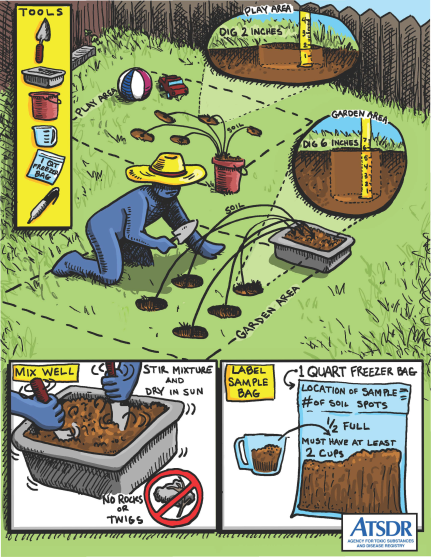
To collect a sample, you should:
an infographic depicting how to sample soil.  Read article for text description of steps illustrated here.
How to take soil samples in your yard.
  1. Identify an area you would like to sample – for example, your garden, where your children play, or even where your pets frequently dig.
  2. Collect and combine soil in a clean container.
    • For a large area, like a backyard, collect soil from 5-10 random spots
    • For a small area, like a garden patch, collect soil from 3 random spots
    • In garden areas, dig 6-8 inches deep
    • In play areas, dig 1-2 inches deep
  3. Mix the soil well.
  4. Remove pebbles, rocks, and roots, then air-dry the sample in the sun.
    • Do not use flame, an oven, or a hair dryer to dry your sample.
  5. Transfer 1-2 cups of mixed soil into a one-quart zip-top bag – about half full.
    • Label each bag with the location the soil was taken from (garden, play area, etc.) so you can keep track.
By Marcus Humberg, Communications Specialist, Toxics Cleanup Program.

Thursday, July 25, 2019

A Little Green for the Brownfields

EPA awards $2.4 million for cleanups in Washington

An empty field with dry brown grass and a few trees
Ninth Street Park, a brownfield cleanup site contaminated with arsenic
and lead from decades of pesticide use.
In June 2019, the U.S. Environmental Protection Agency (EPA) awarded nearly $2.4 million in grants to five recipients in Washington to help assess and clean up local brownfields — properties that haven’t been redeveloped due to potential contamination with hazardous substances.


The five EPA grant recipients are:

We will be working in close partnership with EPA to assist the grant recipients and oversee assessment and cleanup — including making the final determination that a property is clean enough to meet state standards and be redeveloped.

The front entrance to the Northern State Hospital as it appeared in the 1920s, a large stylized building with a roundabout and garden in front
Historic photo of the former Northern State Hospital in Sedro-Woolley
Recipients will use the EPA grants to assess and clean up dozens of brownfield properties, including:
  • Former Northern State Hospital site at Sedro-Woolley
  • Former cherry orchard land in East Wenatchee
  • Blighted properties in Olympia
  • Contaminated properties in Spokane’s 770-acre University District on the Spokane River
  • Former ranch and wood product facilities on the Colville Reservation

To turn brownfield sites into marketable assets for the community, property owners will need to follow remedies that make sure each site meets state human health and environmental protection standards.

After meeting state cleanup requirements under the state Model Toxics Control Act, property owners can seek a “no further action” determination from us. This designation removes many barriers to redevelopment and helps property owners get financing and approvals to develop the sites.

Planning for cleanups


The EPA awarded two types of grants to Washington recipients: assessment grants and cleanup grants.

Assessment grants provide funding for identification of contaminants, evaluation, and cleanup planning.

  • A “Phase I Environmental Site Assessment” is the first step in evaluating a brownfield site. Phase I assessments are a historical review to determine if contamination is likely. This sets the stage for further testing, planning, and cleanup.
  • “Phase II assessments” are scientific evaluations. Soil, groundwater, surface water, and indoor air are sampled and tested to determine the exact contaminants and the extent of contamination. This information is required to plan the cleanup.

Assessment grants also help pay for public outreach and engagement so the community can be informed about the cleanup and the future of the properties.

Cleanup grants help pay for the actual work to clean up a site. Cleanup can take many forms, from removing and replacing soil, to complex treatment plans, to securing contaminants in place.

What the grants pay for


A view of the Northern State Hospital main building with hills and trees in the background
Northern State Hospital campus, a brownfield site in Sedro-Woolley that
housed mental patients in a self-contained community.
  • The Port of Skagit County will use its $395,000 grant to clean up two areas of the former Northern State Hospital campus in Sedro-Wooley. The 225-acre site operated as a state mental health hospital from 1912 to 1972. The hospital campus has 600,000 square feet of buildings, a power plant, a former landfill, and several maintenance shops. The cleanup will focus on groundwater and soil contaminated with chlorinated solvents around the former laundry building, and the gymnasium field, which is contaminated with arsenic.

An
Cherry seedlings growing in Ninth Street Park, a former cherry
orchard, next to a neighborhood in East Wenatchee.
  • The Trust for Public Land will use the $500,000 federal grant to clean up the Ninth Street Park in East Wenatchee. This 2.3-acre park was a cherry orchard from the 1930s through 2008. The cherry trees were removed in 2011, but heavy metal and arsenic contamination remains in the soil from the lead arsenate used as a pesticide. Agricultural use of lead arsenate was stopped in the 1960s and the EPA banned its use entirely in 1988. The grant will also help fund community engagement activities and development of a site management plan that educates workers on the soil conditions and safe practices when working at the site.

  • The Olympia Regional Coalition is receiving a $600,000 grant. The focus is on the Peninsula and West Bay neighborhoods. The coalition will use the funds to conduct 14 Phase I and 10 Phase II site assessments, create five cleanup plans, update the city brownfields inventory, and conduct community outreach.

  • The City of Spokane will use its $600,000 grant for the 770-acre University District along the Spokane River. The city will use the money to assess potential historical contamination on 14 sites (Phase I), sample for contamination on eight more (Phase II), and develop eight cleanup plans and six reuse plans.

  • The Confederated Tribes of the Colville Reservation will use its $300,000 grant to assess potential contamination on three sites (Phase I) and conduct sampling on seven others (Phase II). The focus area includes three wood products facilities, a blighted residential property, and the chemical handling area of the former Hinmans Ranch. The grant money will also help create three cleanup plans and conduct public meetings.

By Marcus Humberg, Communications Specialist, Toxics Cleanup Program.

Tuesday, July 16, 2019

New Tacoma park emerges from Superfund site

Aerial view of Dune Peninsula showing Puget Sound, walking paths, and the Tacoma Yacht Club.
Tacoma's new Dune Peninsula at Point Defiance Park.
Image courtesy Metro Parks Tacoma
Since the 1980s, we have been working in partnership with the City of Tacoma and the EPA to clean up the blight and contamination left behind by the former Asarco smelter.

On Saturday, July 6, 2019, a beautiful new park was born from the smelter’s slag heap after decades of hard work, and millions of dollars in cleanup. The Dune Peninsula at Point Defiance Park is now open to the public with walking paths, a public amphitheater, and sweeping views of Puget Sound and Vashon Island.

History of the site

Aerial view of former Tacoma Smelter Plant showing industrial buildings, docks, and smokestack next to Puget Sound
The former Asarco smelter plant and smokestack
After operating for nearly 100 years, the Asarco smelter was designated as a Superfund cleanup site in 1987. While the smelter provided local jobs and valuable metal resources for the nation, it also left a toxic legacy in the soil, groundwater, and sediments in Puget Sound.

The once-iconic Asarco smokestack – the tallest in the world at 571 feet – vented heavy metals and arsenic that drifted along the winds to contaminate an estimated 1,000 square miles of land from Seattle to Olympia. Even the peninsula that the 11-acre park is built on was created from slag waste that Asarco dumped into Puget Sound over a period of decades.

Since the smelter was closed and its smokestack imploded in spectacular fashion, the site has been undergoing a remarkable physical and economic transformation. This includes the development of Point Ruston, with theaters, restaurants, shopping, and condominiums with spectacular views – and now this beautiful park.

Funding from the ashes

In 2009, Washington state was awarded a $188.5 million settlement during Asarco’s bankruptcy. $95 million of these funds were set aside for the Tacoma smelter. In 2013, the state legislature granted Ecology $5 million of these funds for the Metro Parks Trails Project. This funding was used to permanently cap 400,000 cubic yards of contaminated soil on the peninsula — enough to fill 120 Olympic-sized swimming pools — and allowed the new park to be built over the top.

Many agencies provided funds for additional improvements around the new park including:
  • $36.6 million from Metro Parks' 2014 voter-approved park bond
  • $25.4 million from the EPA
  • $3.5 million from the Washington State Recreation and Conservation Office to create a 20-foot wide trail, and a pedestrian bridge over Pearl Street.
  • $2.5 million from the Washington State Department of Transportation to create a new roundabout entrance to Point Defiance Park
  • $1 million from Ecology to create a regional stormwater facility that can handle 8 million gallons of water daily from a 754 acre watershed

Naming the park

Back in the 1950s, the Asarco smelter and its pervasive pollution inspired local author Frank Herbert to draft an award-winning ecologically-inspired science fiction novel titled “Dune.” The Dune Peninsula Park is named after this novel, and Frank Herbert’s name is emblazoned on the new trail winding through it.

Cleanup continues

While the Dunes Peninsula is now open to the public, Ecology is still cleaning properties in nearby neighborhoods within the Tacoma Smelter Plume. To date, these cleanups have removed contaminated soil from homes, schools, daycares, parks, and camps in the surrounding area. Nearly 1,200 homes in the smelter plume qualify for cleanup.

Around 300 homes have already had their soil replaced, along with nearby city parks, schools and even Fort Nisqually at Point Defiance. Homeowners whose properties may be contaminated can contact us to learn more about the options available. For more information on all of our cleanup programs around the Asarco smelter, visit our Tacoma Smelter Plume Project page.

By Marcus Humberg, Communications Specialist, Toxics Cleanup Program.

Tuesday, April 16, 2019

Register soon: Brownfields Conference room rate ending April 25

If you’re interested in learning about cleaning up and redeveloping properties with suspected or known contamination, please join us for the FREE Washington State Brownfields Conference in Spokane May 28 – 30, 2019. A block of rooms has been reserved at the Doubletree by Hilton Spokane City Center. The special room rate will be available until April 25, or until the group block is sold-out, whichever comes first. The guest list is growing and the cut off for getting the conference rate on hotel rooms is fast approaching, so register and reserve a room before it’s too late!

The goal of this conference is to bring together public and private sector stakeholders and tribes in Washington and the Inland Northwest. This event is being coordinated in partnership with the Northwest Environmental Business Council and is funded in part by the U.S. Environmental Protection Agency. We also want to thank the following event sponsors for their support:
  • GeoSearch
  • Hart Crowser
  • Maul Foster Alongi
  • PBS
  • Restorical Research
  • Spokane Environmental Solutions
  • Stantec
  • TSI
Please visit our conference web page to learn more and download the draft agenda. We hope to see you there! If you have questions, please contact Ali Furmall, office: 509-329-3436, cell: 509-655-0538.

Thursday, April 11, 2019

Tacoma Smelter Plume Yard Program

Work on Vashon-Maury Island moves ahead

If you live in the North end of Tacoma or the southern tip of Vashon-Maury Island, you have likely heard about the Tacoma Smelter Plume. However, if you just moved here, the following information may be new.

The smelter and stack are located on a hill. Water is in the foreground.
The former ASARCO smelter stack.

For nearly 100 years a smelter operated in the small town of Ruston. Air emissions from the smelter were carried by the wind to areas in King, Pierce and Thurston County. These air emissions contained heavy metals including arsenic and lead, which settled on surface soils. The highest levels of soil contamination are seen closest to the former smelter and decrease with distance.
 

Soil replacement work

Through our Residential Yard Sampling and Cleanup Program, we are working on 14 yards and a community-park in the southern end of Vashon-Maury Island. Work started on the first yard in early March 2019.

If you live in this neighborhood, you will likely see construction-related traffic. You may notice orange fencing, closed sidewalks, and Ecology’s Yard Program banner. The contractor usually works on a few yards at a time, which means workers may travel between yards with equipment. Construction can be noisy, and it is important to pay attention to trucks and large machinery that are coming and going. This construction will likely go through July 2019.    

Please call us if you see:
  • Dust in the air from construction.
  • Soil on the sidewalk or street.
  • Mud or water running off the property.
  • Dump trucks without covers.
 
Soil sampling
If you live on the southern end of Vashon-Maury Island it is likely that your property has already been sampled. To find out if your property has soil sampling results, go to our public database and enter your address. Soil sampling is for existing, residential properties. If you are a new homeowner, and your soil hasn’t been sampled, you can fill out an access agreement and get your yard sampled, too. Soil sampling is free and completely voluntary.

Future soil replacement

Currently, 53 properties qualify for soil replacement on Vashon-Maury Island. By the end of 2019, we will have removed and replaced soil on 35 of these properties. Unfortunately, we are not able to remove and replace soil on all the properties that qualify. Some properties have steep slopes or are located in areas we don’t work, like forests or vacant lots. And, sometimes, we are unable to coordinate with the property owner. At the end of the program, we will offer one last opportunity for residents with qualifying properties to participate in our Yard Program.
 

Blue and green dots mark the 14 properties receiving soil replacement in the southern end of Vashon-Maury Island.
By the end of 2019, we will have removed and
replaced soil on 35 properties on Vashon-Maury
Island.

Soil left behind

The main objective of the Tacoma Smelter Plume project is to reduce human health risks from arsenic and lead in soils. Soil replacement is focused on the high-use areas around homes and in areas where children play. Soil contamination may remain in undeveloped and forested areas. It is important to practice healthy actions like taking shoes off at the door and washing hands after working or playing in the dirt no matter where you live within the Tacoma Smelter Plume.
 

Questions

If you have any questions about the Yard Program or construction in your neighborhood, please call our project line 360-407-7688 x 2. We are always available for questions and are happy to help you find the information you need. 

Follow our yard cleanup work:

By Crescent Calimpong, Toxics Cleanup Program
 
Historical photo of the ASARCO smelter, courtesy of the Tacoma Public Library Northwest Digital Collections for historical photos.
 

Thursday, March 14, 2019

Cleaning up: Investing in communities to turn blighted properties into affordable housing

The City of Yakima will use a $200,000 Ecology Integrated Planning Grant
to investigate contamination on a property that will be home to
affordable housing once the site is cleaned up.
Washington’s environmental cleanup law, known as the “Model Toxics Control Act,” turns 30 this month. Our cleanup law has served as a road map to cleaning up industrial sites and other properties contaminated by toxic chemicals.

Removing these threats helps protect human health and the environment, and opens the door to put properties back into use. Ecology is now working to make it easier for affordable housing developers to redevelop once-contaminated properties into housing that communities can afford. 

Rapid development and the housing crisis

Many areas of Washington state are experiencing a housing crisis. Our state’s economic boom and population growth bring many benefits, but they are also driving up rents, home prices, and property taxes with devastating effects on some of our communities’ most vulnerable residents.

As Washington’s cities continue to rapidly grow, easily developable land for residences and commercial centers is becoming harder to find. More valuable real estate means cleaning up and redeveloping contaminated properties is more attractive to developers – which is good news for the environment. But the costs of cleanup often end up being passed through in the price of redevelopment, including housing. We’re trying to take the some of the cost of cleanup out of the equation, easing the way for the building of affordable housing. 

Ecology’s Integrated Planning Grants

If you live in Washington, Ecology works for you. That’s why nearly 70 cents of every dollar that comes to Ecology is passed through to local communities. In 2018, the Legislature provided us with $1 million for Integrated Planning Grants to be used for affordable housing projects. These are flexible grants that local governments can use to support pre-construction cleanup activities, including planning, investigation of levels and types of contamination, community involvement, education, and outreach.

We used these funds to award nearly $200,000 each to six new or potential cleanup projects aimed at expanding affordable housing.

Bellingham

This project, headed by the City of Bellingham and Port of Bellingham, includes cleanup and redevelopment of approximately three acres at the corner of Cornwall Avenue and Laurel Street near downtown Bellingham. Located within walking distance of downtown, Western Washington University, and public transportation, the redevelopment will include up to 50 affordable housing units, work-live spaces, ground-floor commercial spaces, a community kitchen, and public open space. The next steps include coordination with private developers, the Bellingham Housing Authority, other nonprofits, and conducting public outreach and involvement. 

Bremerton

The Bremerton Housing Authority will use these funds to complete the design of the cleanup plan at a vacant and underutilized industrial site along Oyster Bay Avenue. Once cleanup is complete, the housing authority will construct up to 50 units of affordable housing in a multi-story building. Funds will also be used to evaluate planning needs such as parking, utilities, and the potential need to update or rezone the property based on the city’s current comprehensive plan. The Housing Authority will conduct a series of public meetings on land use changes and housing needs. 

Kennewick

The City of Kennewick proposes to redevelop an approximately 10-acre former maintenance yard into the Kennewick Housing Authority Multi-Family Housing Complex with 110 units. The site consists of six buildings, only one of which is currently in use. 

Seattle

The Seattle Chinatown International District Preservation and Development Authority will use its grant funding to examine the cleanup needs and development potential for a currently underutilized eight-acre property in the district. Past environmental assessment work at the site has left concerns that the property could still be contaminated with hazardous substances. More investigation is needed to understand the nature and extent of contamination on the site, and to identify the potential for integrating any required cleanup with the redevelopment of the area into affordable housing units and commercial spaces for this urban community. 

Wenatchee

The City of Wenatchee plans to evaluate a former tree fruit research facility for potential purchase and redevelopment into a community asset that will support affordable housing. The Washington State University Tree Fruit Research and Extension Center property is located at 1100 N. Western Avenue at the corner of N. Western Avenue and Springwater Avenue. The property contains suspected contamination related to historic tree fruit research operations that included storage of pesticides and other agriculture-related chemicals and fuel products. The city is interested in facilitating the development of affordable housing and promoting new economic development. 

Yakima

Yakima has a significant need for affordable housing and facilities to accommodate homeless individuals. The City of Yakima will be using its funding to investigate contamination of a city-owned area that was used for fruit and vegetable processing. Once cleaned up, the site will be used to provide transitional housing units and a shelter. The city hopes to build 30 affordable housing units and a 100-bed shelter.

To learn about other projects already funded by Ecology, check out our interactive grants map.

Keep an eye on our blog for more stories on how we use Washington’s cleanup law to protect the environment, invest in communities, stimulate economic development, and build relationships.


By Cheryl Ann Bishop, Toxics Cleanup Program

Monday, March 11, 2019

Cleaning up: Washington’s environmental cleanup law turns 30


We're celebrating 30 years of cleaning up Washington under our environmental cleanup law – the Model Toxics Control Act. This innovative law powers our work to investigate, clean up, and prevent hazardous waste. Thanks to our cleanup law, more than 7,000 sites in Washington are cleaned up.

Cleanups protect people’s health by removing toxic chemicals from the environment, like arsenic from playground soil or methane gas from a solid waste landfill. Cleanups also preserve wildlife habitat for future generations, spur new economic developments, put abandoned properties back into use, and transform communities.

Our cleanup law evolved from citizens’ Initiative 97 in 1988 and became law in 1989. Its key principles are:
  • The polluter pays.
  • Cleanups should be as permanent as possible.
  • Public participation is crucial.
  • Processes should demonstrate a bias toward action, permanence, and innovation.
While thousands of sites are already cleaned up, there are more than 6,000 known or suspected contaminated sites in Washington that still need to be addressed — and the list keeps growing. We discover about 200-300 new sites a year (find out if there are sites in your neighborhood).

Over the next several months, we’re going to be talking more about our cleanup law and what it means in our state. To get us started, here are a few examples of how cleanups can transform communities and protect the environment.


Protecting the environment

Port Gamble Bay, on scenic Hood Canal, is a vibrant place for tribal and community members and tourists who come to see the picturesque historic mill town. The Port Gamble cleanup is a great example of how cleanups can stimulate habitat restoration and preservation efforts.

This cleanup was one of the largest creosote-treated piling removal projects in Puget Sound. Creosote leaches from treated pilings and structures to surrounding sediment and water. Shellfish – such as mussels and clams that are consumed by fish and humans – accumulate this leached contamination. Removal of pilings and contaminated sediment improves conditions for wildlife.

Thanks to funding from the Washington State Legislature, Ecology was able to purchase land for conservation and recreation, and complete restoration and pollution control projects in the bay. We also studied contamination in fish and shellfish. The projects completed with this funding have improved and protected habitat in and around the bay, created jobs in the area, and improved recreational opportunities.

Investing in communities

Ecology works for you. That’s why about 70 cents of every dollar that comes to Ecology is passed through to local communities. Several years ago we took an in-depth look at the return on investment for cleanups that received state funding.

Environmental cleanups along Tacoma's Thea Foss Waterway
helped turn blighted properties into viable investments. 
A powerful impact of environmental cleanups is economic development – cleanups create strategic opportunities to turn blighted properties into economically-viable developments that can significantly increase local and state tax revenues. For example, successful cleanups helped property values on Tacoma’s Thea Foss Waterway to increase from $11 per square foot to $39 per square feet over a ten-year period.

But the benefits of investing in communities aren’t just economic. These investments improve our quality of life, protect human health and the environment, and allow for redevelopment opportunities that transform communities. 

Supporting community vision

The City of Wenatchee had a vision for a revived Columbia River waterfront. Thanks in part to a $150,000 integrated planning grant from Ecology, the city was able to develop a plan for reuse of an old landfill along the river. Doing so helped the city move ahead with its broader waterfront redevelopment in keeping with the community’s vision, including the vibrant Pybus Public Market. Once home to a metal fabrication business, this property is now a town hub for shopping, great food, and music. The market’s development is included in this video about what’s happening along Wenatchee’s waterfront.

To learn about projects already funded by Ecology, check out our interactive grants map.

Keep an eye on our blog and social media for more stories on how we use Washington’s cleanup law to protect the environment, invest in communities, and stimulate economic development.


Friday, January 11, 2019

2019 Washington State Brownfields Conference

Join us for the Washington State Brownfields Conference in Spokane this coming May. Brownfields are abandoned or underused properties where there may be environmental contamination. Cleaning up and redeveloping brownfields is key to local economic development efforts, turning perceived problems into community assets, such as affordable housing.

The goal of this conference is to bring together public and private sector stakeholders in Washington and the Inland Northwest to share information on brownfields redevelopment successes and future opportunities.

Save the Date postcard for the Washington State Brownfields ConferenceConference dates and location

Wednesday, May 29, 2019, 12 – 5 p.m.
Thursday, May 30, 2019, 8 a.m. – 5 p.m.
Doubletree by Hilton Spokane City Center
322 North Spokane Falls Court, Spokane

Registration information and the agenda will be available February 2019 on our Brownfields Conference web page.

What the conference will include:

  • Sessions on current technical issues, funding sources, and affordable housing opportunities
  • Case studies
  • Field trips to tour successful brownfield redevelopment projects in Spokane
  • Lunch and light refreshments on Day 1
  • Breakfast, lunch, and light refreshments on Day 2

Who should attend?

  • Local and regional government officials
  • Housing agencies
  • Nonprofit economic and community development organizations
  • Environmental consultants
  • Anyone interested in learning about brownfields or financial resources for local redevelopment

For more information, please contact:

Ali Furmall, Small and Rural Communities Brownfields Specialist
ali.furmall@ecy.wa.gov
509-329-3436, cell: 509-655-0538

Thursday, December 6, 2018

New Online Map: Dirt Alert

A hand holds a smart phone. The Dirt Alert map is displayed on the phone's screen.
The new map is mobile friendly, making it easy to access.
from your home computer or your phone.  

This month we launched a new online Dirt Alert map. The map focuses on the Tacoma Smelter Plume, but also covers areas in the state where soil contamination may exist from arsenic-related contamination: 

·        Everett Smelter cleanup


·        Five Washington counties where soil contamination may exist in former orchard lands
By putting both information and data in one place, we hope to make it easier for residents to find out about arsenic-related soil contamination and resources. The new web application replaces two older, online maps, the Arsenic in Soil Database and the Everett and Tacoma Smelter Search. 

New look- Same data
The upgrade means faster downloading times and the ability to access the map by phone. The map also visually displays soil sampling data. Within the Tacoma Smelter Plume and Everett Smelter cleanup area, the map provides access to:
·        Soil sampling maps

·        Soil replacement paperwork

For yards outside of the Everett Smelter cleanup area or Tacoma Smelter Plume Yard Program service area, the map links to our Healthy Actions webpage that teaches you how to protect yourself from arsenic and lead in dirt, and provides contacts for more information.

Questions?
If you have questions or comments about the map, please call the project line at 360-407-7688 and press 2 for Tacoma Smelter Plume. You can also email the Yard Program Outreach Coordinator at Crescent.Calimpong@ecy.wa.gov.

Get the latest updates:
·       Follow our blog!

·       Visit our webpage on the Tacoma Smelter Plume.

·       Sign up for email updates on our listserv.


A map of the Tacoma Smelter Plume, displaying predicted arsenic for the areas closest to the former smelter. The link to the dirt alert map is:  https://fortress.wa.gov/ecy/dirtalert/
The home page of Ecology's new, online map, Dirt Alert.


By Crescent Calimpong, Toxics Cleanup Program