Showing posts with label phytoplankton. Show all posts

Friday, August 17, 2018

Ecology researchers study climate effects on Puget Sound food web

Unusual phytoplankton blooms caused by warm ocean water give scientists a glimpse into the future of marine life, from shellfish to whales.

By studying the effects of warmer marine water on the tiny plant-like organisms called phytoplankton, scientists at Ecology are learning how the Puget Sound ecosystem responds to climate change.
They did so when a mass of warm water nicknamed “the Blob” made its way to the Puget Sound in 2015. This unusually warm water gave scientists the opportunity to see what a world with warmer oceans might look like.
The Blob changed the timing and size of phytoplankton blooms significantly; spring blooms happened earlier than usual, and summer blooms were dramatically larger than in previous years.
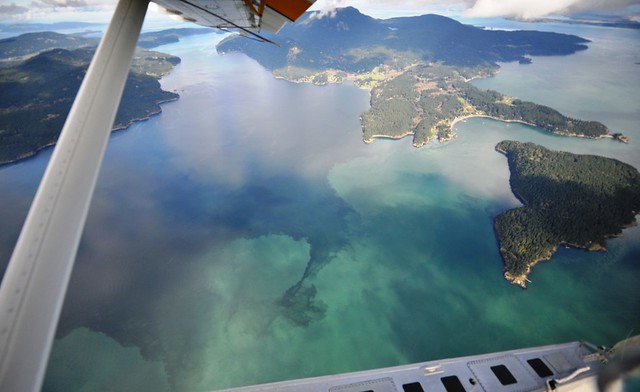
2015 Blooms from Eyes Over Puget Sound
Most of the marine food web depends on phytoplankton blooms happening at certain times. Because phytoplankton are a key source of energy, their availability affects the life cycles of marine creatures.
Ecology’s Senior Oceanographer, Dr. Christopher Krembs, tells us more.
Krembs: “A lot of life cycles of invertebrates and fish are triggered by temperature. . . . for little larvae that come out of their eggs and for juvenile fish and other species, it is important that they find their food early on in their life cycle because most of the juveniles die if they don’t find optimal conditions.”
If phytoplankton blooms don’t align with critical developmental stages of marine creatures like small fish and krill, the entire food web can suffer. A healthy marine food web is essential to regional efforts to recover salmon and Southern Resident Killer Whale populations, as well as to support the commercial, tribal, and recreational shellfish industries.
Krembs says that the data from 2015 will help scientists model climate change more accurately.
Krembs: “When you see a scenario, you become much better at predicting the future, because now you have environmental data that you can calibrate your models with. And so our predictions become better.”
More research on how a warming climate may affect Puget Sound ecosystems has already begun. To learn more, visit Ecology’s webpage about the Salish Sea Model.


By Ruth Froese, Environmental Assessment Program Communications

Thursday, September 18, 2014

What our Eyes Over Puget Sound saw on Sept. 16

By Sandy Howard, Communication Manager, Environmental Assessment Program

Have you ever looked at water from Puget Sound under a microscope? 

You may be surprised at what you see. 

Wednesday, August 20, 2014

Eyes Over Puget Sound for August 18

By Sandy Howard, communication manager, Environmental Assessment Program

If you haven’t gotten up to the San Juans this summer, Eyes Over Puget Sound can take you there.

Our August cover shows a bird’s eye view of Sucia Island — looking like a giant downward-facing hand.

We saw an intense yellow-green phytoplankton bloom inside Fossil and Mud bays in this photo taken at 11:22 a.m. last Monday.

Sunshine and warm temperatures have returned after last week’s intense rain. 

We observed that the Puyallup and Nisqually rivers are flowing high. Red-brown blooms and numerous patches of jellyfish remain strong in South Sound, Sinclair and Dyes Inlets, and in Bellingham Bay. And we saw brown-green blooms in Whidbey Basin.

Macro-algae surface debris is very high in South and Central Sound. Hood Canal remains cooler but Puget Sound-wide temperatures are now warmer and less salty.

Sea surface temperatures are above 15 °C, conditions favorable for some pathogens, and harmful algae blooms.
Read about super colonies of by-the-wind sailors washing up on our shores. They are called Vellela vellela.

Eyes Over Puget Sound combines high-resolution photo observations with satellite images, en route ferry data between Seattle and Victoria BC, and measurements from our moored instruments.

Follow us on Twitter, Facebook and on our website.

Sign up to receive email notifications about the latest Eyes Over Puget Sound by subscribing to Ecology’s email listserv.

See the August issue of Eyes Over Puget Sound.

Thursday, June 26, 2014

Eyes Over Puget Sound on June 23, 2014

By Sandy Howard, communications manager, Environmental Assessment Program

Our guest feature this month is about phytoplankton monitoring in Budd Inlet, plus we’ve got an in-depth look at our mooring program. Our technology is now hitching a ride on the state ferries.

We hope you enjoy our June 23, 2014 Eyes Over Puget Sound.


floating at thesurface in Fidalgo Bay, Anacortes.

What's happening right now in Puget Sound

Onshore winds have been keeping the Puget Sound lowlands cool and cloudy, but sunlight and warmer temperatures are returning.

We saw large organic mats of surface debris in Hood Canal, Padilla Bay, and Lay Inlet – our scientists say that many are macro-algae. There were strong red-brown blooms in Discovery Bay, East Sound, and parts of Georgia Basin.

There was sediment-rich water north of San Juan Islands. Jelly fish are increasing in numbers. Colder, saltier conditions in early 2014 and lower oxygen in Whidbey Basin, Central, and South Sound continue. Hood Canal remains unusually cold. At our Mukilteo mooring, temperatures are similar to last year, but salinity and dissolved oxygen follow the Puget Sound-wide trend.

Follow us!

Eyes Over Puget Sound combines high-resolution photo observations with satellite images, en route ferry data between Seattle and Victoria BC, and measurements from our moored instruments.

Sign up to receive email notifications about the latest Eyes Over Puget Sound by subscribing to Ecology’s email listserv.  Eyes Over Puget Sound home page.