Showing posts with label Lead. Show all posts

Thursday, August 29, 2019

Women in Science: Sara Sekerak navigates new cannabis lab legislation

Sekerak leading a presentation about cannabis testing methods, protocols, and quality standards.

Sara Sekerak is working in uncharted territory. She is part of a new task force mandated by Washington’s Legislature to define scientific standards for our state’s cannabis laboratories. How does someone end up with such a high-pressure job? It takes a lot of lab experience, a keen eye for quality assurance, and a thorough background in ensuring products comply with regulatory standards. Sara shares more about what led her to this important new position on the task force in this month’s Women in Science interview.


Sara's job at Ecology


Sekerak performing size reduction of a study product in the Product Testing
Prep Room. Pre-processing of products is a necessary step in producing
samples for lab analysis.
Right now, I am the lead chemist for the Cannabis Science Task Force, but the road to my current position has been a winding one. Before I joined the Task Force, I was a Product Testing project manager. In that position, most of my work supported the Children’s Safe Product Act.

During the past two years, I managed a study of school supplies marketed to children ages 12 and under. We looked for lead and cadmium because those metals have both federal and state limits. School supplies are not explicitly covered in the Children’s Safe Product Act, so the Attorney General’s office took a special interest in this. We worked with the Attorney General’s Office and scoped a project to meet their needs.


In May 2019, the Attorney General’s Office finalized a settlement with Amazon that our study helped substantiate. The most important outcome of this settlement is that Amazon now requires all third-party sellers of school supplies and jewelry to produce a certificate confirming that their products meet the federal requirements for lead and cadmium.

Recent work

Authoring a Cannabis Laboratory Accreditation report led me to my current position as lead chemist for the Cannabis Science Task Force. The goal of the Task Force is to work with multiple agencies, as well as scientists from the cannabis industry. We have been asked by the Legislature to provide recommendations that would help cannabis testing labs apply science-based practices and other critical elements needed for a robust accreditation.
Because there is no federal oversight for cannabis (like there is for drinking water or agricultural products), there are currently no standard methods specifically for testing cannabis. So labs are creating their own procedures and processes. Right now, each lab defines their own level of quality; the problem with this is that there is variability from one lab to the next. Our task force will meet from now to Dec. 1, 2021, and this multidisciplinary group of agencies and scientists will try to close some gaps in the labs’ processes.

Advice for future women in science

I’ve often felt like my work has been challenged or questioned. But, wherever I have gone, these challenges and questions have always motivated me to work harder. So my first piece of advice would be to not let negative comments get you down. I have worked hard to build my name and reputation to prove that I am a valuable team member. If anyone questioned my work ethic, I just worked harder to prove that I could.
Sekerak working at Manchester Environmental Laboratory.
My second piece of advice would be to never stop learning and always ask questions. In 2000, I started my first job at a lab through an internship at Manchester Environmental Laboratory. I always wanted to learn new things, so I would offer to help and job shadow everywhere I could.
From there, I worked my way up to my current position as a lead chemist, and my experience communicating with labs gave me a leg up. My diverse experiences lined me up perfectly for my current position, which requires a broad scope of knowledge.

By: Ruth Froese, Environmental Assessment Program Communications

Tuesday, August 27, 2019

Tacoma Smelter Plume: Model Remedies Guidance gets an update

To encourage cleanup of soil contaminated by the former Asarco smelter in Tacoma, we've updated our Tacoma Smelter Plume Model Remedies Guidance. For almost 100 years, the Asarco Company operated a copper smelter in Tacoma. Air pollution from the smelter settled on the surface soil of more than 1,000 square miles of the Puget Sound basin. Arsenic, lead, and other heavy metals are still in the soil as a result of this pollution.

This guidance was created to encourage cleanup of Asarco contaminated soil during property development. It provides straightforward directions on soil sampling and cleanup of soil contaminated with arsenic and lead within the Tacoma Smelter Plume. In July, we launched a revised version of the guidance, replacing the older, 2012 version.

The guidance was written primarily for developers who build residential housing or commercial buildings. However, anyone who wants to sample and clean up their Asarco contaminated soil within the Tacoma Smelter Plume can use this guidance. The guidance streamlines the sampling and cleanup process and eliminates the need to develop separate sampling and cleanup plans. When developers use the remedies covered in this guidance to clean up their properties before building structures, Ecology is able to issue timely opinion letters stating that the cleanup meets state requirements.

Picture of smelter stack on hill, vegetation and tunnel entrance in foreground.
Former Asarco smelter stack.
In updating the guidance, we kept the same format, updated some information and links to resources, and added a new chapter. Some of the revisions answered and clarified frequently asked questions, such as calculating the minimum number of soil and duff samples needed. The new chapter describes sampling and remediation in natural areas, such as steep slopes, wetlands and their buffers.

Please, note that the publication number has changed from 12-09-086-A to 19-09-101.

If you have questions about the revised Tacoma Smelter Plume Model Remedies Guidance, contact our Technical Assistant, Eva Barber at 360-407-7094 or Eva.Barber@ecy.wa.gov.

Some internet web browsers store the address to the older version of the guidance in a cookie. If searching for the new guidance using Google or Google Chrome, you may need to clear the existing cookies and search again.

To download the new version of the guidance, go to:

To find out if you are within the Tacoma Smelter Plume, visit Ecology’s Dirt Alert Map.

By Crescent Calimpong, Toxics Cleanup Program


Thursday, August 1, 2019

Vashon Islanders can get their soil tested at the farmer's market

Residents visiting the soilSHOP booth at the Vashon Farmer's Market
Residents visiting the 2018 soilSHOP booth
at the Vashon Farmer's Market
When residents of Vashon–Maury Island visit the Vashon Farmer’s Market from 10 a.m. to 2 p.m., on Aug. 10, 2019, they can go home with more than crafts and fresh vegetables – they can also learn if they have lead and arsenic in their soil.

Public Health Seattle King County and Ecology have teamed up to offer soilSHOP – a quick, easy, and anonymous way for residents to get their soil tested. Using handheld scanners, we will test soil samples that residents bring and provide instant analysis of arsenic and lead in the soil. As an added incentive, the first 15 soil-sampling participants will also receive a complimentary 30-pound bag of King County GroCo compost.

Vashon–Maury Island, while a beautiful place to live, is located downwind from the former Asarco Smelter site in Tacoma. Because of this, many properties have heavy metal contamination from the smelter.


Instant soil testing


two men using handheld scanners to test soil samples
Testing soil using XRF scanners
Ecology and health department staff will be using X-ray fluorescence (XRF) scanning technology that returns real-time, reliable data and can detect the presence of arsenic and lead in a sample. These metals are the primary concern in the Tacoma Smelter Plume, since they can have a detrimental effect on human health and development, especially for children.

The results of the XRF scan can help educate residents and property owners about soil contamination.

Staff will be available to talk with residents about healthy actions and ways they can reduce their contact with contaminated soil. We may offer further sampling to a property.

Preparing a soil sample for testing


Vashon–Maury Island residents are encouraged to bring up to three soil samples for testing to the August 10th Vashon Farmer’s Market. Be sure to arrive before 1:30 p.m. to make sure there is enough time for testing.

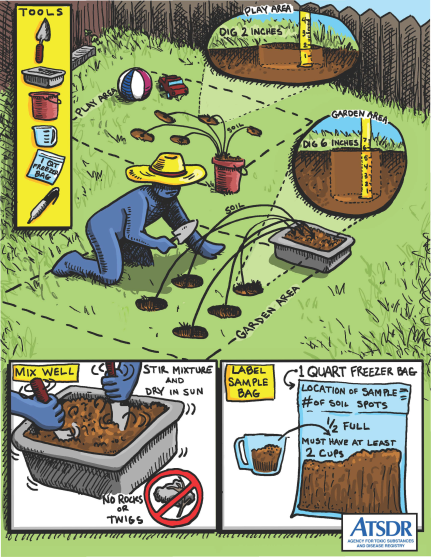
To collect a sample, you should:
an infographic depicting how to sample soil.  Read article for text description of steps illustrated here.
How to take soil samples in your yard.
  1. Identify an area you would like to sample – for example, your garden, where your children play, or even where your pets frequently dig.
  2. Collect and combine soil in a clean container.
    • For a large area, like a backyard, collect soil from 5-10 random spots
    • For a small area, like a garden patch, collect soil from 3 random spots
    • In garden areas, dig 6-8 inches deep
    • In play areas, dig 1-2 inches deep
  3. Mix the soil well.
  4. Remove pebbles, rocks, and roots, then air-dry the sample in the sun.
    • Do not use flame, an oven, or a hair dryer to dry your sample.
  5. Transfer 1-2 cups of mixed soil into a one-quart zip-top bag – about half full.
    • Label each bag with the location the soil was taken from (garden, play area, etc.) so you can keep track.
By Marcus Humberg, Communications Specialist, Toxics Cleanup Program.

Thursday, April 11, 2019

Tacoma Smelter Plume Yard Program

Work on Vashon-Maury Island moves ahead

If you live in the North end of Tacoma or the southern tip of Vashon-Maury Island, you have likely heard about the Tacoma Smelter Plume. However, if you just moved here, the following information may be new.

The smelter and stack are located on a hill. Water is in the foreground.
The former ASARCO smelter stack.

For nearly 100 years a smelter operated in the small town of Ruston. Air emissions from the smelter were carried by the wind to areas in King, Pierce and Thurston County. These air emissions contained heavy metals including arsenic and lead, which settled on surface soils. The highest levels of soil contamination are seen closest to the former smelter and decrease with distance.
 

Soil replacement work

Through our Residential Yard Sampling and Cleanup Program, we are working on 14 yards and a community-park in the southern end of Vashon-Maury Island. Work started on the first yard in early March 2019.

If you live in this neighborhood, you will likely see construction-related traffic. You may notice orange fencing, closed sidewalks, and Ecology’s Yard Program banner. The contractor usually works on a few yards at a time, which means workers may travel between yards with equipment. Construction can be noisy, and it is important to pay attention to trucks and large machinery that are coming and going. This construction will likely go through July 2019.    

Please call us if you see:
  • Dust in the air from construction.
  • Soil on the sidewalk or street.
  • Mud or water running off the property.
  • Dump trucks without covers.
 
Soil sampling
If you live on the southern end of Vashon-Maury Island it is likely that your property has already been sampled. To find out if your property has soil sampling results, go to our public database and enter your address. Soil sampling is for existing, residential properties. If you are a new homeowner, and your soil hasn’t been sampled, you can fill out an access agreement and get your yard sampled, too. Soil sampling is free and completely voluntary.

Future soil replacement

Currently, 53 properties qualify for soil replacement on Vashon-Maury Island. By the end of 2019, we will have removed and replaced soil on 35 of these properties. Unfortunately, we are not able to remove and replace soil on all the properties that qualify. Some properties have steep slopes or are located in areas we don’t work, like forests or vacant lots. And, sometimes, we are unable to coordinate with the property owner. At the end of the program, we will offer one last opportunity for residents with qualifying properties to participate in our Yard Program.
 

Blue and green dots mark the 14 properties receiving soil replacement in the southern end of Vashon-Maury Island.
By the end of 2019, we will have removed and
replaced soil on 35 properties on Vashon-Maury
Island.

Soil left behind

The main objective of the Tacoma Smelter Plume project is to reduce human health risks from arsenic and lead in soils. Soil replacement is focused on the high-use areas around homes and in areas where children play. Soil contamination may remain in undeveloped and forested areas. It is important to practice healthy actions like taking shoes off at the door and washing hands after working or playing in the dirt no matter where you live within the Tacoma Smelter Plume.
 

Questions

If you have any questions about the Yard Program or construction in your neighborhood, please call our project line 360-407-7688 x 2. We are always available for questions and are happy to help you find the information you need. 

Follow our yard cleanup work:

By Crescent Calimpong, Toxics Cleanup Program
 
Historical photo of the ASARCO smelter, courtesy of the Tacoma Public Library Northwest Digital Collections for historical photos.
 

Thursday, December 6, 2018

New Online Map: Dirt Alert

A hand holds a smart phone. The Dirt Alert map is displayed on the phone's screen.
The new map is mobile friendly, making it easy to access.
from your home computer or your phone.  

This month we launched a new online Dirt Alert map. The map focuses on the Tacoma Smelter Plume, but also covers areas in the state where soil contamination may exist from arsenic-related contamination: 

·        Everett Smelter cleanup


·        Five Washington counties where soil contamination may exist in former orchard lands
By putting both information and data in one place, we hope to make it easier for residents to find out about arsenic-related soil contamination and resources. The new web application replaces two older, online maps, the Arsenic in Soil Database and the Everett and Tacoma Smelter Search. 

New look- Same data
The upgrade means faster downloading times and the ability to access the map by phone. The map also visually displays soil sampling data. Within the Tacoma Smelter Plume and Everett Smelter cleanup area, the map provides access to:
·        Soil sampling maps

·        Soil replacement paperwork

For yards outside of the Everett Smelter cleanup area or Tacoma Smelter Plume Yard Program service area, the map links to our Healthy Actions webpage that teaches you how to protect yourself from arsenic and lead in dirt, and provides contacts for more information.

Questions?
If you have questions or comments about the map, please call the project line at 360-407-7688 and press 2 for Tacoma Smelter Plume. You can also email the Yard Program Outreach Coordinator at Crescent.Calimpong@ecy.wa.gov.

Get the latest updates:
·       Follow our blog!

·       Visit our webpage on the Tacoma Smelter Plume.

·       Sign up for email updates on our listserv.


A map of the Tacoma Smelter Plume, displaying predicted arsenic for the areas closest to the former smelter. The link to the dirt alert map is:  https://fortress.wa.gov/ecy/dirtalert/
The home page of Ecology's new, online map, Dirt Alert.


By Crescent Calimpong, Toxics Cleanup Program

Monday, June 18, 2018

Tacoma Smelter Plume Yard Program progress

Steady movement forward

We are breaking ground, removing dirt, and moving forward on cleanup of 39 yards in north Tacoma, and 16 yards on Vashon-Maury Island.  This work is part of Department of Ecology’s (Ecology) larger efforts to address soil contamination left behind by the former Asarco smelter.

For nearly 100 years, the former Asarco Company operated a copper smelter in north Tacoma.  Air pollution from the smelter settled on surface soils over more than 1,000 square miles of the Puget Sound.  Arsenic, lead, and other heavy metals are still in the soil as a result of this pollution.

We have been working on soil replacement in Tacoma
since 2013.  Our work has been focused in Area 1 and 2
 of the Study Area.  The Study Area is colored green.
Ecology’s Yard Program is offering soil replacement to the most highly contaminated yards.  To date, we have found 1,186 yards that qualify for the program.  We have completed soil replacement on 224 of those yards in the Tacoma area (see map), and 245 yards in our Yard Program Service Area.  Our Yard Program Service Area includes parts of North Tacoma, Ruston and the southern end of Vashon-Maury Island.

Work underway

Our funding was put on hold when a capital budget was not passed during the 2017 legislative session.  As a result, last year we scaled back, and worked on a small group of 17 yards in Tacoma.  In early 2018, the capital budget passed, freeing up funding to continue work.

This year we are working on 39 yards in the Tacoma area.  We break the work into groups of yards.  The largest group is 25 yards located in Area 2 of the study area (see map).  The remaining 14 yards are located outside of the study area. To date, yards that we worked on outside of the study area in Tacoma have levels of arsenic over the EPA action level and are funded by the EPA.
If you live in Area 2, you will likely see construction-related traffic.  You may notice orange fencing, closed sidewalks, and Ecology’s Yard Program banner.  The contractor usually works on a few yards at a time, which means they may travel between yards with equipment.  Construction can be noisy, and it is important to pay attention to trucks and large machinery that are coming and going.  Construction in this area will likely start in mid-July.  We hope to start work on Vashon-Maury Island in the fall of 2018.  
   

Questions?

If you have any questions about the Yard Program or construction in your neighborhood, please call our project line (360) 407-7688 x 2.  We are always available for questions, and are happy to help you find the information you need.

By Crescent Calimpong, Toxics Cleanup Program

Monday, July 31, 2017

Tacoma Smelter Plume: Reduced Services for Residents


Picture of children playing in dirtWe are reducing some services to residents

Because a state capital budget was not approved, Ecology did not receive any new funding. We are using the money we didn’t spend fully from last biennium to fund our program. We must cut back on the services we offer to the residents of the Tacoma Smelter Plume area for this next year to fit this remaining budget.
 
Throughout the plume area, soil sampling will be limited or temporarily stopped. We will not replace soil on 42 yards and one park play area this next year as planned. This will have a domino effect - residents further down the list will have to wait longer to have their soil replaced. Also, the health departments must reduce their education and outreach work. If a capital budget is not approved in the next 6-12 months, we will need staff restructuring, potential layoffs, and a complete stop of all services in July 2018.

Specifically, we will no longer be able to:

  • Replace soil on 42 yards and one park play area which were planned for this year
  • Complete planning for soil replacement on over 100 properties
  • Sample soil for new residents in the Yard Program service area
  • Sample soil on Vashon-Maury Island
  • Fully fund Pierce and King County Health Departments to do healthy action outreach with residents and handwashing demonstrations in childcares and schools
  • Provide commercials to inform residents about the plume and healthy actions they can take
  • Fund Thurston County for outreach and education work

We will update you when we have more information

Ecology staff are working with the Pierce and King County Health Departments to provide the most cost efficient services and are still working out what we can provide. We will continue to update residents during this limited funding period on any further changes. To stay informed, you can:

The Tacoma Smelter Plume Project has dedicated funding but we depend on the capital budget

The funding for this project is from a bankruptcy settlement with the ASARCO company. However, the money sits in the Cleanup Settlement Account which is a capital budget item. Every biennium the legislature must approve Ecology’s request to spend the funds. For 2017-2019, we requested nearly $24 million to provide full services in the plume area. This year, the capital budget was not passed, and we did not receive funding. We are currently using the money leftover from last biennium, about $4 million to fund our reduced services for one year. In 2018, we will request funding for our work through the last year of the 2017-2019 biennium cycle. If we do not receive additional funds, we will stop all services in the plume area in the fall of 2018.

Questions about the Yard Program?

Please call the project line at (360) 407-7688 and press 2 for Tacoma Smelter Plume, or email the Yard Program Outreach Coordinator at Crescent.Calimpong@ecy.wa.gov.

The Yard Program cleans up arsenic and lead from the former Asarco smelter in Tacoma. It is a voluntary program that’s offered at no cost to the homeowner. This work is part of Ecology’s efforts to sample and replace contaminated soil in the Tacoma Smelter Plume. The plume is a 1,000 square-mile-area of arsenic and lead contamination from the former Asarco smelter in north Tacoma.

Friday, January 20, 2017

Tacoma Smelter Plume: New Outreach in Spanish

Picture of Spanish Facebook Post

Ecology launched new Spanish language outreach in Federal Way, last month. In partnership with Public Health Seattle King County and the Latino Community Fund we developed a Facebook advertisement post for the Dirt Alert Program pictured at right.

Based on community feedback, we focused on taking off your shoes. This is an easy way to reduce the risk from arsenic and lead that may be in the dirt that is tracked into your home. The former ASARCO smelter left arsenic and lead in the soil in King, Pierce, and North Thurston counties (see map of affected area here, in English).

The Dirt Alert program has a website with a list of more Healthy Actions (in Spanish and English).  

 We Recommend:
Mop and Vacuum Once a WeekPicture: Wash your hands with soap and waterPicture: Wash Children's Toys and Pacifiers Frequently

We also created a new page on www.DirtAlert.info (the Dirt Alert Partner website) in Spanish that gives people some basic information and links to more resources about the Dirt Alert program.  

This is not our first Dirt Alert outreach in Spanish. In 2014, Ecology translated several webpages about the Tacoma Smelter Plume into Spanish (see picture below) to reach the Spanish speaking community in the Plume.

Ecology's Spanish Tacoma Smelter Plume Website
For more information: Visit www.DirtAlert.info
Call: Latino Community Fund - 206.397.2440

Additional links to Spanish resources:


By Stacy Galleher, Toxics Cleanup Program