Showing posts with label youth outreach. Show all posts

Thursday, July 3, 2014

Ecology Youth Corps: Making a Difference One Piece of Litter at a Time

By Erika Holmes, communications manager, Waste 2 Resources

Drivers are urged to watch out for 248 teens with the Ecology Youth Corps (EYC) picking up litter along roadways across the state through mid-August.

EYC crews based out of the Department of Ecology’s northwest and eastern regional offices started working in late June. The central crew began July 1, and the southwest crew begins work July 7.

Since 1975, the Ecology Youth Corps (EYC) has hired over 12,000 teens ages 14 to 17 to clean roadsides and other illegal dump sites. Youths from all over Washington gain valuable job skills, teamwork experience, safety awareness and education about environmental topics.

As we gear up for this summer’s cleaning, we want to share why this program is more than just picking up litter. In the following video, three people who’ve been there share their rewarding experiences working on the EYC.


Rapper Sir Mix-a-Lot appreciating the EYC in The Seattle Times. 

Sir Picks-a-Lot (of litter up)

Anthony Ray, or Sir Mix-a-Lot as he’s more commonly called now, worked on an EYC crew in the late 1970s. After reaching rap fame, he shared his experience with The Seattle Times. He brings up an important misconception about teens working for the EYC. They definitely aren’t juvenile delinquents. The best part: the EYC taught him work ethic, something “a lot of cats my age didn't have.”

That work ethic is proven by the numbers, and EYC crews didn’t disappoint in 2013.


2013 litter cleanup results

Last summer, EYC crews worked 64,869 hours (totals include spring and fall median crews):
  • Picking up 1,081,874 pounds of litter
  • Recycling 116,673 pounds of litter collected
  • Cleaning 5,952 miles of road
  • Cleaning up 192 illegal dumps

How you can help EYC crews


Step 1: The easy part: don’t litter.

Step 2: Look out for crews picking up litter on the road this summer. Give them a break for safety, and inform others about the important service they provide.

Step 3: Engage with the EYC on social media. We’ll post pictures and statistics from the road tagged with #EYC4life and #IThinkYouDroppedThis.
  • Were you in the EYC? Post your old pictures and stories from the road using #EYC4life.
  • See something somebody shouldn’t have tossed? Snap a photo and tag it with #IThinkYouDroppedThis.


Friday, May 9, 2014

Baby herons draw a crowd to the activities at Padilla Bay

By Krista Kenner, communications manager, Bellingham


Kids of all ages can attend special classes and/or watch an educational video in the theater before exploring the shoreline of the bay.

This week, baby blue herons have been abuzz over here at the Department of Ecology. Baby animals, inherently squeal-worthy, are even better when you combine them with a live web cam to watch their every move —so it has definitely kept people talking this week.

The heron population is located in Skagit County near the Padilla Bay National Estuarine Reserve, which is managed by the Washington State Department of Ecology. Ecology research is conducted at Padilla Bay to monitor plant and animal populations (especially eelgrass), evaluate sources of pollution, protect water quality—and to understand the bay's relationship to greater Puget Sound.

Herons have nested at this site on Padilla Bay since the late 1970s. Today it's believed to be the largest nesting area for Great Blue Herons in all of Western North America, with recent estimates ranging from 600-700 nests.

The Padilla Bay babies began hatching about two weeks ago. Thanks to a partnership with Skagit Land Trust, which owns most of the land that the herons nest on, we're able to watch the fuzzy creatures grow and develop over the next six to eight weeks.

Connecting people to estuaries

The live heron cam is one of many exhibits available to visitors of the Breazeale Interpretive Center, an educational facility located at the Reserve. A popular class outing or weekend family activity, the center provides a place where people can learn about estuaries and watersheds, both important to the health of Puget Sound. The center offers educational exhibits, fish tanks, and interactive learning experiences such as games, art and more.

"We're helping people make the connection between their actions and the health of the estuaries and beyond," said Glen "Alex" Alexander, educational coordinator at the Padilla Bay Reserve. In the video, he gives an example of how kids can learn something and carry it on, making an impact on a larger scale.

The Breazeale Interpretive Center at the Padilla Bay Reserve is open to the public Wednesday through Sunday, 10am-5pm except on official State holidays. For more information visit http://www.padillabay.gov/.


Thursday, April 3, 2014

After 39 years, the 1-800-RECYCLE Hotline has joined the social revolution!

by Michelle Payne, outreach & education, Waste 2 Resources Program

The Washington Department of Ecology invites you to join our Facebook page for the 1-800-RECYCLE Hotline! Please visit our page, “like” us, and “share” it with your Facebook friends. You'll find Green Tips on Tuesday, Shout Outs on Wednesday, Throwback Thursday, Trivia on Friday, and other interesting recycling information.
Throwback Thursday? Yeah, we do that.

Check out the 1-800-RECYCLE Hotline Facebook page to:
  • Post recycling questions and receive answers.
  • Locate recycling facilities and events.
  • Learn ways to reduce, reuse, and recycle.
  • Share innovative recycling ideas.
If you know of a useful recycling website, facility, or special collection event that we don’t have listed, please share it on our Facebook page. We want to learn from you, too!

What is the 1-800-RECYCLE Hotline?

The 1-800-RECYCLE team maintains a database of more than 1,500 recycling facilities to link the public with recycling opportunities available in Washington. We hope that through our use of social media, we will increase that number as we connect with new potential recyclers.

The hotline phone service remains a vital part of 1-800-RECYCLE and the E-Cycle program. You can still dial 1-800-RECYCLE and talk to a real person between 9 a.m. and 1 p.m. Monday through Friday (except holidays). You can also email us at 1800recycle@ecy.wa.gov.

Call 1-800-Recycle or search 1800recycle@ecy.wa.gov

Monday, April 1, 2013

College students crunch Hanford groundwater contaminant numbers

By Erika Bronson, Community Outreach & Environmental Education, Nuclear Waste Program

Ecology hydrogeologist Joe Caggiano working with Columbia Basin College students to analyze Hanford groundwater contamination data.
Over the last three months, Ecology's Nuclear Waste Program teamed up with statistics teacher Linda Rogers and her two classes at Columbia Basin College to analyze Hanford groundwater data. At Hanford, about 72 square miles of groundwater are contaminated above drinking water standards. One of Ecology’s top goals is to keep this contamination from reaching the Columbia River, an extremely important resource for the Northwest. To clean it up, we need consistent information about contaminant behavior to predict how contamination moves and make plans to intercept it.


Much of the groundwater contamination is the result of leaks or spills from Hanford’s 177 underground
Ecology chemist Mike Barnes working with Columbia Basin College students to analyze Hanford groundwater contamination data.
storage tanks that hold a total of 56 million gallons of radioactive and chemical waste. These tanks are organized into groups called tank farms, and Linda and her students’ work focuses on data from C Tank Farm in Hanford’s 200 East Area. Using groundwater sampling data spanning from the 1980s through today, we asked this group to establish movement trends for three groundwater contaminants beneath C Tank Farm: nitrate, sulfate, technetium-99.

The work of Linda and her students adds valuable input to Hanford cleanup and is a great service to our community. We plan to share their findings with the U.S. Department of Energy, their tank farm contractor, and the public. Stay tuned, as we’ll be posting more about this project as the reports are finalized …

For more photos of this project, please see our Columbia Basin College, Hanford Groundwater Statistics Project album on Ecology’s Hanford Education & Outreach Facebook page. "Liking" this Facebook page is an easy way to keep up with Hanford news and events!

Monday, June 11, 2012

Enviro ed journal features Ecology’s Hanford outreach efforts

By Erika Bronson, Community Outreach & Environmental Education, Nuclear Waste Program

Late last year, the environmental education journal Clearing put out a call for articles for their annual compendium issue. With the majority of readers in, and content focused on, the Pacific Northwest, I figured it would be a great opportunity to share ways teachers can bring Hanford into their lessons.

The article covers some of the service-learning projects we’ve done with college students, and shorter classroom activities we’ve done with younger students. In addition, it has sections overviewing Hanford history, the cleanup effort, and Hanford-related classroom resources.

To read “Hands-on Hanford: Linking lessons to the world’s largest environmental cleanup” in the Clearing Compendium, skip to page 24 after opening it online.


Thursday, December 8, 2011

WSU students create a buzz about Hanford among Tri-City youth

By Erika Bronson, Community Outreach & Environmental Education Specialist, Nuclear Waste Program

Working with an English instructor at the Tri-Cities branch of Washington State University (WSU), we tasked his 48 technical communication students with the goal of reaching high school and college students about the Hanford nuclear site cleanup. Usually when students are given more control over the direction of a project, their interest level increases as does the creativity of their solutions. These students didn’t disappoint, single-handedly informing over 600 young Tri-Citians about Hanford.

A Tri-Cities Prep senior wins a WSU frisbee for a correct answer.
Four of the eight groups chose to present Hanford information in history and science classes at four local high schools. In all, they presented to 14 classes, playing Jeopardy-style games and giving away informative handouts, vitrified marbles simulating glassified waste from Hanford tanks, and WSU and Ecology promotional items.

Another group took a risk by holding a public presentation about the various roles of Hanford contractors and the types of people they employ. Knowing the success of their project depended upon attendance at their event, they offered free pizza afterward and extra credit for Hanford High students who stayed throughout. Their sign-in sheet, which was only available to attendees as they exited, had 51 names on it.

Noor Ullah presents HanfordLearning.com to his classmates.
The remaining three groups sought to reach young minds through the Internet. HanfordLearning.org includes historical and cleanup information with quizzes to test users’ comprehension, video interviews with Tri-Party Agency representatives, and resources for teachers and others interested in learning more about Hanford. This group’s phenomenal work also creates an opportunity for other students to maintain and grow this website.

The B Reactor Hanford Facebook group scored when the reactor’s former historical researcher joined and started posting trivia questions. They deserved the boost based on all they did to bring their membership to 84 people. It took six months to get our Hanford Education & Outreach Facebook page to 70 people. Because of this group linking to us, we’re now up to 101! This dedicated team talked to friends, visited the CREHST Museum and shot informative videos to upload, walked Richland’s streets with signs advertising gift card raffles for people joining their group and “liking” our page, and impressed the B Reactor staff. The icing on the cake: 23 lucky Facebook group members were offered a special tour of the B Reactor.

The last group created the original, animated video What’s In Hanford’s Backyard?, overviewing Hanford history and cleanup and focusing on why it matters to young people. Their process included researching the issues, writing a detailed script including the narrator’s lines and the accompanying drawings, recording the voice-over, drawing the animations, and finally editing it all into one fabulous movie.

Next step: Going viral.


These students have far exceeded the course goals and our expectations, navigating difficult rhetorical situations in writing and in real-time and communicating about extremely technical subjects while making them understandable to their audience. They’ve become more skilled at collaboration, document design, public speaking, project management, and plain ol’ problem solving. And, did I mention that they reached over 600 other students in less than a month?!

For more photos of the project, see the album on our Hanford Education & Outreach Facebook page.


Thursday, August 18, 2011

Ready, set… RODEO!

By Erika Bronson, Community Outreach & Environmental Education Specialist, Nuclear Waste Program

We’re prepped and psyched to hit the Benton Franklin Fair & Rodeo with some new activities for passersby. Come one, come all: kids; Hanford workers, neophytes, and haters alike; visitors from out of town. We want to talk to everyone.

This year, our booth really is “more than an 8-second ride”! Explore the bottom of the Columbia River with our critters’ aquarium, test your Hanford knowledge by playing games, and connect with our social media tools and public mailing lists on the spot on our new touch-screen kiosk.

Our Hanford groundwater model is sitting this one out, awaiting its next showing. Teachers, school is starting soon, and we’re looking to book classroom visits. Don’t let the model get dusty! Come see us and schedule your class.

If you can’t make it, find us online anytime with Ecology’s Hanford Education & Outreach Facebook page, our ECOconnect blog, and website.

We hope to see you at the fair or in cyberspace!


Tuesday, July 5, 2011

Nuke waste program experiment may improve state soil sampling standards

By Erika Bronson, Community Outreach & Environmental Education Specialist, Nuclear Waste Program

Last week, we completed an exciting service-learning project with statistics students at Columbia Basin College. They helped Ecology’s Nuclear Waste Program do statistical analysis on soil contamination data from Hanford’s 200 Area. Our goal was to see if new multi-increment soil sampling produces similar results to the current discrete sampling methods used statewide: systematic and judgmental.

This was a big step forward in a process that began three years ago.

In 2008, with the U.S. Department of Energy, our program initiated an effort to test multi-increment sampling, a process adopted by state agencies in Alaska and Hawaii. This proposed change to Washington state soil sampling standards would save time and money and potentially improve soil sample quality.

With systematic and multi-increment sampling, a contaminated site is divided into a grid composed of 30-50 units, and a sample is collected from each. Each systematic sample is then analyzed separately, which is costly due to the high number of samples and the time it takes to process that volume of data. Judgmental sample locations are chosen using radiochemical detection equipment and professional judgment, and are also processed individually.

But multi-increment samples are combined into one composite sample and analyzed. With this method, a larger soil sample can be extracted for analysis at a lower cost than it would take to cover the site with discrete samples.

The proof is in the dirtBut do the three methods produce similar results? Volunteer CBC classroom aide, tutor, and statistician-in-training, Kelly Rogers, compared the contaminant levels detected with all three sampling methods. The results below are from her full report.

Out of 44 comparisons of mean contaminant levels, results showed a high correlation between the multi-increment samples and the large number of systematic samples taken. The judgmental samples either overestimated or underestimated the average contamination level, depending on the contaminant. Nitrate contamination is a good example of judgmental sampling underestimating average contamination levels.

When field workers first sampled this dried waste discharge pond, they assumed most of the chemical contamination would be near the radiological contamination, which held true for heavy metals. But nitrates appear to have moved down through the soil, separating from the other major concentrations of contaminants.

Here is a quick summary of the results:
  • Few differences were found between systematic and multi-increment samples, which supports changing state soil sampling standards.
  • Judgmental sampling leaves the possibility of not taking enough samples and taking them in the wrong places.
Now what?We consider this dried pond sample site homogenous because the contamination was fairly evenly spread throughout. Our next step will be to repeat the process, taking samples from a heterogeneous site with many “hot spots,” or areas of concentrated contamination next to areas with little to no contamination.

Washington suspended most rule-making processes last year due to budget cuts. This pushed back the Model Toxics Control Act (MTCA) revision until 2012. MTCA is a state law guiding the cleanup of environmental contamination. This delay actually gives us a chance to further study multi-increment soil sampling, get others in the agency on board, and possibly revise the state standards in MTCA.

More information:


Thursday, June 23, 2011

CBC stats students shed light on new soil sampling method

By Erika Bronson, Community Outreach & Environmental Education Specialist, Nuclear Waste Program

Early in 2011, I emailed just about every college instructor in the Tri-Cities area who taught a class that might be remotely related to Hanford. One of the replies came from Linda Rogers, a statistics teacher at Columbia Basin College in Pasco. She had two statistics classes in the spring and very much wanted to work with us. The feeling was mutual.

The preparation

Having focused on visual art and English in college, I needed help designing a Hanford-related statistics project. Ecology chemist Jerry Yokel answered my call. He had stacks and stacks of soil sample data fresh from a professional laboratory. The data needed to be compiled into a spreadsheet and analyzed.

Linda and her daughter Kelly Rogers, a student at CBC and an aspiring cryptographer (cracking codes using math) or professional statistician, spent hours entering all the data into spreadsheets and then compared their numbers to ensure accuracy.

The project

The data reflected soil contamination levels in a dried waste discharge pond in the 200 Area at Hanford. Those levels guide cleanup decisions, and the contaminated soil was removed in August 2010.

However, this soil sampling process also tested something else: a new method of sample collection. Ecology currently uses a systematic sampling process, in which the goal is to collect and analyze approximately 40 soil samples throughout a contaminated area. This process is time consuming and costly.

To improve efficiency, we are trying a new multi-incremental sampling (MIS) process. MIS involves taking 100 evenly spaced scoops of soil in a given area. These scoops are then combined, and a single sample is taken from this mixture to represent the entire area. The composite sample is then extracted and analyzed for contaminant levels. This scooping, combining and analyzing process is repeated five times. If it can be proved that MIS produces results comparable to systematic sampling, the MIS process could improve state standards for soil sample collection and analysis.

CBC students, along with Linda and Kelly, compared the results of both sampling processes and created graphic displays of their findings. The class focused on the project all quarter, so instead of cranking out book assignments, the students addressed the course learning goals by applying them to the data we provided. This process gave them real-world experience using statistics while also practicing teamwork and project management. And because each student wrote a 30- to 40-page report worth 40% of their grade, they also practiced technical writing by explaining and analyzing the graphs and charts they produced.

The “personal” results (technical findings coming soon)

Yesterday, I met with Linda, Kelly and Jerry. Linda gave us the top five student reports, and we’d all like to recognize the excellent work done by Sarah Pedersen, Lorena Perkins, Angela Shaw, Eileen Sheppard, and Kristen Smith (click the author’s name to see her report).

About the project, Angela said, “I am so proud of the completed project and it feels fantastic to have all of my hard work noticed. … I really appreciate the opportunity you gave me and I feel honored to be a part of this project!”

During Jerry’s and my last visit to the class, Kristen described the synergistic effect of being in a history class at the same time. “In that class, we covered the wars and such, but we also took a field trip to the CREHST Museum in Richland. … Working with the data you provided our stats class, I was able to understand most of what was being said during that tour. … I was impressed that, even though this class was very time consuming and I may have had to put more effort in this term, I was able to relate two of the three classes I took this quarter, which made things a lot easier and gave me motivation to keep going.”

Though Linda had to choose the top five reports, the effort that many of the other students put in is no small feat. The project was challenging, but many found the experience rewarding and useful for their future. Two of the students used their reports as part of their nursing program entrance portfolio; others have included the reports in writing portfolios to apply for admission to four-year universities like Washington State and Eastern Washington.

In an email to Linda, who was formerly a professional statistician with the U.S. Department of Defense, student Martin Lopéz said, “Thanks for everything you have done for me and the class. … It was a great journey with a great reward. I never felt so accomplished about anything like this before, it is a great feeling, but it was not possible without your critique for improvement. Thank you so much for a great class!”

Stay tuned...

I’ll be reporting on the results soon. Meanwhile, visit our Hanford Education & Outreach Facebook page to see pictures from the project and CBC’s news release. If you have questions or feedback about the project, please comment below.


Monday, June 13, 2011

Planets In the Playground

By Nancy Uziemblo, Geologist, Nuclear Waste Program


Third graders at Southgate Elementary share their solar system facts.


Ecology's Nancy Uziemblo and Southgate third grade teacher Sangetta Goswami join the inner planetary bodies to wave to their distant counterparts, Uranus, Neptune and Pluto.
We talk about Hanford cleanup and actively promote care of the Earth… Why not extend it to the solar system? When asked to share a geology lesson, sometimes I get carried away and think big. So when Sangetta Goswami (wife of Dib Goswami, Hydrogeologist with the Nuclear Waste Program) requested my annual geology lesson for the 3rd graders at Southgate Elementary School, I said, "Sure!" This time we would study our solar system, how big it is, and how we fit in.

In the classroom, I showed recent pictures of the sun, planets and moons from the NASA website. The students were each assigned a planetary body and came ready to share a fact that they gathered about it. This research prepared them to go to the playground and act like the sun, planets, dwarf planet, planets’ rings and many moons in our solar system. If one student was Europa, she would be rotating around Jupiter. A few students twirled about Saturn as one of its many rings. Uranus would be poised tilted, and Mercury would be small and hot when he was facing the sun.

Outside we stretched a 100-foot rope marked with the relative locations of the sun, planets and Pluto and became the solar system! The students ran to their spots and acted large or small, hot or cold. The inner planets and their moons realized how crammed they were being so close to the sun. Pluto and its moons were a bit lonely at the end of the rope and waved to their nearest neighbor, Neptune. Uranus realized it was hard to lean sideways.

We learned how big our solar system is and that there are large planets, hot planets, tiny planets and far away planets. The students know that we are not alone in our solar system, and I think they will now extend that care to our planetary objects near and far.

For more information about Ecology in the classroom or to schedule a presentation, please contact Erika Holmes, 509-372-7880. Keep tabs on Hanford with our Hanford Education & Outreach Facebook page and email list.


Tuesday, June 7, 2011

Securing Hanford’s Future in the Classroom

By Erika Bronson, Community Outreach & Environmental Education Specialist, Nuclear Waste Program

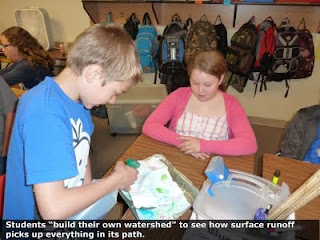
Students build their own watershedto see how surface runoff picks up everything in its path.


Students learn about cleanup methods for Hanford's 80 square miles of contaminated groundwater.


Students play Ecology's card game matching pictures of Hanford Site animals to their descriptions.


A few weeks ago, I received letters from 50 fifth graders at James McGee Elementary in Pasco. They’d been studying ecosystems, conservation and pollution, and they wanted answers about Hanford. Why is Hanford so contaminated? What is a Vit Plant? How can radiation be captured in glass?

So, on June 1st, I visited the classrooms of two teachers: Mrs. Palomarez and Mrs. Kopf. First, their students wowed me with what they’d learned about ecosystems and pollution. Too much fertilizer on lawns and crops can speed up algae growth in surface waters. Removing a species from an ecosystem impacts other life in that system. Only rain should go in the storm drain, and so on.

Then, I showed them a slideshow on the Columbia River watershed and Hanford history and cleanup. We finished our session playing Ecology’s card game matching descriptions of animals on the Hanford Site to their pictures, trying out Hanford groundwater cleanup methods on Ecology’s model, and playing Bechtel’s WTP 2020 educational video game about the Vit Plant (also known as the Waste Treatment Plant).

Continuing the conversationOne student commented that he couldn’t believe all he had to do was write a letter to get someone from Hanford to come to his class. Surprised by the power of his own words, he sincerely appreciated that someone heard his voice and took action. Some students asked if they could continue to write to me over the summer and have their parents drop off their letters on the way to work. Why not?

The Hanford community often feels like an echo chamber in which all the same voices are heard. Though a diverse chorus, we’re always hoping to get more people in on the conversation. The genuine interest these kids showed in Hanford and the health of our environment demonstrated to me that youth can engage, and intelligently at that.

Some DO stay engagedAs I was writing this, I checked Ecology’s Hanford Education & Outreach Facebook page and discovered 5 new “likes,” two of which were University of Washington students whom I met through service-learning projects. Both promoted a public meeting to fellow students and one went on to write a glossary of terms related to Hanford’s underground tank waste (I’ll be posting it soon).

Some question the ongoing benefits of educational outreach and service learning, claiming it’s a waste of time and money. But Hanford cleanup needs funding for at least another 41 years, and we need informed people to continue working on and caring about it until then and beyond. Educating today’s youth prepares them to be tomorrow’s leaders (McGee fifth graders, that means you!).

For more pictures of my visit to McGee, see our Facebook page.


Thursday, November 4, 2010

University students dig deep into Hanford burial ground issue

By Erika Bronson, Community Outreach & Environmental Education Specialist, Nuclear Waste Program

To prepare for the recent public workshops about cleaning up Hanford’s 200 Area radioactive solid waste burial grounds, John Price, our Tri-Party Agreement Section manager, presented to 96 amazing students whom we hope to continue working with in the future.

The first stop on our west coast tour was at Avram Hiller’s undergraduate environmental ethics class at Portland State University. Next, we headed north to the University of Washington to visit two more classes: Amy Hagopian’s graduate-level public health policy seminar and Holly Barker’s undergraduate cultural anthropology special studies course on Hanford.

To gain fresh perspectives, we also enlisted these students’ help in unearthing this complex topic. The public health policy students, who had recently taken a Hanford Site tour, produced two research reports that the Hanford Advisory Board are considering as they weigh in on the issue. You can read these reports (Protecting Health: Criteria for the Hanford Burial Grounds and Hanford Radioactive Solid Waste Burial Ground Position Paper) and the informative flier they created about the burial grounds.

The cultural anthropology students created posters, started a Facebook group (Team Hanford), and hit the campus to spread the word about Hanford to their classmates (see photo right). Thanks to their efforts, we had significantly higher attendance at the Seattle public workshop than we did in Hood River and Portland.

As planning for burial ground cleanup continues, we need continued public input and interest. To find out more, check out the factsheet and frequently-asked-questions. You can also view the public workshop presentation and the Department of Energy’s work plan.

Thursday, October 14, 2010

College students analyze Hanford documents for credit

By Erika Bronson, Community Outreach & Environmental Education Specialist, Nuclear Waste Program

As part of an effort to extend our outreach to higher education, I recently visited two English classes at Columbia Basin College in Pasco. The 54 students who are participating are reading and analyzing three documents about a public comment period affecting Hanford’s Waste Treatment Plant (also commonly called the Vit Plant, short for “vitrification”). In doing so, they’ll practice their critical thinking and analysis skills. They’ll also be learning about important issues right in their backyard and the public’s right to be educated about and involved in cleanup decisions.

A cutting-edge facility

Since 2002, contractors of the U.S. Department of Energy have been busy constructing the $12 billion Waste Treatment Plant, which consists of four buildings that will work in tandem to complete the vitrification process. The Pretreatment Facility will separate out the two different waste streams: low-activity waste and high-level waste. Then the waste will be transferred for processing to the Low-Activity Waste and High-Level Waste facilities. The fourth building is an Analytical Laboratory that will be used for testing and research.

What is vitrification?

Vitrification is the process by which a substance is turned into glass. The 53 million gallons of tank waste currently in aging underground storage tanks will be mixed with molten glass and poured into stainless steel containers for cooling and storage. The waste will be safely stored in glass form while the radioactivity levels decrease over hundreds to thousands of years.

We want your input, too!

If you’re curious about the current public comment period involving the design of waste sampling systems in the Waste Treatment Plant, I encourage you to access the documents the students are reading:
If you’re a college instructor who would like to bring Hanford to life in the classroom, I’d love to brainstorm ideas with you (Erika.Holmes@ecy.wa.gov, 509-372-7880). Elementary and high school teachers can contact Ginger Wireman (509-372-7935) to discuss classroom outreach opportunities.

Tuesday, September 21, 2010

Nuclear Waste Program “Scene” at Sturgeon Festival 2010

By Erika Bronson, Community Outreach & Environmental Education Specialist, Nuclear Waste Program

On September 18, I had the opportunity to participate in the Sturgeon Festival at the Water Resources Education Center in Vancouver, Wash. This educational, annual family event celebrates the ecosystems of the Columbia River.

Our exhibit featured the Hanford-specific groundwater model that demonstrates how contamination enters the groundwater and soil beneath the nuclear reservation. But it’s also a great tool for showing kids why it’s important to keep our groundwater clean.

For adults, we offered invitations to upcoming public workshops on Hanford’s radioactive solid waste burial grounds and the opportunity to sign up for the Hanford Public Involvement mailing lists.
We also asked attendees to identify which Hanford issues are most important to them. The top three responses were:
  • Protecting the Columbia River from Hanford contaminants
  • Finding a long-term storage solution for high-level nuclear waste now that progress on the Yucca Mountain Project has halted
  • Ensuring that the public is informed and included in the decision-making process.

We also participated in the Water Center’s “Scene a Sturgeon Lately?” photo challenge, entering in the “Sturgeon and You Go Green” category. Our sturgeon sets a clean, green example by recycling and bringing a reusable water bottle!


Wednesday, September 1, 2010

Columbia Critters Spark Hanford Cleanup Conversations

By Ginger Wireman, Community Outreach & Environmental Education Specialist, Nuclear Waste Program

Late August is fair time in Benton and Franklin Counties. Our fair serves a population of about 300,000 from the Tri-Cities and outlying communities. Many more travel in to compete in the rodeo, perform on a stage, or sell their wares.

That makes it a great opportunity for Ecology’s Nuclear Waste Program
to reach out to new audiences with information about Hanford cleanup.

This year and last, we focused our booth on protecting the Columbia RiverWe featured a tank with crayfish and aquatic insects from the river (pictured right with Ecology employee Madeleine Brown) and brought information about how Hanford contamination has reached groundwater and how that water reaches the river. We share research findings that show—despite contributions from Hanford—the river is still safe for ‘all uses’ and meets Class A water body standards.

We partnered with the Department of Health’s Radiation Protection Division to staff the booth. They brought a fully functional 1950’s Geiger counter in mint condition to raffle! Entry was free, but participants were encouraged to sign up for the Hanford cleanup mailing list . We added 34 new people to the list, and a West Richland resident has a new antique toy!

We also asked fairgoers to identify which Hanford issues are most important to them. The top three responses were:
  • Finding a long-term storage solution for high-level nuclear waste now that progress on the Yucca Mountain Project has halted

  • Protecting the Columbia River from Hanford contaminants

  • Ensuring that future generations are protected and informed about the site’s history and pollution.
If you have questions or concerns about Hanford cleanup, please share them by commenting on this post

Thursday, June 17, 2010

Local girls inspired to pursue environmental careers

By Erika Bronson, Community Outreach & Environmental Education Specialist, Nuclear Waste Program

Ten high school girls from the Tri-Cities area traveled deep into the Umatilla National Forest in northeastern Oregon this week to learn about post-high school opportunities in the field of natural resources. Staying three days at the Buck Creek Cabins, attendees hiked, ate camp grub, hung around the fire at night, and met with representatives from Northwest environmental organizations at the first Environmental Career Camp for Young Women.

Ecology was fortunate enough to be invited to this forward-thinking event. Driving down beautiful wooded backroads dodging mule deer bucks with velvety antlers, I pulled into the Corporation Guard Station with just enough time to set up our presentation. Returning from a hike with camp coordinator Deanna Engelmann, the girls were ready to hear about opportunities at Ecology.

The eager soon-to-be juniors and seniors learned about public service, Ecology’s mission and our youth programs, and the history of Hanford. To give the girls a taste of what it’s like to work for Ecology’s Nuclear Waste Program, I also discussed my job and highlighted three other women in the office: hydrogeologist Suzanne Dahl, geologist Nancy Uziemblo, and permit writer Kristi Wold. The program’s popular groundwater model was also available for them to explore.

Funding for the camp came from a grant secured by the Kennewick School District which then partnered with Umatilla National Forest and the Mid-Columbia River National Wildlife Refuge. The goal is to make this an annual event. I just hope I can join them for the hike next time!

Friday, May 28, 2010

Students soak up groundwater lessons at Salmon Summit in Kennewick

By Erika Bronson and Ginger Wireman, Community Outreach & Environmental Education Specialists, Nuclear Waste Program

On May 4 and 5, about 4,000 students from schools in Benton and Franklin counties flocked to the east end of Columbia Park in Kennewick. They were there to release the salmon they'd raised into the Columbia River as part of the Salmon in the Classroom program and to attend Salmon Summit. Each of the mostly fourth- and fifth-grade classes visited eight learning stations during their visit. There were 80 stations focusing on water, salmon, and other environmental science topics.

One station featured Community Outreach and Environmental Education Specialists Ginger Wireman and Erika Holmes from Ecology’s Nuclear Waste Program, one of the regulators of the Hanford Nuclear Reservation cleanup. They shared presentations with roughly 400 students and 30 chaperones and teachers. Wireman has presented at Salmon Summit for 10 years both with Ecology and as a Washington State University Water Resources Specialist. Holmes’ experience includes pairing Eastern Washington University college students with a local conservation group to create outreach materials about endangered species in Washington.

“The students, teachers, and chaperones were all a pleasure to work with, and they asked a lot of great questions,” Holmes said. “I hope to work with many more by increasing Ecology’s presence in schools throughout the area.”
Modeling cleanup methods
Watching a Hanford-specific groundwater model in action, students saw how plumes of groundwater contamination look, how they occur at Hanford, and how techniques like pump and treat, apatite sequestration, and biostimulation have helped to reduce the 80 square miles of groundwater contaminated above federal and state drinking water standards.

Not just nuclear waste
The Benton and Franklin Conservation Districts — sponsors of local Salmon in the Classroom programs — searched the region for presenters to cover all the stations. Professionals came from as far away as Spokane, including Ecology's own Brook Beeler and Kendra Robinson-Harding who presented on water quality and air quality.

Wireman attended the Summit as a chaperone with her daughter's fifth-grade class the second day. “I've known many of the people in the environmental education community for years. It was nice to finally get to see all these amazing 'non-formal' educators in action.”

Want more?
Sign up your class for free classroom outreach by contacting Ginger Wireman (372-7935), and don’t miss our web pages made just for kids. More photos of the event are available from the Tri-City Herald and Pasco School District.