Thursday, March 28, 2019

Moss animals: Animals in plant disguises!

Eyes Under Puget Sound's "Critter of the Month"

No matter the season, moss abounds in the forests, sidewalk crevices, and rooftops of the Pacific Northwest. But did you know there is also “moss” growing under the sea?
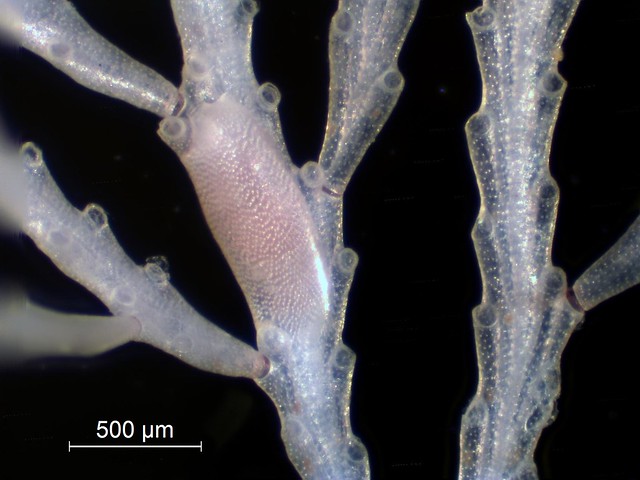
Moss Animals (Bryozoans)

Stuck on you

Moss animals, or bryozoans, are actually animals in a plant disguise! They can be found attached to hard surfaces like rocks or pilings – you will often see tufts of them on floating docks or small white patches of them encrusting kelp fronds. Although our Marine Sediment Monitoring Program typically samples soft sediments, we occasionally collect rocks, sticks, or shells with bryozoans attached.  
Kingdom Animalia, Phylum BryozoaBryozoans take on many different growth forms including calcareous sheets or upright branches that provide habitat and shelter for juvenile fish and invertebrates. Some resemble fans or lace, while others appear more geometric.

Nature’s undersea carpet

A bryozoan’s intricate patterns aren’t just for show – if you look at one under a microscope, you will see that it isn’t just one individual organism, but a colony of many tiny animals called zooids. Most bryozoans produce calcium carbonate compartments to house their zooids, similar to the polyps in a coral colony. However, the delicate structures are too flimsy to form reefs, so scientists refer to a group of bryozoans as a “thicket” instead.

Teamwork makes the dream work

Although zooids are separated by walls, they maintain constant contact with their neighbors, exchanging nutrients and other fluids through the tiny holes or tubes connecting their “houses.”
Each bryozoan colony includes several types of zooids working together to accomplish different jobs:

  • Ancestrula – the parent zooid, which settles as a larva to form a new colony. The colony expands outward as new zooids bud off asexually.
  • Kenozooids – primitive zooids that attach the colony to a hard surface, fill gaps, and provide structural support.
  • Autozooids – responsible for feeding and digestion. Each contains a feeding unit called the polypide, made up of the gut and a retractable crown of tentacles called the lophophore. The lophophore filters food particles from the water.
  • Vibracula – have long hairs or bristles thought to keep the colony clean.
  • Ooecia – specialized for brooding eggs.
  • Avicularia – modified zooids thought to be responsible for defense.

Angry birds
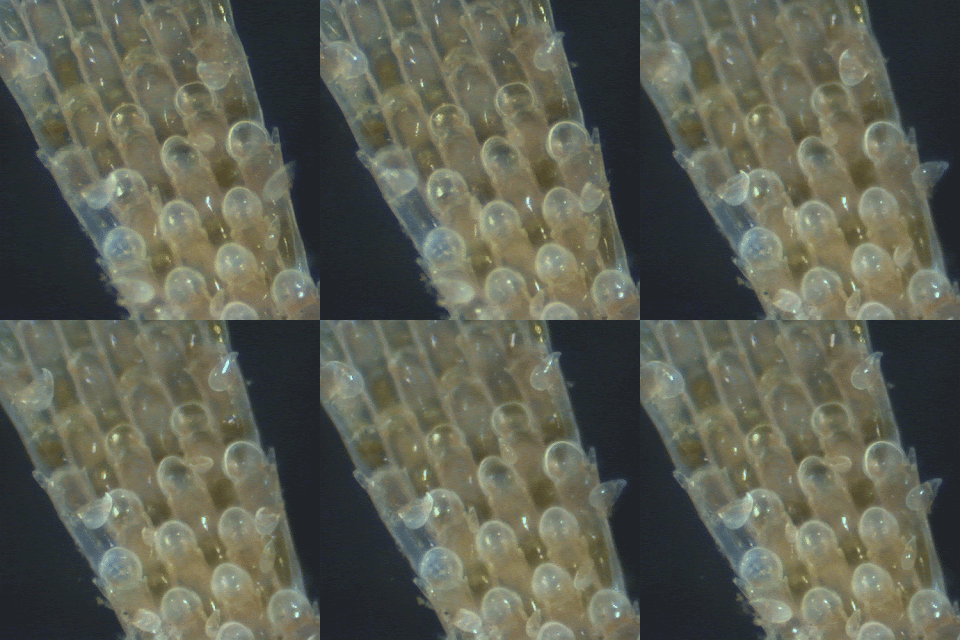
Avicularia pecking motion
Avicularia of Bugula californica in action! The pecking
movements of the avicularia are thought to deter predators.  
Even though this plant-like colony is stuck in one place, it can still defend itself from predators like nudibranchs and fish. The avicularia – derived from Latin for “little bird” because of their resemblance to bird heads – have been theorized to deter predatory grazing with their “pecking” movements. This “pecking” begins when tiny sensory hairs inside the beaks detect a disturbance. (See the avicularia of Bugula californica in action, right!) The function of these zooids has not been extensively studied, but you can certainly get an Alfred Hitchcock vibe just from looking at all those sharp beaks (that actually open and close). Let’s see the moss in your lawn do that!


Acid test

As climate change and ocean acidification threaten to impact the temperature and chemistry of our oceans, scientists wonder if the effects will be felt by animals like bryozoans. Researchers in New Zealand are testing whether bryozoans will have a harder time obtaining carbonate from the water around them to build their skeletons when ocean conditions become more acidic. Will these mossy creatures become some of the newest sentinels for environmental change?


By: Dany Burgess & Angela Eagleston, Environmental Assessment Program

Critter of the Month

Dany and Angela, hard at work. Our benthic taxonomists, Dany and Angela, are scientists who identify and count the benthic (sediment-dwelling) organisms in our samples as part of our Marine Sediment Monitoring Program. We are tracking the numbers and types of species we see in order to understand the health of Puget Sound and to detect any changes over time.
Dany and Angela share their discoveries by bringing us a Benthic Critter of the Month. These posts will give you a peek into the life of Puget Sound’s least-known inhabitants. We’ll share details on identification, habitat, life history, and the role each critter plays in the sediment community. Can't get enough benthos? See photos from our Eyes Under Puget Sound collection on Flickr.

Wednesday, March 27, 2019

Reclaimed water in Sammamish Valley to benefit community

A new reclaimed water permit reminds us to use the right water for the right use

All water on earth is recycled, thanks to nature. Several sewage treatment plants in Washington are using their own process, instead of nature’s, to produce high-quality reclaimed water suitable for local use. Although reclaimed water has been around in Washington for more than 20 years, Ecology issued the state’s first administrative rule last year – the Reclaimed Water Rule (WAC 173-219). All new and reissued permits now follow our new requirements.

Map showing brighwater facility location and purple pipes to Sammamish Valley areas where water is being used. Reclaimed — or recycled — water starts out as domestic wastewater, but is then highly-treated through systems designed to produce water that is safe for many beneficial uses. King County’s Brightwater treatment plant is designed to be the largest reclaimed water producer in the state. Brightwater will receive one of the first new permits issued under the new reclaimed water rule and will be effective on May 1, 2019. The permit renews authority we granted to King County in 2011 to produce, distribute, and use reclaimed water. It also adds requirements based on the new rule. King County supplies reclaimed water from the Brightwater treatment plant for landscape irrigation at the Brightwater Education Center, at a golf course, a soccer complex, and a tree farm in the Sammamish valley. Water is also supplied for toilet flushing at the Brightwater Education Center. 

The Brightwater facility serves 67 square miles, stretching from the north end of Lake Sammamish to the City of Mill Creek in Snohomish County. The facility treats sewage from about 205,000 residents as well as wastewater from local businesses and factories. This relatively new facility was built to help with the population growth in the area and to help prevent overflow into Lake Washington.
 

Many facilities are using reclaimed water to meet community water needs

In late December 2018, we reissued a permit under the new rule to the Holmes Harbor Sewer District. This small facility outside of Freeland on Whidbey Island exclusively produces reclaimed water to use for irrigation of the Holmes Harbor Golf Course. During the winter, when the golf course does not need the water, the facility stores the reclaimed water in large lagoons until the summer.   

We currently have 29 facilities across the state producing reclaimed water (see map below) for a variety of irrigation uses, groundwater recharge, and other environmental benefits such as wetland enhancement. Over the next year we will work on renewing the permits for more than half of those facilities. Also, several other communities across the state are looking at adding reclaimed water as one of their tools meet their long-term water needs.

Map of all reclaimed water facilities across the state as of 2018


Reclaimed Water Rule first anniversary

After an extensive public process that started in 2006, we finalized the Reclaimed Water Rule in early 2018. This collaborative effort with the State Department of Health (Health) relied on many important partners across the state, including existing reclaimed water producers, tribal representatives, water utility representatives, consultants from engineering and other technical areas, and interested residents. After finalizing the rule, we worked with many of the same partners to complete our guidance manual for reclaimed water facilities – a document we call the Purple Book

We work with Heath to protect public health and the environment as we implement the new rule. We work together in reviewing proposals for new reclaimed water projects and in the development of permits for new and existing facilities. Safeguards in the new rule and in the reclaimed water permits are designed to match the water quality requirements with the planned uses. This ensures that water used in public areas is safe for public contact, while allowing use of lower quality water in areas with restricted access. The safeguards also protect drinking water sources by preventing cross-connections for reclaimed water to mix with drinking water supplies.


How is reclaimed water treated so it is safe?

Modern sewage treatment plants do a good job at removing most of the stuff people flush down a toilet or send to a sewer system. They typically remove more than 85% of the solids and biodegradable pollutants that enter the facility and disinfect the water to kill most pathogens. While the treated wastewater is generally safe to discharge and meets appropriate water quality standards, it is not necessarily safe to reuse, especially in areas with direct public contact.

Reclaimed water facilities take the treated domestic wastewater and apply higher levels of treatment to remove more solids and destroy more pathogens. The highest class of reclaimed water – Class A – is processed through filtration systems to remove nearly all solids and disinfected to a level that removes 99.99% of the viruses that may be in treated domestic wastewater. The high level of treatment is enough to turn what was once a wastewater into something that is no longer a waste – it is now a valuable resource ready for a beneficial use.

Brightwater Treatment Plant uses a process called a
Membrane Bioreactor or MBR to produce
Class A reclaimed water.
Reclaimed water treatment processes may differ across the state but there are two common types of treatment – filtration through sand or filter fabrics and filtration using membranes. These systems are followed by disinfection using intense ultraviolet light or chlorine. King County’s Brightwater Treatment Plant uses a process called a Membrane Bioreactor or MBR to produce Class A reclaimed water. This process combines typical treatment processes for a modern sewage treatment plant with an ultrafine membrane to produce water that is free of most pollutants.

By using the right water for the right use, reclaimed water is one way that Washington can help preserve our water supplies. If you are interested in receiving updates on reclaimed water in Washington, sign up for our listserv.

Visit King County’s reclaimed water website for more information on their facilities. 

Monday, March 25, 2019

Women in Science: Brandee Era-Miller


The full interview with Brandee Era-Miller


What do you do at Ecology?

I am a natural resource scientist and have been with Ecology’s Environmental Assessment Program, Toxics Studies Unit for almost 19 years. I conduct toxics source assessments and characterization projects in waterbodies all over the state from the Puget Sound to the Spokane River and many places in between. These studies have included analysis of toxics in water, stormwater, fish, biofilm (slime on rocks), sediment, and atmospheric deposition. “Toxics” covers a wide range of chemicals, so I’ve studied many different chemicals like polychlorinated biphenyls (PCBs), pesticides, metals, flame retardants, and more. I’ve also worked on toxicity studies including a project where we placed trout eggs in hatch boxes instream and monitored the health of the trout as they grew into fry over the course of several weeks. How the trout responded and developed gave an indication of water quality at the site.


What gets you excited to go to work in the morning?

I am a jack of all trades. I have enjoyed working on so many different kinds of toxics studies. Spending time in different places all over the state has been amazing. Washington is incredibly beautiful! Many people both within and outside of Ecology use the data and information from our studies to guide their environmental decisions and to learn about the water quality in their watersheds. That makes my work feel important.

What advice do you have for women who want a career in science?

My advice for getting into a scientific field is to work hard in school and seek out internships, volunteer opportunities, and hands-on experience wherever you can. Besides at least a general degree in sciences, nothing beats hands-on experience when it comes to getting your foot in the door.

My interest in environmental sciences started as kid, where I would spend all my time outside climbing trees and exploring the woods and nearby creeks. My mom also passed on her passion for the natural world to me. On camping trips, she would always stop and explain all the plants and aquatic insects to me. In high school I became involved in a program called the Envirothon.  Through that excellent program, I went on to compete nationally in Niagara Falls, New York, in 1993. In college, I had internships with the Chehalis Tribe’s natural resources department and with the city of Lacey’s water resources department.


By Ruth Froese, Environmental Assessment Program

Wednesday, March 20, 2019

Cleaning up: It’s about turf in two Everett parks

We’re pulling up sod in two northeast Everett parks and will plant new turf when we’re done. The project started this month on three acres of Wiggums Hollow Park, and we’ll start tackling the slope below the Viola Oursler Overlook in April.

A grass field with a large area of turf removed, exposing bare soil.
A field in Wiggums Hollow Park awaits new topsoil 
and turf. The sod and a layer of soil have been 
removed, as part of the Everett Smelter cleanup.
Both parks lie within the Everett Smelter plume, a 1.1 square mile area where contaminated particles from smokestacks settled out of the air and onto the ground. The Everett Smelter operated near today’s intersection of North Broadway and East Marine View Drive from 1894-1912, but the contamination wasn't discovered until 1990. 

A string of park cleanups

Our park work this year will complete a trio of projects that began with the cleanup of American Legion Park in 2015 and 2016. We removed contaminated soils while protecting the park’s trees.

At Wiggums Hollow Park we’re clearing large areas of lawn, removing 6 to 18 inches of contaminated soil, putting in new topsoil, then rolling out new sod. The work area and a nearby basketball court are fenced off. After we’re done, fencing will remain around the new sod for two months to allow the new lawn’s roots to establish. The park should be fully open by early July.

Map of Everett Smelter Plume cleanup area, with three parks labeled: American Legion, Wiggums Hollow and Viola Oursler Overlook.
Soil and grass replacement at Wiggums
Hollow Park and Viola Oursler Overlook will
complete a series of cleanups at three parks
in the Everett Smelter plume area.
We’ll close the Viola Oursler Overlook, starting in late April, so that we can clear grass, shrubs and about a foot of contaminated soil from its slope. We’ll put in new topsoil and use hydro seeding to plant new grass. The overlook should re-open late in July, but the slope will remain fenced through the end of the summer.

A last bit of road work

Cleanup of most of the former smelter property itself took place in 2005-2007, and last year we removed contaminated soil from the rest of that area, now occupied by East Marine View Drive.

That project tied up traffic with lane closures, and we thank everyone affected for their patience and cooperation. Removing soil and rubble from demolished buildings – to a depth of about 18 feet – got rid of sources of lead and arsenic contamination in groundwater that flows to the Snohomish River.

We’re about to finish that work this week, on East Marine View Drive near SR 529 and Riverside Road, with the final paving and striping. Those had to wait until after freezing weather. We’ll have to slow, restrict and direct traffic, but there will be no closures! 

Yard cleanups continue

The park cleanups are like a large version of our ongoing cleanup of residential yards in the plume area. We’re offering soil sampling at any yard we haven’t previously sampled in the cleanup area.

We work with property owners on a voluntary basis. We start with soil testing and, when needed, we offer to remove contaminated dirt and bring in clean soil to restore the yard.

If you live within the cleanup site and your yard has not had its cleanup, please continue to follow healthy actions that include washing hands with soap, leaving shoes at the door, regular floor and carpet cleaning, and frequent washing of children’s toys and pacifiers.

By: Larry Altose, Communications Manager, Northwest Regional Office


Tuesday, March 19, 2019

Puget Sound Nutrient Watch: What we're learning from other states

Nutrient management from coast to coast

Across the country, many states are dealing with similar environmental issues. This month, thanks to funding from the EPA’s National Estuary Program Grant, we invited experts from Long Island Sound, Chesapeake Bay and the San Francisco Bay to speak to the Puget Sound Nutrient Forum and share their work on reducing nutrients in estuaries. Puget Sound is the country’s second largest estuary, an area where saltwater from the ocean meets freshwater from rivers. Our state shares similar challenges as other coastal estuary states.

Many coastal areas need to reduce the amount of nutrients coming into the waterway. Excess nutrients can come from humans and cause low dissolved oxygen conditions, a problem for aquatic species and food webs. Long Island Sound and Chesapeake Bay were experiencing extremely low levels of oxygen, called hypoxia, due to excess nutrients from humans. Through state-run clean-up plans, each state was able to reduce human nutrient sources and improve water quality.  

There’s nothing like a good success story to keep us inspired in our nutrient reduction strategies. Check out some highlights from their work:

Tricks of the trade from Long Island Sound

The Long Island Sound’s largest source of nutrients, according to Rowland Denny of the Connecticut Department of Energy and Environmental Protection, was discharges from wastewater treatment plants (WWTPs). Connecticut’s cleanup plan focused solely on reducing nutrients at WWTPs. 

Because treatment technologies can be costly and require long-term planning, Connecticut set out to create a cost-effective plan in the 1990’s to restore a healthy Long Island Sound.  
To start their cleanup plan, Connecticut first established a cleanup goal: reduce nutrients from WWTPs by 58.5%. Their plan has three main elements:
Changes in hypoxia in Long Island Sound from 1994-2018. 
Extreme hypoxia (red) is entirely gone and the Sound 
is much healthier.
  • Require equal nutrient reductions at WWTPs: This means all WWTPs in Connecticut were given the same minimum nutrient reduction requirement and were on the same compliance schedule. 
  • Give the WWTPs time to transition: Requirements ramped up in three stages: a first reduction goal by 2004, a second reduction by 2009, and finally the total 58.5% reduction by 2014. This gave WWTPs time to make strategic upgrades to their facilities 
  • Allow trading: If WWTPs reduce nutrients beyond the requirement, they can sell excess “credits” to WWTPs unable to meet their requirement that year. The state manages the trading program providing a financial incentive to reduce more nutrients than required. It also gives flexibility for WWTPs to buy credits when they have difficulty meeting their requirement. Total nutrients from all WWTPs that enter the Sound must meet the reduction requirement, ensuring the Sound is still healthy even if a few WWTPs don’t meet their exact targets.  

Result: Success! Long Island Sound was able to meet required reductions by the 2014 deadline. The plan was cost-effective and flexible for WWTP treatment upgrades, and 61 facilities upgraded their treatment technologies.

For more info, visit the Long Island Sound Nitrogen Trading Program webpage.

Chesapeake Bay: the grass is greener

Allan Brockenbrough, Virginia Department of Environmental 
Quality, speaking at the Puget Sound Nutrient Forum.
To clean up the Chesapeake Bay, Allan Brockenbrough from Virginia Department of Environmental Quality, explained the need to reduce nutrients from all human sources to meet their bay cleanup goals. Allan described Virginia’s nutrient management plan as “everyone doing everything, everywhere.” The most significant source of nutrients to the Bay was WWTPs, but other human sources were also quite high, including agriculture, runoff from urban areas, forestry, and septic systems. 

Similar to the Long Island Sound cleanup, Chesapeake Bay used a nitrogen reduction requirement for WWTPs and allowed trading. They also created technology requirements so that any new facilities or planned upgrades must meet minimum reductions set by the cleanup plan. 

Virginia included reduction for non-point sources, or sources that don’t directly discharge into the Bay. This includes fertilizer run-off from agriculture, stormwater pollution, and failing septic systems. Virginia allowed non-point sources that met nutrient reduction goals to trade with WWTPs. They also did outreach to involve all residents in cleaning up the Bay.

Recovered eelgrass provides habitat for the famous 
Chesapeake Bay Blue Crab.
Result: Success! Chesapeake Bay is on its way to meeting the nutrient reduction goal and you can literally see the improvements. Eelgrass and other aquatic vegetation is recovering and providing habitat for fish and aquatic species. Eelgrass also protects shorelines by lessening wave impact and keeping water clear by rooting down seafloor sediment. 

For more info, visit the Chesapeake Bay water cleanup plan webpage.

San Francisco Bay: Same, same, but different

San Francisco Bay, seen here, is also concerned about 
a growing human population.
Our West Coast estuary neighbor, San Francisco Bay, is planning for future population growth and climate change impacts on their waterways. Nutrient issues have been kept at bay here, due to the strong tides. But, there are concerns about the effects of algal blooms from excess nutrients. 

David Senn, from the San Francisco Estuary Institute, explained that just because excess nutrients aren’t obvious now, it doesn’t mean it won’t be an issue as the human population grows in the surrounding area. That’s why San Francisco wastewater treatment plants and other stakeholders are investing in monitoring and science. 

Puget Sound is also a quickly growing region and is not immune to the impacts of climate change. That’s why we use our sharpest tool in the (water)shed, the Salish Sea Model, to help us understand the impacts of future growth and climate change on the health of Puget Sound. You can explore our recent modeling results evaluating nutrient reductions in Puget Sound on our Salish Sea Model webmap

Sharing is Caring

We plan to stay connected with other nutrient management plans around the U.S., because we all benefit from each other’s successes and lessons learned. Managing excess nutrients is a global issue, especially in coastal estuaries near growing populations. 

If you’re interested in what’s being done to reduce nutrients in Puget Sound, please visit our project page for resources and to sign up for email updates. All Forum meetings are open to the public. 

Funding for guest speakers’ travel to the Puget Sound Forum was provided by the EPA’s National Estuary Program. 

By: Kelly Ferron, Water Quality Program

Friday, March 15, 2019

Money available for residents to take part in Ecology projects

Groups and individuals in highly impacted or low-income areas encouraged to apply 

Whether we’re leading the cleanup of an industrial property or implementing a project that will reduce the use of single-use plastics, acting locally and engaging your government in public processes during ongoing projects such as these is one of the most important things you can do to effect change. For Washington residents who live or work in low-income communities, or those highly impacted by contaminated sites, the importance of participation only rises because public participation in the work we do at the Washington Department of Ecology is vital for success.

Public Participation Grants are available to help individuals and groups participate in Ecology projects across the state. Groups and individuals in highly impacted and low-income communities are encouraged to apply. The PPG awarded to
Columbia Springs supported a waste reduction project repairing household items rather than throwing them away.

Ecology is currently accepting applications for Public Participation Grants (PPG). The PPG program is a competitive grant program. Grants are available to individuals affected by a contaminated site, or to non-profit public service organizations. The purpose of the grants is to facilitate public participation in:

           •The cleanup of hazardous substance release sites, or
           •The implementation of the state’s solid and hazardous waste priorities.

Applications are available through Ecology’s Administration of Grants and Loans (EAGL) online grant management system.  You will need to set up a Secure Access Washington (SAW) account before you can access EAGL.

The application will be open until 5 p.m. April 4, 2019. Late applications will not be accepted. Ecology will evaluate and score each eligible application received. Grant funds are available for projects conducted July 1, 2019 through June 30, 2021.

Application instructions can be found in Appendix B of the program guidelines. Summaries of the guidelines are available in Spanish, Korean, Vietnamese, and Chinese.

For more information, please contact Lynn Gooding at (360) 407-6062.

What’s in a name: Defining the problem with nuclear waste


Two developments in recent weeks herald potential major changes in the long-term federal effort to clean up the highly contaminated Hanford nuclear reservation in southeast Washington. The result, if we’re not vigilant, could be significant degradation in the quality and long-term effectiveness of that cleanup.
  • A new report greatly increased both the estimated cost and the time it will take to finish the Hanford cleanup.
  • The U.S. Department of Energy wants to redefine what constitutes high-level nuclear waste.

Multiple images pieced together showing panoramic view of Hanford waste tank interior.
A panoramic view, assembled from multiple photos, inside Hanford tank AX-104.
What’s at stake? Whether millions of gallons of toxic, radioactive waste are effectively removed from the environment, or whether that waste will be left to eventually make its way into the groundwater and from there into the Columbia River.

Even before the cost and timeline report came out at the end of January, pressure was building for the federal government to reduce Hanford clean-up costs. This proposal would accomplish that by backing off the federal government’s decades-old legal and moral commitment to a clean-up that truly protects public health and the environment from waste that makes the site one of the most contaminated places on Earth.

Origin vs. characteristics

One of the chief arguments in favor of the federal Energy department’s move to redefine high-level nuclear waste is that the definition is based on where the waste originated, rather than on its level of radioactivity. It only makes sense, the argument goes, to define waste based on its physical characteristics rather than where it came from.

If that were to happen, proponents say, only about 10 percent of Hanford’s tank waste would qualify as high-level. The rest could be treated much more quickly and cheaply as low-level.

While that has a certain logical appeal, it misses the point. Here’s why: Regulators and the federal Energy department agreed years ago to treat 90 percent of Hanford’s tank waste as if it were low-level, provided that the waste is vitrified (incorporated into glass). That is the status quo.

The crux: how to treat the waste

So what’s the question? The real issue here is how that low-activity waste will be treated and disposed of.

Currently, Energy has agreed to incorporate much of the waste into glass, encase it in steel canisters and place it in engineered landfills on the Hanford site. Glass should hold the waste stable and keep it from re-entering the environment. Especially, it should keep it out of the water table and the Columbia.

If Energy is allowed to redefine waste, it could unilaterally – without oversight from the Nuclear Regulatory Commission, the Environmental Protection Agency or our own Department of Ecology – determine how to treat and dispose of the 90 percent it would likely declare to be low-level.

Since it already plans, with our concurrence, to treat 90 percent as if it were low-level, we conclude that there’s really only one reason to proceed with a new definition. And that is to back away from its commitments to retrieve as much waste as possible from Hanford’s 177 underground tanks and incorporate much of it in glass. 

Leave it in the tanks?

Instead, Energy could propose to leave millions of gallons of waste in the tanks and simply dump concrete on top of it. Or it could propose to retrieve the waste and essentially do the same thing – incorporate it into concrete and dispose of it at Hanford or elsewhere.

The problem: concrete is porous and relatively short-lived. It might keep the waste out of the water table for a few years, or even a few decades, but eventually waste mixed with concrete will seep out, back into the environment. Our environment.

As for cost and timeline, we agree that the new projections are troubling. The federal government already has spent billions designing and building plants intended to glassify Hanford’s tank waste. The low-activity waste plant is on schedule to begin operation in just a few years. 

A promise made

However, the total cost of Hanford cleanup – even at the new projected levels – is a small fraction of the total the nation has spent on nuclear defense. We in Washington State and our neighbors along the Columbia River in Oregon have done our part. We expect the federal government to stick to its promises to properly, effectively clean up the mess it made.

Furthermore – the costs and timelines are based on current levels of funding. We’ve been pointing out for years that if spending was increased now to the levels required to meet current commitments, the longterm total cost and the time to complete the cleanup both would be significantly reduced.

For these reasons, we remain opposed to the federal Energy department’s proposal to give itself unilateral authority to redefine high-level nuclear waste.


1940s-era nuclear reactor with smokestack, surrounded by shrubbs and hills.
Hanford's B Reactor - the world's first nuclear reactor.

Hanford: The cradle of nuclear waste 

Nuclear waste, like all things nuclear, began at Hanford. 

Hanford’s B Reactor was the world’s first large-scale nuclear reactor. And as soon as it began operation, it began to create radioactive waste. In a commercial reactor, once the uranium fuel rods no longer yield enough heat to generate power, they are removed and that’s essentially the end of the process. But in the production of weapons-grade plutonium, those rods are treated with toxic chemicals to separate the small quantities of plutonium created by the reaction.

The plutonium was collected, refined and made into nuclear weapons. The radioactive, toxic stew that created in the process was stored in Hanford’s underground tanks.

Although the definition of high-level nuclear waste evolved in the early days, it has for decades been defined as the spent fuel rods and associated materials created in nuclear reactors. Energy’s current proposal would base the definition on the level of radioactivity – and would give Energy sole authority to make that determination.

Earthen berm covering Hanford PUREX Tunnel 1 showing hole where part of roof collapsed.
PUREX Tunnel 1 showing the hole where part of its roof collapsed in 2017.

What about PUREX?

In 2017 and again in 2018, we approved Energy projects to stabilize the two PUREX tunnels with concrete.

So if concrete was good enough for PUREX, why not for tank waste?

The answer: Because these are two very different applications. While the material in the two PUREX tunnels is highly radioactive, it is almost all equipment. There is little, if any, liquid. Also, a portion of PUREX Tunnel 1’s roof collapsed and the consensus was that Tunnel 2 was vulnerable to collapse.

Concrete fills the tunnels so they can’t collapse, and stabilizes the contents.

Waste in the tanks, on the other hand, contains a high percentage of liquid. If a tank is filled with concrete, the liquid will eventually seep out of the concrete, out of the corroding tank and into the ground.

- Randy Bradbury, communications manager, Nuclear Waste Program

Thursday, March 14, 2019

Cleaning up: Investing in communities to turn blighted properties into affordable housing

The City of Yakima will use a $200,000 Ecology Integrated Planning Grant
to investigate contamination on a property that will be home to
affordable housing once the site is cleaned up.
Washington’s environmental cleanup law, known as the “Model Toxics Control Act,” turns 30 this month. Our cleanup law has served as a road map to cleaning up industrial sites and other properties contaminated by toxic chemicals.

Removing these threats helps protect human health and the environment, and opens the door to put properties back into use. Ecology is now working to make it easier for affordable housing developers to redevelop once-contaminated properties into housing that communities can afford

Rapid development and the housing crisis

Many areas of Washington state are experiencing a housing crisis. Our state’s economic boom and population growth bring many benefits, but they are also driving up rents, home prices, and property taxes with devastating effects on some of our communities’ most vulnerable residents.

As Washington’s cities continue to rapidly grow, easily developable land for residences and commercial centers is becoming harder to find. More valuable real estate means cleaning up and redeveloping contaminated properties is more attractive to developers – which is good news for the environment. But the costs of cleanup often end up being passed through in the price of redevelopment, including housing. We’re trying to take the some of the cost of cleanup out of the equation, easing the way for the building of affordable housing. 

Ecology’s Integrated Planning Grants

If you live in Washington, Ecology works for you. That’s why nearly 70 cents of every dollar that comes to Ecology is passed through to local communities. In 2018, the Legislature provided us with $1 million for Integrated Planning Grants to be used for affordable housing projects. These are flexible grants that local governments can use to support pre-construction cleanup activities, including planning, investigation of levels and types of contamination, community involvement, education, and outreach.

We used these funds to award nearly $200,000 each to six new or potential cleanup projects aimed at expanding affordable housing.

Bellingham

This project, headed by the City of Bellingham and Port of Bellingham, includes cleanup and redevelopment of approximately three acres at the corner of Cornwall Avenue and Laurel Street near downtown Bellingham. Located within walking distance of downtown, Western Washington University, and public transportation, the redevelopment will include up to 50 affordable housing units, work-live spaces, ground-floor commercial spaces, a community kitchen, and public open space. The next steps include coordination with private developers, the Bellingham Housing Authority, other nonprofits, and conducting public outreach and involvement. 

Bremerton

The Bremerton Housing Authority will use these funds to complete the design of the cleanup plan at a vacant and underutilized industrial site along Oyster Bay Avenue. Once cleanup is complete, the housing authority will construct up to 50 units of affordable housing in a multi-story building. Funds will also be used to evaluate planning needs such as parking, utilities, and the potential need to update or rezone the property based on the city’s current comprehensive plan. The Housing Authority will conduct a series of public meetings on land use changes and housing needs. 

Kennewick

The City of Kennewick proposes to redevelop an approximately 10-acre former maintenance yard into the Kennewick Housing Authority Multi-Family Housing Complex with 110 units. The site consists of six buildings, only one of which is currently in use. 

Seattle

The Seattle Chinatown International District Preservation and Development Authority will use its grant funding to examine the cleanup needs and development potential for a currently underutilized eight-acre property in the district. Past environmental assessment work at the site has left concerns that the property could still be contaminated with hazardous substances. More investigation is needed to understand the nature and extent of contamination on the site, and to identify the potential for integrating any required cleanup with the redevelopment of the area into affordable housing units and commercial spaces for this urban community. 

Wenatchee

The City of Wenatchee plans to evaluate a former tree fruit research facility for potential purchase and redevelopment into a community asset that will support affordable housing. The Washington State University Tree Fruit Research and Extension Center property is located at 1100 N. Western Avenue at the corner of N. Western Avenue and Springwater Avenue. The property contains suspected contamination related to historic tree fruit research operations that included storage of pesticides and other agriculture-related chemicals and fuel products. The city is interested in facilitating the development of affordable housing and promoting new economic development. 

Yakima

Yakima has a significant need for affordable housing and facilities to accommodate homeless individuals. The City of Yakima will be using its funding to investigate contamination of a city-owned area that was used for fruit and vegetable processing. Once cleaned up, the site will be used to provide transitional housing units and a shelter. The city hopes to build 30 affordable housing units and a 100-bed shelter.

To learn about other projects already funded by Ecology, check out our interactive grants map.

Keep an eye on our blog for more stories on how we use Washington’s cleanup law to protect the environment, invest in communities, stimulate economic development, and build relationships.


By Cheryl Ann Bishop, Toxics Cleanup Program

Wednesday, March 13, 2019

Water supply issues could be a reality for North-Central Washington

Map of Washington state. Methow and Okanogan show as 78% chance of reaching drought conditions.

It seems unbelievable that with the exceptional cold and snow in February that state officials could actually be talking about communities facing water supply hardships. Yet, it’s true.

Maia Bellon, director of Ecology, today met with the Executive Water Emergency Committee to discuss water supply conditions in Washington. The committee is comprised of state leaders and experts in an array of areas tied to water supply.

The Methow and Okanogan basins in North-Central Washington near the Canada border, are projected to experience some water supply shortages based on current snowpack levels, soil conditions, and climate predictions.

The committee will confer in the coming weeks to determine if any action is needed to help address hardships that could be felt by communities, farms or fisheries resources. State and federal experts will continue collecting data and updating the water supply forecasts and potential hardships

Below are highlights from the most recent water supply update made by Ecology and partner experts.


Snowpack conditions
At 87 percent of normal, statewide snowpack currently ranks 11th lowest out of the past 30 years. Compared to this time over the previous five years, snowpack is lower than in 2018, 2017, and 2016, but significantly higher than 2015, which was a record snow-drought.

It is unlikely that snowpack, averaged statewide, will reach normal by early April, which is when snowpack generally peaks. It would require many feet of snow across the state. However, spring precipitation can continue to add water to existing snowpack.

Snowpack is deficient in the headwaters of the Methow and Okanogan watersheds, east of the North Cascades. River forecasts there indicate a high likelihood of below normal summer water conditions and the U.S. Drought Monitor has designated portions of Okanogan and Ferry County as being in Moderate Drought due to an extended precipitation deficit. Water supply forecasts for the Okanogan and Methow Rivers indicate a high probability that this year’s April – September runoff will be among the lowest recorded over the past 70 years.


The Walla Walla/Lower Snake regions in Southeast Washington are the only regions of the state with above normal snowpack. They benefited from the major storms that brought copious amounts of snow to California and Oregon. Lower Yakima is shy of normal, at 95 percent. The remainder of the state is below normal, generally in the 85 – 95 percent range. The Central Puget Sound is the biggest laggard, at 74 percent of normal. This area supplies Green-Duwamish, Lake-Washington/Cedar, Snoqualmie, and Skykomish basins.
  

Temperature

February was Washington's 5th coldest since 1895. Temperatures in Eastern Washington averaged between 10 and 15 degrees below normal, an anomaly described as “staggering” by the Office of Washington State Climatologist. Since the beginning of March, the anomalies have been even larger, with some locations recording average temperatures up to 20 degrees more below normal. Western Washington has been much colder than normal as well. Since the beginning of the month, temperatures have averaged 5 – 8 degrees below normal at lower elevations and 10 degrees below normal on the Western flank of the cascades. 
NOAA climate mao that show parts of Washington with a 50% chance of warmer conditions than usual over the the next three months.

Rivers and streams

Cold temperatures means snowpack is holding strong and not melting. Numerous rivers on the west side of the state are flowing at record low or near record low levels for this time of year. Seven-day average streamflow is below normal at 84 percent of the river stations managed by the United States Geologic Surveys.

Future forecasting

Our water supply expert Jeff Marti regularly updates Ecology’s water supply forecast. You can see the full recap of current conditions and forecasting on our website.  

By Camille St. Onge, communications

Washington litter czars welcome viral #Trashtag Challenge – but advise safety first

Teens encouraged to join Ecology Youth Corps to clean up roadways

Do you remember the Harlem Shake? What about planking? Most social media phenomena are little more than silly time wasters, but a new viral challenge aims to leave the world a little cleaner than we found it: Thousands of people around the world are joining the #Trashtag Challenge on social media by posting photos of themselves ridding their roadsides, beaches, and parks of garbage.

Ecology Youth Crews is 2018 cleared more than 1 million
pounds of litter from Washington roadways. Here a crew
from the Puyallup area poses with a one-day haul of
picked litter last year.
The Washington Department of Ecology, which oversees litter prevention and pickup programs in our state, commends the efforts of #Trashtag volunteers. But everyone cleaning up litter should put safety first, particularly when working near traffic or dealing with potentially dangerous trash like needles, biomedical waste and weapons.

“Litterers annually dump more than 12 million pounds of junk in our beautiful state,” said Peter Christiansen, manager for Ecology’s roadside litter crews. “We’ll take all the help we can get picking up that trash – but make sure you take a few commonsense precautions. And consider helping out your community by picking up garbage at a park or a school.”

Christiansen advises Trashtaggers to stick to safe places like parks and beaches, and to wear high-visibility clothing and puncture-resistant boots and gloves, and stay away from roadways. If Trashtaggers choose to pick up litter from a roadway make sure it is legal, always face traffic, and be sure to have an escape route from out-of-control vehicles.

Social media fads fade over time, but litter never ends. If cleaning up your community means more to you than just a selfie for a few likes, sign up with the Washington Department of Transportation’s Adopt-a-Highway program by contacting a local coordinator.

And if you know a teenager inspired to clean up, let them know they can do more than volunteer. The Department of Ecology plans to hire 300 teenagers throughout Washington this summer as part of the Ecology Youth Corps. Teens chosen for the Ecology Youth Corps will earn $12 per hour and work up to 32 hours per week.

In 2018, Ecology Youth Corps crews picked up over 1 million pounds of litter and cleaned about 4,500 miles of roads statewide. Since 1975, the program has hired more than 12,000 Washington teens, offering them work experience, a summer job, and the chance to preserve Washington’s natural beauty and protect our state’s environment.

Applicants must be ages 14-17 as of July 1. The first deadline for applications in the Central and Eastern regions is April 1. Deadlines for applications in our Southwest and Northwest regions are April 12 and April 16, respectively.  Applications are available through area school counselors and at www.ecology.wa.gov/EYC.

Contact one of our EYC coordinators for more information:

Central Region
Ellensburg, Goldendale, Richland, Sunnyside, Toppenish, and Union Gap.

Rod Hankinson
rodney.hankinson@ecy.wa.gov
509-454-7209

Monica Martinez
monica.martinez@ecy.wa.gov
509-454-7873

Eastern Region
Chewelah, Colville, Moses Lake, Othello, Pasco, Spokane, Deer Park, Pasco

Laurie Dahmen
laurie.dahmen@ecy.wa.gov
509-329-3506

Lynette Kuehl
lynette.kuehl@ecy.wa.gov
509-329-3434

Northwest Region
South King County, North King County, South/Central Snohomish County, North Snohomish/Skagit Counties, Kitsap County, and Whatcom County.

Steven Williams
steven.williams@ecy.wa.gov
425-649-7048

Sarah Elledge
sarah.elledge@ecy.wa.gov
425-649-7029

Southwest Region
Aberdeen/Montesano, Chehalis, Olympia, Puyallup, Tacoma, and Vancouver

Lexi Ehresmann
lexi.ehresmann@ecy.wa.gov
360-407-6391

Ariona
Southwest Region Litter Administrator
ariona@ecy.wa.gov
360-407-6351

Monday, March 11, 2019

Cleaning up: Washington’s environmental cleanup law turns 30


We're celebrating 30 years of cleaning up Washington under our environmental cleanup law – the Model Toxics Control Act. This innovative law powers our work to investigate, clean up, and prevent hazardous waste. Thanks to our cleanup law, more than 7,000 sites in Washington are cleaned up.

Cleanups protect people’s health by removing toxic chemicals from the environment, like arsenic from playground soil or methane gas from a solid waste landfill. Cleanups also preserve wildlife habitat for future generations, spur new economic developments, put abandoned properties back into use, and transform communities.

Our cleanup law evolved from citizens’ Initiative 97 in 1988 and became law in 1989. Its key principles are:
  • The polluter pays.
  • Cleanups should be as permanent as possible.
  • Public participation is crucial.
  • Processes should demonstrate a bias toward action, permanence, and innovation.
While thousands of sites are already cleaned up, there are more than 6,000 known or suspected contaminated sites in Washington that still need to be addressed — and the list keeps growing. We discover about 200-300 new sites a year (find out if there are sites in your neighborhood).

Over the next several months, we’re going to be talking more about our cleanup law and what it means in our state. To get us started, here are a few examples of how cleanups can transform communities and protect the environment.


Protecting the environment

Port Gamble Bay, on scenic Hood Canal, is a vibrant place for tribal and community members and tourists who come to see the picturesque historic mill town. The Port Gamble cleanup is a great example of how cleanups can stimulate habitat restoration and preservation efforts.

This cleanup was one of the largest creosote-treated piling removal projects in Puget Sound. Creosote leaches from treated pilings and structures to surrounding sediment and water. Shellfish – such as mussels and clams that are consumed by fish and humans – accumulate this leached contamination. Removal of pilings and contaminated sediment improves conditions for wildlife.

Thanks to funding from the Washington State Legislature, Ecology was able to purchase land for conservation and recreation, and complete restoration and pollution control projects in the bay. We also studied contamination in fish and shellfish. The projects completed with this funding have improved and protected habitat in and around the bay, created jobs in the area, and improved recreational opportunities.

Investing in communities

Ecology works for you. That’s why about 70 cents of every dollar that comes to Ecology is passed through to local communities. Several years ago we took an in-depth look at the return on investment for cleanups that received state funding.

Environmental cleanups along Tacoma's Thea Foss Waterway
helped turn blighted properties into viable investments. 
A powerful impact of environmental cleanups is economic development – cleanups create strategic opportunities to turn blighted properties into economically-viable developments that can significantly increase local and state tax revenues. For example, successful cleanups helped property values on Tacoma’s Thea Foss Waterway to increase from $11 per square foot to $39 per square feet over a ten-year period.

But the benefits of investing in communities aren’t just economic. These investments improve our quality of life, protect human health and the environment, and allow for redevelopment opportunities that transform communities. 

Supporting community vision

The City of Wenatchee had a vision for a revived Columbia River waterfront. Thanks in part to a $150,000 integrated planning grant from Ecology, the city was able to develop a plan for reuse of an old landfill along the river. Doing so helped the city move ahead with its broader waterfront redevelopment in keeping with the community’s vision, including the vibrant Pybus Public Market. Once home to a metal fabrication business, this property is now a town hub for shopping, great food, and music. The market’s development is included in this video about what’s happening along Wenatchee’s waterfront.

To learn about projects already funded by Ecology, check out our interactive grants map.

Keep an eye on our blog and social media for more stories on how we use Washington’s cleanup law to protect the environment, invest in communities, and stimulate economic development.