Department of Ecology’s Dam Safety Office regulates 1,055 dams in Washington. Many of those are doing just fine, but 409 pose a potential risk to people living and working below.
Outlet pipe broken and submerged at Newcastle Railroad Embankment Dam
Unfortunately, there’s no reality tv show that renovates dams, and most owners are left to cover repair costs themselves. So, we were excited to hear this week that Ecology has received $153,007 in grant funding to assist two dam owners in repairing their dams.
The funds are part of a new grant program administered by the Federal Emergency Management Agency (FEMA). FEMA had $10 million to provide assistance for planning and other pre-construction activities such as data collection, design and permitting. We applied for funds to assist three dam owners, and two of these were accepted. The funds will be split evenly between the city of Aberdeen to work on slope stability issues at their Fairview Reservoir #1 and the city of Newcastle to stabilize and remove the Newcastle Railroad Embankment Dam. For the next year, both owners will use dam engineer consultants to collect and analyze data and develop solutions and designs.
“Through our inspection program, we identified both of these projects as being in poor condition and needing engineer assessments and repairs,” said Joe Witczak, Ecology’s Dam Safety Office manager. “This is the first year this grant funding was available and we intend to apply again next year in support of other high hazard dams in need of repair.”
Ecology dam safety inspectors at Fairview Reservoir #1
In addition to the funds that Ecology was awarded, the dam owners must provide a 35 percent match. In Washington, a dam owner (such as private, local government or public utilities) is legally responsible to safely maintain, repair and operate their dam. The Dam Safety Office helps to ensure dams are properly designed and constructed. We also inspect existing dams for proper operation and maintenance. There are an additional 134 dams in the state that are owned and/or regulated by federal agencies.
By Keeley Belva, Water Resources Program communications manager
by Lynne Geller, communications
and outreach, Water Resources Program
For dams in forested
watersheds, fires, floods and failures can happen, and happen quickly. Ecology’s
Dam Safety Office (DSO) is getting the word out about the potential impacts of
wildfires on dams, especially if heavy rains follow. As a dam owner, you are
responsible for the proper care and management of your dam. We all have a stake
in dams functioning properly and safely. And wildfires in our state are on the
rise.
Wildfires can damage the
surface of a dam or spillway. Associated facilities, especially wood structures
or plastic pipes, are vulnerable. Fire changes the water conditions of a
watershed, such as how fast water can move, and how vulnerable the land is to
erosion.
Heavy rains in a burned
area can create an additional set of problems. These include more and faster
runoff; large amounts of sediment which reduce storage capacity; and mudslides
that can block spillways and access to the dam.
If there is a wildfire at
or near your dam, or within the watershed where your dam is located, you must
promptly evaluate the situation. Determine what, if anything, is needed to keep
the dam and surrounding area safe, and take necessary action. This is your
responsibility as a dam owner.
Pay close attention to
rain predictions and events
It is important for dam
owners to remember that water moves differently through a burned watershed than
it does through an undamaged one. Rainfall events that previously would have
been considered rather minor can now be very damaging.
If rain is forecast,
especially heavy rain or flash flooding, you must closely monitor actual rainfall
near your dam or in your watershed.
If rain actually occurs,
especially heavy rain or thunderstorms, you must closely monitor actual runoff
and spillway performance. Be prepared to implement your emergency action plan
in case spillway capacity is exceeded.
Be prepared: the
importance of planning
Although only owners of
dams classified as significant hazard and high hazard are legally required to have Emergency Action Plans (EAPs) in place,
all dam owners should have plans for emergency situations. Being aware of the
potential impacts of wildfires is an important part of that planning.
Our DSO strongly
recommends that you have a watershed assessment by a qualified consultant,
especially if there is a risk of harm to people and property downstream. The
Dam Safety Office just released burned
watershed guidance for use by qualified engineers or engineering
hydrologists to assess dam safety in the event a forest fire occurs at or near
the site of a specific dam.
The problem isn’t going
away
Wildfires in our state are
on the rise. In 2014, wildfires burned six times as many acres as usual:
363,000 acres. Already this year, three have been more than 750 unintended
fires that have burned 74,000 acres. Compare this to the average amount of
acres burned in each of the past five years: 61,000. Rising temperatures, more
and longer lasting heat waves, and drier summers are expected to contribute to
larger, more severe and more frequent wildfires in the future.
For more information, see Ecology’s
webpage on dams and fires. This page includes links to other resources.
By Chase Gallagher, Southwest Region Communications Manager
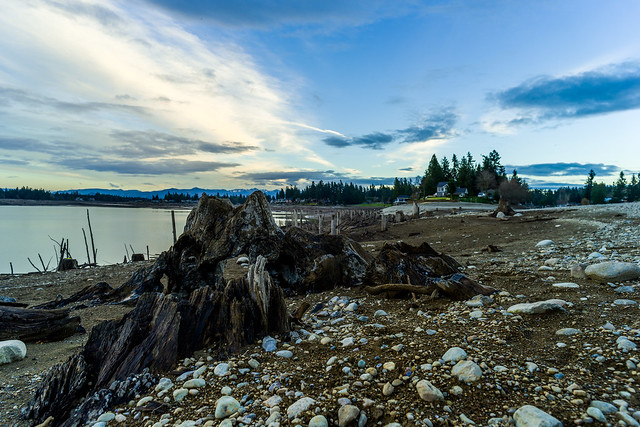
Last winter, Lake Tapps in Pierce County was drained for maintenance crews to conduct extensive work on the Lake Tapps reservoir dikes and to replace the wooden flume. This meant taking the lake down to near historic low levels, leaving what looked like a galactic landscape with stumps sticking out of the ground and normally floating docks stuck on shore.
Normally, the snowpack melts, keeping the rivers going strong throughout spring and summer. The White River would flow and Cascade Water Alliance, the owners of the Lake Tapps reservoir, could divert their allotted water and the lake would begin to refill as it normally does each spring. But this year, with our lack of snowpack, instead of melting snow we have our first statewide drought since 2005.
It was a bit of a perfect storm – normal maintenance meeting abnormal snowpack – that left Lake Tapps drained for the last few months. With decreased flow, the threshold for Cascade Water Alliance to be able to divert water into Lake Tapps couldn’t be met.
But as it turns out, there’s another perfect storm that’s leading toward the lake being filled.
Fish Apron under repairs in the White River
The Army Corps of Engineers needed to perform repairs on a fish apron a few weeks ago, which required holding more water up at Mud Mountain Dam. When that reserved water gets released, it temporarily increases the flow of the river. Think of holding a vessel under a running faucet, which reduces the water into the drain, and then pouring the vessel along the normal flow:
That extra flow was enough to meet the threshold, and Cascade Water Alliance could test their new concrete flume, and in turn begin filling the lake. We went to Buckley last week to see the diversion in action:
That little uptick on the right side of the chart shows water returning to Lake Tapps.
The circumstances for the extended drawdown of Lake Tapps are unlikely to happen again, and the same goes for the recent news in being able to begin the refill. But within these perfect storms, the story of Lake Tapps is one of cooperation.
The partnerships between Ecology, Cascade Water Alliance, the Muckleshoot and Puyallup Tribes and the Army Corps of Engineers all led to working together - finding a solution to keep the river flowing, ensure fish passage, and get Lake Tapps back to its picturesque self.
Lake Osoyoos (Okanogan County) is beginning to rise as snow melt
feeds the lakes and streams in British Columbia, and dam operators in the
Province let more water out of Lake Okanagan. Operators at the Zosel Dam in
Oroville have been filling Lake Osoyoos from its winter level of 909.5 feet to its
usual summer operating level of 911.5.
However, this year Ecology has elected to operate the Lake at
closer to 912 feet. Ecology maintains the Lake level in part for water uses
below the Canadian border, down the Okanogan River. One of these uses could
also include fish passage later in the summer. In this very unusual water year, with potential for a long, dry
summer, storing a bit more water in the freshet is a prudent thing to do. Osoyoos Lake is regulated at Zosel Dam at Oroville by Ecology. The
lake serves as a source of water for irrigation and summer recreation in both
the U.S. and Canada. Planning for an unusual summer Usual spring operations at the dam call for slowly raising the
level of the lake from winter operating levels to summer levels between March 1
and June 1 of the year. But 2015 has not played out as a “usual” year. Snow water
has been absent this year in most of the Columbia Basin and across the Cascade
corridor as well. As a result, many river basins are likely to see drought
during the summer. Lake Osoyoos is fed from Okanagan Lake and is governed under
Orders created and overseen by the International Joint Commission (IJC). Lake
levels are an integral part of those Orders. Ecology is required to operate the
Lake between 911 and 912 feet between June and mid-September. In most years it
is convenient for Ecology to maintain approximately 911.5 feet. For more information on the operation of Zosel Dam or LakeOsoyoos, contact Al Josephy at Ecology at 360-407-6456. Additional information
on the International Osoyoos Lake Board of Control and the new Order of
Approval can be found at http://ijc.org/boards/iolbc/. To track the progress of lake levels in “real-time,” as well as
find additional information, go to the U.S. Geological
Survey web page for Osoyoos Lake.
By Dan Partridge, communications manager, Water Resources Program
Record numbers of sockeye salmon are swimming up the Columbia River and the Department of Ecology is working with its partners at Zosel Dam near the Canadian border to help as many of them as possible reach their destination.
A sockeye salmon leaps up the fish gate at Zosel
Dam, one of hundreds moving through the dam last week.
Photo Richard McGuire, Osoyoos Times
The salmon have been migrating upriver annually for a millennium from where the Columbia River empties into the Pacific Ocrean at Astoria, Ore., to the Okanogan River on the Canadian border. This year conditions are such that Washington state is seeing the largest run of sockeye since 1938.
It's a tough run upstream
More than 500,000 fish have passed the Bonneville Dam east of Portland in Oregon but ultimately scores of them won’t make it to their final destination in Canada because of predators, fishermen and dams.
The Zosel Dam at Oroville, owned and operated by Washington state through the Department of Ecology is one of the final hurdles for the fish. The dam, constructed in 1987, has as its primary purpose the maintenance of water levels in Lake Osoyoos. Ecology contracts with the Oroville Tonasket Irrigation District to operate the dam. The lake provides water for irrigation and recreation, as well as the growing fishery in the upper Okanogan Basin.
Flexible rules help the run
Operation of the dam, which does not produce electricity, is governed by orders developed under the Boundary Waters Treaty of 1909 between the U.S. and Canada. For over 100 years this treaty has governed the management of water bodies that cross the border of our two countries. While these orders are confined largely to water quantity issues, they leave Ecology with enough flexibility to meet many demands not covered under the orders.
One of these demands for Ecology and our local, tribal, state and provincial partners is helping these fish get upriver past Zosel Dam as quickly as possible.
“Ecology is able to adjust the configuration of the gates that control the flow of water through the dam to assist fish as they pass through the structure,” said Al Josephy, environmental planner at Ecology. “This passage occurs when water temperatures in the river fall below 24 degrees Celsius (74 degrees Fahrenheit) which happens irregularly through the summer months. When it does happen, the fish rush to clear the dam and move into the lakes and the Okanagan River in Canada.”
Record numbers now
As of Friday, July 25th, fish were moving through the gates at Zosel at a rate of 800 to 1000 fish per hour.
Despite the efforts of Ecology and our partners, a large number of dead fish will likely be seen along river banks and lake shores this year because the size of the sockeye run is so large.
“We get calls every year from folks who assume the fish are dying because of how we regulate water levels at Zosel Dam,” Josephy said. “ The truth is, natural conditions like high temperatures take their toll on the fish runs. We are doing all we can to help sustain this tremendously valuable natural resource.”
Agencies convene to find water supply solutions behind Wanapum Dam
By Brook Beeler, communication manager, Eastern Region
More than 100 people filled a Wenatchee meeting room Thursday night (March 13) seeking information on what impact the drawdown at Wanapum Dam will have on their water supplies. The Columbia River system has been lowered in response to a crack in the dam near Vantage and upstream water users – both irrigators and well users - are worried.
The meeting, hosted by Chelan PUD and the Washington State Horticulture Association, brought local and state officials together to address concerns and identify potential solutions.
Growers and irrigators expressed relief as state and local officials assured the crowd they were working cooperatively and as efficiently as possible to find solutions.
Cooperation and partnership
Chelan PUD General Manager Steve Wright opened the meeting with the statement, “It has been an intense two weeks, but I can assure you that the response by our partners both locally and at the state level has been remarkable.”
With more than six state agencies, four counties, and two different public utilities involved, the public could easily see the complexity. Officials quickly assured folks that they were working together to identify and reduce bottlenecks in order to get safe and secure water supplies online to those affected.
“We are working as fast as we possibly can,” said Ecology’s Central Office Regional Director Tom Tebb, when asked about timing.
He said the agency is working at the problem from both ends to identify the
affected population.
“Once details and data are gathered, we will be better prepared to work through the permitting requirements for safety, in-water
work, fish screening, cultural resource protection, and legal water use,” said Tebb.
What is at risk
For fruit growers, Department of Agriculture Director Bud Hover highlighted that thousands of acres of high value crops are
grown along this stretch of the Columbia River, including Kittitas, Chelan, Douglas and Grant counties. According to Hover cherries bring in $15,500 per acre and apples average about $12,500.
But farmers aren’t the only population impacted. Two individuals from the crowd said their household water supply has been
affected. People who lose household water may have to rely on temporary solutions such as bottled water for drinking or trucking in water supplies during the drawdown. In some cases, a more permanent solution would be to make sure pumps are fully penetrating an aquifer or wells deepened to avoid water shortages.
Defining the scope of affected water users
It was made clear that the more information state and local officials have on individual problems, the quicker solutions can be
found. They encouraged those affected to provide details on their intakes and water supply infrastructure.
Actions that irrigators can take that may not require any permits are outlined on Ecology’s webpage, including details and best practices from Washington
Department of Fish and Wildlife.
Agencies aren’t sitting back and waiting for information to flow in before troubleshooting ways to get the ball rolling.“No one is letting the grass grow on this problem,” said meeting facilitator Bruce Grim, Executive Director of the Washington State Horticultural Association.
By gathering details on the type of water supply infrastructure, location, purpose of use and in the case of pipes and pumps – photos
-- officials think they can possibly get a simplified permit to cover any necessary work.
Identify and report impacts
Wanapum Dam owner, Grant PUD, is already working with Ecology to ensure that the 11 orchard irrigators with land-use authorizations for surface-water withdrawals from the Wanapum reservoir have information and technical assistance they need to prepare for the upcoming irrigation season. Irrigators affected by the reservoir drawdown have been contacted individually by Grant PUD.
Chelan PUD will be conducting a test for water users on the Rock Island pool from 1-4 p.m. on March 22 and 23. Dam operators expect to operate at a stable level. They are asking irrigators to test their pumps that day to gain an accurate count of who is affected. Detailed information is available on their webpage.
Any water user may call Ecology’s water resources customer service representatives if they anticipate a problem with their surface water intake or groundwater wells. This will help narrow the inventory of potential problems as Ecology explores approaches to remedy water supply concerns.
Customer service phone lines: Chelan, Douglas, and Kittitas counties call 509-575-2490; Grant county call 509-329-3400
But report says state’s aging dams need continual attention and funding
by Lynne D. Geller, Water Resources Communication & Education
When was the last time the importance of well-maintained dams came up in dinner conversation? For most of us, maybe never! Like so much of our state’s infrastructure, the safety of our state’s dams is taken for granted — unless one fails.
So it’s good to know that in the recently released 2013 Report Card for Wasington's Infrastructure, the American Society of Civil Engineers (ASCE) gave our dams the highest grade of the nine infrastructure areas studied and evaluated.
Ecology’s Dam Safety Office (DSO), part of the Water
Resources Program, has regulatory authority for over 1,000 dams. The DSO
oversees dams that store more than 10 acre-feet of water. (Picture a football
field filled with eight feet of water.)
The ASCE gave our dams a “B”, the only grade above a “C”
for Washington. (America’s overall GPA for dams was a “D.”) ASCE evaluates
infrastructure for each U.S. state and generates a Report Card every four
years. The report also looked at Aviation, Bridges, Drinking Water, Rail,
Roads, Schools, Solid and Hazardous Waste, and Transit: the fundamental
facilities and systems serving Washington.
But ASCE cautions: “Continued funding of dam safety
programs is essential to maintain or improve upon the current level of dam
safety in Washington. No funding programs are on the horizon for repairing
private dams.” (The majority of regulated dams are privately owned.)
How the DSO helps ensure the prevention of safety problems
The DSO is made up of engineers with specialized
expertise. Their three key areas of focus are:
Performing periodic inspections of dams where dam failure could result in loss of life downstream. Regulated dams are
categorized by downstream risk: high, significant and low.
Monitoring the construction of new dams and
modifications to existing ones. This is done through permitting, plan review
and site inspections.
Making sure that dams have useful up-to-date Emergency
Action Plans (EAPs), so people are prepared on the chance there is a problem.
Ongoing attention and funding is key to maintaining and improving Washington’s dams
Jerald LaVassar, DSO’s lead engineer, acknowledges the
high mark, but reminds us that “keeping dams in good repair is a continuing
challenge, especially as our understanding of storms and seismic threats
evolves. We can’t take safety for granted. The stakes are high if things go
wrong.
“A large proportion of dams in this state are over 50
years old. Ongoing attention and funding is necessary to continue protecting
lives and property, both on our part and that of the owners.”
Let’s not wait for something
to go wrong before we address continued and increased funding for the safety of
dams throughout the state. You know what they say about an ounce of prevention. . . investing in dam safety is an investment that pays off exponentially.
Association of State Dam
Safety Officials website and booklet “Living with Dams: Know Your Risks” — (for
people living, working or playing in areas near dams) www.livingneardams.org.
James DeMay, Ecology DSO section manager, 360-407-6603
By Marcie Mangold, Ecology’s Eastern Regional Office
This future fisherman helps release a baby white sturgeon.
On April 28, over 60 people formed a “human chain” to pass buckets containing baby sturgeon so they could release them into the Columbia River in Grant County. A truck transported the 10-month-old sturgeon from the hatchery to the ceremony site near Priest Rapids.
The fish release was part of a ceremony to celebrate the White Sturgeon Recovery Conservation Program effort. Rex Buck, Jr. and other Wanapum Tribal members blessed the fish at the event and spoke of their importance to Wanapum and Yakama Native American cultures. Other speakers at the event included Paul Ward and Donella Miller from the Yakama Nation, and Grant PUD’s Assistant Manager, Chuck Berrie and Senior Biologist, Mike Clement.
Each fish tagged
Each fish released contained a passive tag that biologists can use to identify the fish when they are caught. These tags allow the researchers to track their movements, growth, and survival within the river over the next 20+ years. About one percent of the total sturgeon released also contained a sonic tag that emits a signal that can tell the biologists specifically where they are located without the need to catch the fish. These tags will work for up to five years.
Dams are hard on sturgeon
Dams along the Columbia River Basin have reduced white sturgeon populations. White sturgeon in the middle and upper Columbia River now reside in human-controlled and impounded reservoirs between dams. While these populations are able to reproduce, the juvenile or larval fish have a poor survival rate in the natural river, which leads to population declines. Some researchers believe this is likely due to regulation of river flows; flooding of historical critical spawning and rearing habitats; and increased numbers of native and non-native predators due to habitat alteration, introduction of exotic species, and increased pollution.
Water quality success stories provide a wealth of information associated with novel project designs, funding ideas, and useful resource suggestions. Some are clear successes; others supply valuable lessons to help us grow in our understanding of water quality protection and restoration. Stories illustrate successes gained from cooperation among Washington’s citizens and organizations.