Showing posts with label #ecologywa. Show all posts

Wednesday, December 18, 2019

Protecting Puget Sound’s No Discharge Zone

Ecology will continue to implement the NDZ and protect Puget Sound while the court case proceeds


Since May 10, 2018, a federal “No Discharge Zone” (NDZ) has made it illegal to discharge both treated and untreated sewage from boats and vessels into Puget Sound.

Vessel sewage can contain bacteria and viruses that are harmful to people and the environment. These contaminants are harmful to water quality, beaches, and shellfish beds. Eating shellfish that have been exposed to pollution can make people sick. The presence of one type of bacteria, fecal coliform, has closed shellfish beds throughout Puget Sound.

While this is Washington’s first NDZ, there are more than 90 No Discharge Zones in 27 states. The U.S. Environmental Protection Agency (EPA) approved the Puget Sound NDZ and has continued to approve NDZs across the country, including a new NDZ in Maryland on Dec. 16, 2019. View the full list of EPA-approved NDZs.

We are implementing the NDZ and Washington’s boaters are using the more than 100 pumpout stations in Puget Sound. We have seen approximately 700 acres of shellfish beds reopen since implementation, a sign that the NDZ is working to protect and restore Puget Sound.

At the same time, a coalition of marine businesses have challenged the NDZ in federal court. While the U.S. District Court for D.C. has not yet ruled on the case, there are recent developments in the case and we wanted to share the current status of Washington’s NDZ. 

view of puget sound with text Puget Sound off limits to vessel sewage

Legal Matters

In December 2018, the American Waterways Operators (AWO) filed suit in federal court  against EPA, challenging EPA's determination that there are adequate pumpout facilities in Puget Sound to support a No Discharge Zone. We intervened in the AWO lawsuit because we support the NDZ and know it is a critical part of helping restore and protect Puget Sound. 

The court granted our motion to intervene on March 25, 2019. Washington Environmental Council, Puget Soundkeeper, and Friends of the Earth were also granted intervention.

In late May 2019, EPA filed a motion with the court asking the court to remand the case to EPA, so EPA could evaluate the cost of its adequate pumpout determination. Industry joined EPA’s motion and requested  the court vacate EPA’s adequate pumpout determination during the remand. On December 13, 2019,  the court  ruled against the motions to remand the NDZ decision back to EPA and the case is now proceeding on the merits. 

What's next for Washington's NDZ?

We will continue to implement the NDZ as the court case proceeds. We believe EPA correctly determined there are adequate pumpout facilities in Puget Sound to support the Puget Sound NDZ and are confident the court will ultimately rule in Washington’s favor. 
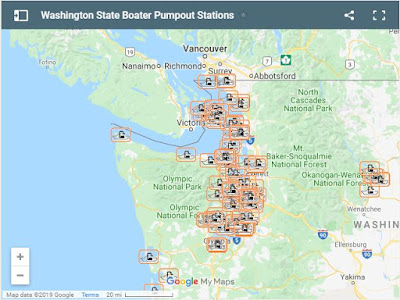
map of pumpout stations
There are well over 100 recreational and commercial pumpouts on Puget Sound and funding is available through Washington State Parks grants to establish more. Washington boaters are already using these convenient locations to safely dispose of vessel sewage. 

We provided an extended compliance timeframe for the rule, so some operators, including tug boats, have until 2023 to fully retrofit all their vessels to hold sewage. Vessel operators have begun investing in retrofits to comply with the rule.

Investments in the newly upgraded shellfish beds have begun and we expect more good news as the NDZ continues to be a part of Puget Sound. 

Why does Washington have an NDZ?

We established the NDZ to stop the discharge of vessel sewage into our waters.  Puget Sound is a regional treasure of great economic importance and preventing vessel sewage from being released throughout Puget Sound is a common sense decision. The NDZ is an important part of protecting and restoring the sound.

To learn more about why we have an NDZ and how it protects Puget Sound, read our April 2018 blog post.

Additional NDZ information is available on our NDZ webpage.

Find a pumpout in Washington or visit the State Parks pumpout website.

Washington's NDZ helps protect water quality, beaches, and shellfish.

By Colleen Keltz, Water Quality Communications

Friday, October 4, 2019

Federal grants go toward repairing two Washington dams

Department of Ecology’s Dam Safety Office regulates 1,055 dams in Washington. Many of those are doing just fine, but 409 pose a potential risk to people living and working below.

Broken pipe underwater at Newcastle dam
Outlet pipe broken and submerged
at Newcastle Railroad Embankment Dam
Unfortunately, there’s no reality tv show that renovates dams, and most owners are left to cover repair costs themselves. So, we were excited to hear this week that Ecology has received $153,007 in grant funding to assist two dam owners in repairing their dams. 

The funds are part of a new grant program administered by the Federal Emergency Management Agency (FEMA). FEMA had $10 million to provide assistance for planning and other pre-construction activities such as data collection, design and permitting. We applied for funds to assist three dam owners, and two of these were accepted. 

The funds will be split evenly between the city of Aberdeen to work on slope stability issues at their Fairview Reservoir #1 and the city of Newcastle to stabilize and remove the Newcastle Railroad Embankment Dam. For the next year, both owners will use dam engineer consultants to collect and analyze data and develop solutions and designs.

“Through our inspection program, we identified both of these projects as being in poor condition and needing engineer assessments and repairs,” said Joe Witczak, Ecology’s Dam Safety Office manager. “This is the first year this grant funding was available and we intend to apply again next year in support of other high hazard dams in need of repair.” 


Two Ecology dam safety inspectors at Fairview
Ecology dam safety inspectors at Fairview Reservoir #1
In addition to the funds that Ecology was awarded, the dam owners must provide a 35 percent match. 

In Washington, a dam owner (such as private, local government or public utilities) is legally responsible to safely maintain, repair and operate their dam. The Dam Safety Office helps to ensure dams are properly designed and constructed. We also inspect existing dams for proper operation and maintenance. 

There are an additional 134 dams in the state that are owned and/or regulated by federal agencies. 


By Keeley Belva, Water Resources Program communications manager

Monday, July 15, 2019

Wait, how can there be a drought when it’s raining?

While recent rain is helping many parts of the state, more than a
few scattered showers are needed to fix Washington's drought.
For the past few months, Washington’s weather has been all over the map.

Residents of Spokane and the south east experienced a relatively damp spring, while much of western and central Washington have seen warmer than normal temperatures and low precipitation since April.

And for most of the summer, the usually fire-resistant west side has had a higher risk of wildfires relative to historical norms than has most of Eastern Washington, according to the National Interagency Fire Center.

As of July 11, the U.S. Drought Monitor still shows abnormally dry to severe drought conditions in all but the southeast corner of our state. Five percent of the state’s rivers are at record low, and many locations in western and north central Washington are expecting between 50 and 75 percent of normal stream flow through September.

So what does this all mean when more than half the state is in a declared drought emergency?

Jeff Marti, Ecology’s Water Resources Program drought coordinator, says recent precipitation has been a welcome change, but it hasn’t made up the deficit caused by warmer than usual conditions and a lack of snow pack.

“Over the last few days, some parts of the state have gotten some good shots of rain, and some places, like the Olympic Peninsula, have really needed it," Marti said. "Some rivers have rebounded nicely, but about a quarter of our rivers are still experiencing flows much below normal. It will take continuing rainfall to make that more than a temporary rebound. Our lowest flow season is still ahead.”

Conditions by region


While cooler weather and some rain has bumped up flows that supply irrigation water and support important fish migration in Central Washington, water supply remains in flux. Low reservoir levels in the Yakima Basin – the 7th lowest storage volume in 44 years – mean farmers must remain vigilant and fish managers on alert.

From arid areas to sudden downpours, weather patterns east of the Columbia River have meanwhile been wide ranging. The northeast portions of Pend Oreille and Stevens counties are in severe drought, while the east side’s midsection has seen thunderstorms and flash flood warnings several times over the past few weeks.

Crop damage from heavy rains was reported in Okanogan and Ferry counties, although NOAA’s National Weather Service shows total regional precipitation hovering just under average for the past month.

Conditions in the southeast have mirrored the majority of the U.S., and are wetter than in past years. Walla Walla basin water users have seen some low flows, but that’s mainly due to normal demand across the border in Oregon.

Taken as a whole, Washington’s lingering dehydration – the 13th driest July-June period ever recorded in the state – stands in stark contrast to the rest of the country. According to NOAA, the continental U.S. had its wettest 12 months on record, even as the Pacific Northwest became more parched. And with much of the summer yet to come, resolving this drought will require more than scattered showers.
Washington precipitation departure from average (inches), from July 1-15, 2019. Image courtesy of NOAA.

Tuesday, July 2, 2019

Drought in the rainforest

Known for rain, city of Forks struggles with water supply

You know something is wrong when one of the wettest places in the entire country is worried about water. That’s what’s happening in the city of Forks on the west side of the Olympic Peninsula. Forks, famous for the Twilight Series and rain, is experiencing a drought. 

One of the wettest places in the country

Nestled in the temperate rainforest, Forks is technically the third wettest place in the lower 48 with 119 inches of annual rainfall. By comparison, Seattle is 140 miles east and gets about 37.5 inches year—that’s less than Dallas, Texas.  And the wettest spot in the continental United States isn’t too far from Forks either. Just to the south in Grays Harbor County, the Aberdeen Reservoir gets a whopping 131 inches a year. Still, Fork’s massive amount of rainfall is certainly enough to justify its soggy reputation.

The Calahwa River in Forks has hit record low daily flows this spring

A warm and dry spring

So why is a place that gets so much rain concerned about water? Forks, along with the rest of the state’s Pacific Ocean coast, experienced the second driest spring on record since measuring started in 1895. In addition, we had the eighth warmest May on record which melted the mountain snowpack much faster and earlier than normal. The combination of the lack of spring rain and early snow melt has created a water double whammy for the Olympic Peninsula.

State and federal drought determinations

Gov. Jay Inslee declared a drought emergency for the area and the US Drought Monitor recently determined that most of the Olympic Peninsula was facing “severe” drought. Those determinations reflect what we’re seeing on the ground. Peninsula rivers and streams such as the Satsop, Hoh, Calahwa, Hoko, and Elwha have recently hit all-time record low daily flows.

Forks is feeling the heat

In Forks, where the city relies on wells to provide drinking water, officials are growing increasingly concerned about having enough water heading into the summer months.  Water levels in the city’s wells are dropping by about a foot a week and Forks has already asked residents to voluntarily begin to conserve water. Officials expect a decision about mandatory water conservation in coming weeks.

The Salmon River south of Forks has a fish hatchery and dangerously low flows

Ecology is working to find solutions

We recently held an informational meeting in Forks where Mike Gallagher, Ecology’s water resources manager for southwest Washington and the Olympic Peninsula,  gave a presentation about current and projected water supply conditions. Some attendees represented small water systems in the area and told us they are also experiencing dwindling water supplies. These small water suppliers are now discussing contingency plans that involve mandatory conservation, water rationing, and the need to truck water to their customers.

Forks officials are submitting applications in hopes of taking advantage of grant funding recently made available by Ecology to address hardships caused by the drought. In 2019, state lawmakers appropriated $2 million to Ecology for drought response. Grant funding is used for projects such as drilling emergency standby wells, or helping hatcheries maintain cool and clean water for fish. 

By Jeff Zenk, Southwest Region communications