Friday, June 28, 2019

Time to get #SmokeReady

Despite the thunder and lightning earlier this week, we thankfully haven’t seen much smoke in Washington skies yet this year. All it takes is one spark, though, so ask yourself: Are you #SmokeReady? 


Some inexpensive tools, a little reading and a simple plan will make sure you and your family are ready for the summer smoke season. 

Here are 10 tips to help you prepare:

  1. Plan ahead with your doctor: If you or a family member has asthma, or suffers from heart or lung disease, have a plan to manage your condition. Children, pregnant women, and people over age 65 are especially at risk during smoke events. Learn more.
  2. Get HEPA filters, recirculate your AC, and share space: Use a HEPA filter in your home’s central air system or your air conditioner unit or air purifier. Learn how to turn your AC to “recirculate” in both your home and your car. Also, check with your neighbors. If you or your neighbor doesn’t have good air filtration or air conditioning at home, arrange to share spaces with those who do.
  3. Employers, plan ahead with your employees: Have a plan in place for employees who work outdoors. Consider alternate work assignments or relocation to reduce employee exposure to smoke. For staff that work indoors, ensure your air filtration system is protective for smoke. Prepare for employees to face childcare closures, home emergencies, etc. Check with Washington Labor & Industries for guidance.
  4. Have a Plan B for outdoor events: Have a contingency plan prepared in case you need to cancel, reschedule, or move an outdoor event indoors. (Make sure the indoor venue has good air filtration!) If you have children in summer camps or childcare, ask the organizers about their smoke plan. Check with your county health department about cancellation guidelines.
  5. Buy a respirator mask: If you’ll be outdoors long enough to need a mask, check into an N95 or N100 respirator now. Plan ahead to ensure it's properly fitted. Masks do not work for everyone, though, so test the fit and comfort before you need it. Learn more.
  6. Stock up: Have several days of water, groceries, and family needs on hand so you don’t have to go out when it’s smoky.
  7. Don’t forget your pets: If the air quality is forecasted to be poor while you’re away from home, plan ahead to keep your pets inside or with a caregiver. Learn more.
  8. Learn the air quality index numbers and colors: During periods of poor air quality, watch for air quality alerts, pay attention to numbers and colors of air quality monitors, and know when to limit your time outdoors.
  9. Get alerts: Sign up to receive air quality email alerts for your zip code. Also, bookmark or subscribe to the Washington Smoke Blog for statewide air quality and wildfire updates.
  10. Become an expert: Learn more about being Smoke Ready at EPA’s Smoke-Ready Toolbox for Wildfires and the Washington Department of Health’s Smoke From Wildfires Toolkit.


- Kari Johnson, Air Quality program

Thursday, June 27, 2019

Celebrate Pride! The Ornate Tube Worm sports all the colors of the rainbow

Eyes Under Puget Sound's "Critter of the Month"

June is LGBTQ+ Pride Month, and in the spirit of celebrating diversity—both invertebrate and human—we’re featuring a critter that wears its rainbow colors with pride every day of the year. Meet one of Puget Sound’s most beautiful creatures: the ornate tube worm, Diopatra ornata.

Ornate Tube Worm under the microscope.
Diopatra ornata collected from subtidal sediments at Nisqually Reach.

Breathe with me

Like many other species of polychaetes, or marine segmented worms, D. ornata has gill structures called branchiae on each segment, which help pull oxygen from the surrounding water and sediment. In D. ornata, the branchiae are distinctly spiraled and look like frilly trees or ferns running down either side of its iridescent body. The bright red color of the branchiae comes from the blood vessels inside—if you look closely at the live worm, you can see them expanding and contracting to help circulate blood throughout the body.

Family: Onuphidae, Genus: Diopatra, Species: Diopatra ornata.

Fancy digs

The “ornate” parchment-like tube of a Diopatra worm gets its name, and decorative appearance, from the bits of shells and algae attached to the hook-shaped top end, which projects from the sediment surface. Although only a few centimeters of tube are exposed above the sand, the buried portion may extend down as much as a meter!
Photo courtesy of Jeff Adams, Washington SeaGrant.

The tube’s adornments, which the worm sticks on with mucus, not only serve as camouflage from predators, but also encourage small animals to colonize the outside. In some parts of D. ornata’s range, especially off the central California coast, the tubes occur in great densities, forming mats that provide complex habitat for macroalgae (seaweed) and other animals. The little communities of organisms on the outside of the tubes may also serve as a built-in snack bar when the worms get hungry.

Left: Shell-covered tube worm protruding from the sand. Right: Shell-covered tube worm removed from the sand.

Left: A shell-covered Diopatra ornata tube protrudes from sandy sediment (photo courtesy of Kevin Lee, www.diverkevin.com). Right: This tube has been dug up, showing the bare end that stays buried in the sand (photo courtesy of Jeff Adams, Washington SeaGrant).

Jaw-dropping

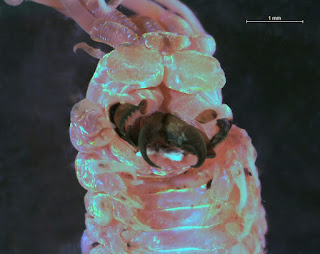
Close-up of the Ornate Tube Worm's jaws under a microscope.

Ventral (bottom) close-up of a preserved
Diopatra ornata specimen
with its jaws extended.
Scientists disagree on what D. ornata’s favorite food is—perhaps because it likes them all! It is perfectly happy munching on detritus (organic matter), but can also grab pieces of seaweed or small invertebrate prey in its rather fearsome black jaws. It has no eyes, but can sense the world with five long antennae attached to its head.

Diopatra like to build their tubes in sand rather than fine mud, so in Puget Sound, we see them most frequently where the sediment is coarse, such as around Nisqually Reach and East Anderson Island. So next time you’re walking on the beach at low tide and spot a large debris-covered tube sticking out of the sand, chances are you’ve encountered the home of one of these ornate beauties!

By Dany Burgess & Angela Eagleston, Environmental Assessment Program


Critter of the Month

Our benthic taxonomists, Dany and Angela, are scientists who identify and count the benthic (sediment-dwelling) organisms in our samples as part of our Marine Sediment Monitoring Program. We track the numbers and types of species we see in order to understand the health of Puget Sound and detect changes over time. 

Dany and Angela share their discoveries by bringing us a Benthic Critter of the Month. These posts will give you a peek into the life of Puget Sound’s least-known inhabitants. We’ll share details on identification, habitat, life history, and the role each critter plays in the sediment community. Can't get enough benthos? See photos from our Eyes Under Puget Sound collection on Flickr.

Wednesday, June 26, 2019

Fecal Matters: No-contact advisory issued for Golden Gardens, King County

BEACH program update


June 27 update: The estimated amount of sewage overflow near Golden Gardens Park is 165,000 gallons. Additional water samples were taken on June 26 by Seattle Public Utilities and results are anticipated  on June 27. 

You can get more updates by following Seattle Public Utilities' Twitter account. 

----------------------------------
June 26

Seattle and King County Public Health issued a no-contact health advisory on June 26 at Golden Gardens due to a 16,500 gallon sewage overflow. Signs have been posted at public access points, and the public is advised to avoid contact with the water in the affected area.

Contact with fecal contaminated waters can result in gastroenteritis, skin rashes, upper respiratory infections, and other illnesses. Children and the elderly may be more vulnerable to waterborne illnesses.

Stay updated on water quality at your beaches by following our Fecal Matters blog posts, connecting on Facebook, or joining our listserv.

Julianne Ruffner, our BEACH Program Manager, is available to answer questions:

Phone: 360-407-6154

Email: julianne.ruffner@ecy.wa.gov


Fecal Matters: Bay View State Park is open for water recreation, Skagit County

BEACH Program Update

The no-contact advisory at Bay View State Park in Padilla Bay has been lifted. Analysis of water samples collected this week found bacteria levels were low and safe for water contact.

Contact with fecal contaminated waters can result in gastroenteritis, skin rashes, upper respiratory infections, and other illnesses. Children and the elderly may be more vulnerable to waterborne illnesses.

Stay updated about water quality at your beaches by keeping up with us on our blog Fecal Matters, on Facebook, or join our listserv.

Julianne Ruffner, our BEACH Program Manager, is available at 360-407-6154 or julianne.ruffner@ecy.wa.gov for questions.

Monday, June 24, 2019

Cleaning up: In the footprint of an old corner gas station


One of the largest categories of cleanup sites, statewide, is former gas stations. Old-school underground storage tanks were prone to leaking into the surrounding soil. Tank owners today must follow laws and regulations to prevent leaks and spills. Many of the places once occupied by a corner gas station have since become desirable redevelopment locations. We're taking public comment and inviting you to a community meeting about one example that’s unfolding now in Seattle.

A line of shops with a few cars angle-parked in front.
row of convenience shops at the station, toward the end
of its heyday.

First, some history

There was a gas station operating under the Texaco brand at Queen Anne Avenue North and Roy Street from 1927 to 1993. After the pumps closed, a deli operated on the property to 2018.

In 1986 Ecology responded to complaints of gasoline odors at the adjacent Monterey Apartments. An investigation we conducted from 1986 to 1990 revealed the gas station as the source. We installed two wells to remove petroleum from groundwater.

When the pumps closed and the underground tanks were removed in 1993, we found soil and groundwater contamination. We installed and operated a system from 1993 to 1997 to extract vapor and recover groundwater.

Texaco’s successor, Chevron Environmental Management Company (CEMC), upgraded and operated the system from 2003 to 2008 under Ecology’s Voluntary Cleanup Program. CEMC also mapped areas where low levels of contaminated groundwater extend into part of the surrounding neighborhood. Buildings over this plume and adjacent to the former gas station -- the Del Roy and Monterey apartments -- received vapor tests in 2009 that found indoor air quality within health thresholds. 

Aerial map with a yellow line surrounding about half a dozen properties.
Roystone on Queen Anne, LLC plans to clean up contamination at the former Texaco station. Chevron Environmental Management Co. will take steps needed for final cleanup of the entire site.

This corner’s about to change

Fast forward to 2019, and a developer named Roystone on Queen Anne, LLC has acquired the old gas station lot. The company plans to re-develop the vacant property into a multistory mixed-use building.

We’ve negotiated an agreement with both companies. Roystone will clean up contaminated soil and groundwater on its property to meet state cleanup standards in conjunction with excavation for its project. That cleanup is called an interim action.

Meanwhile, CEMC will proceed with the steps needed for final cleanup of the entire site. These include a site assessment, called a remedial investigation, a feasibility study of cleanup options, and a draft cleanup action plan.

What’s your take?

Closed retail store fronts, with an empty parking lot in the foreground, behind fabric-covered chain link fencing.
These empty shops will give way to cleanup work as part of re-developing
the site into a multi-story mixed-use building.
We’re inviting you to learn about these plans and tell us your thoughts about them. We’re taking comments through July 23, 2019 on the interim action plan, a legal agreement called an agreed order with the two companies, environmental reviews we’ve conducted, and a proposed public participation plan, which describes how we’ll work to inform people about the cleanup.

Our website has links to all of these documents, to our online public comment app for this site, and contacts for answers to questions. We’ve also placed copies of the documents at Seattle Public Library’s Queen Anne Branch, 400 W. Garfield St.

Pleased to see you

We’re hosting a public meeting to provide information, answer questions about the site and the cleanup process, and to take comments. The meeting will take place from 6 to 8 p.m., Thu., June 27, 2019 at the Maxwell Hotel, 300 Roy St. in Seattle.

Cleanup site information


By: Larry Altose, communications manager, Northwest Region

Friday, June 21, 2019

Wood stove roundup: helping to clear wintertime smoke

Volunteers help to unload wood stoves brought in for recycling


It may be hot outside, but that didn't deter folks in Okanogan County from taking advantage of a cashback incentive to recycle old, smoky wood stoves earlier this month. At $250 per stove, limited to two stoves per customer, each person could claim up to $500!

Reducing wintertime air pollution is a priority in the county, where poor ventilation traps wood smoke in mountain valleys, often for days on end.

Our Air Quality Program in Central Washington teamed with Okanogan County, the Methow Valley Clean Air Project and the Okanogan River Airshed Partnership, to sponsor the collection event at the Twisp Transfer Station and the county's Central Landfill, June 5-6.

The results: A total of 74 participants turned in 105 stoves, leading to a payout of $26,250! Translating to a potential reduction of over 2 tons of PM 2.5 emissions, the small particles in smoke that when inhaled lodge in our lungs and can cause respiratory damage.

Participants will receive payment by check in a few weeks, and also got some cool outreach goodies at the events. Additionally, all the stoves turned in will be recycled! Funding was made available through the Woodsmoke Reduction Grant Program to improve air quality in our state's most vulnerable regions.

Stoves of all shapes and sizes
Recent data shows Okanogan County residents are exposed to more smoke, due to wildfires and wood stoves, than people in any other county in the state. While we can't do much about wildfire smoke, it makes sense to reduce other sources of smoke and provide an incentive for cleaner burning alternatives, such as new stoves or switching to gas or electric heat.
Waiting for the crusher and to be recycled

Although this round of buybacks is over, everyone can make a difference. If you own a wood stove, burn only dry, seasoned wood, and consider replacing your older stove with a newer, more efficient model. 

Homeowners can help reduce smoke emissions by composting and chipping instead of burning yard waste (which is illegal in urban growth areas throughout the state).

Please check out our community partner’s pages. They helped by volunteering at this buyback, and are also working with us to sponsor future events and other programs. Use the links below to learn more about their mission and ways you can help keep the air clean!

Also, local clean air agencies may sponsor similar events.


Kimi Matsushima checks in a stove to be recycled - from the trunk of  a car!


By Kimi Matsushima, Air Quality Specialist

Thursday, June 20, 2019

Fecal Matters: Water contact advisory issued for Bay View State Park, Skagit County


A no-contact advisory to water recreation was issued at Bay View State Park in Padilla Bay. This advisory is due to high levels of fecal bacteria in the water. Signs have been posted at the beach to warn the public. This beach will be re-sampled next week to see if bacterial levels have dropped to safe levels.

Contact with fecal contaminated waters can result in gastroenteritis, skin rashes, upper respiratory infections and other illnesses. Children and the elderly may be more vulnerable to waterborne illnesses.

Stay updated about water quality at your beaches by keeping up with us on our blog Fecal Matters, on Facebook, or join our listserv.

Julianne Ruffner, our BEACH Program Manager, is available at 360-407-6154 or julianne.ruffner@ecy.wa.gov for questions.

Women in Science: Meredith Jones works to keep toxic metals out of children's products

Ecology chemist Meredith Jones in front of Inductively Coupled Plasma Mass Spectrometer.
Meredith Jones is a chemist at Ecology’s environmental laboratory. Her recent lab work testing metals in children’s products led to an important agreement between the Washington Attorney General and the online retailer, Amazon. Meredith’s work helped identify high levels of lead and cadmium in children’s products sold on Amazon’s website. Now, the company must obtain certificates from third-party sellers proving their compliance with state and federal consumer protection laws. Read the full interview below to learn more about Meredith’s recent work!

Meredith's job at Ecology

Jones at work using a 
microwave to digest consumer products.
I am a chemist, metals unit lead, and Ecology’s Inductively Coupled Plasma Mass Spectrometer (ICP-MS) specialist. I have been working at Manchester Environmental Laboratory for 21 years. My job involves preparing and analyzing various types of samples including freshwater, seawater, soils/sediments, paints, plant and animal tissues, consumer products, and wastes for trace metals. My job includes selecting which prep method will result in the best digestion of these various matrices, analyzing the samples following method-specific quality criteria, and reporting results that are accurate, free from bias and interferences, and legally defensible.

Recent work

In 2017, I began developing a method to analyze nanoparticles using single nanoparticle Inductively Coupled Plasma Mass Spectrometer. The use and production of engineered nanomaterials, which are manufactured for many consumer products,  is on the rise. This poses important toxicological concerns. The development of this method is challenging and ongoing, as it is a relatively new technology.

For the last several years, I have been involved in the preparation and analysis of several consumer product projects including:
  • Cadmium and other metals in children’s jewelry.
  • Toxics and metals in packaging.
  • Clothing studies and school supplies. 
I tested products for arsenic, cadmium, cobalt, mercury, molybdenum, lead, antimony and chromium, or a subset of these metals. Some of the results had alarmingly high metals concentrations, including one piece of children’s jewelry that was 98 percent cadmium. 

In a recent school supply project, I analyzed samples containing up to 1,270 parts per million (ppm) cadmium and 8,560 ppm lead. These results led to a nationwide recall of 15,000 products. Some school supplies had more than 80 times legal limit of lead. The recall of these products has been accompanied by stricter regulations on the sale of such items, and funding being granted for future testing. I believe the outcome of this testing is just the beginning of many changes to come that will protect consumers from being unknowingly exposed to toxic materials. I am proud to have contributed to these changes.

Advice for future women in science

A love of animals and nature is what drew me to a career in science. Although my degree in environmental science led me to a job in a laboratory rather than one in the field, I know that the work I do at our lab is helping to protect and improve the environment.

I would advise young girls and women to have fun with science and keep digging for solutions. If you don’t succeed the first time, try again. Don’t be afraid of failure. The learning process includes discovering where the mistakes came from and troubleshooting new strategies for the next time.
Jones adds acid to a vessel containing a consumer product sample.
Ignore gender stereotyping and the misconception that science is nerdy. I know, off the top of my head, the most abundant atomic mass of over 50 elements on the periodic table. Is that nerdy? Perhaps, but I love to find a way to interject these numbers into everyday conversations. I can’t tell if my teenage daughters find this impressive or annoying and embarrassing, but probably the latter. Oh well ... I think it's funny. Science is fun!

By: Ruth Froese, Environmental Assessment Program

Tuesday, June 18, 2019

Latest health report on Washington beaches


Curious to see how your favorite beach fared for water quality and healthy swimming last year? See the good, the best, and the "poopy" marine swimming beaches in our BEACH Program 2018 Annual Report.

In this report, you can now see how beaches stacked up. You'll find the top swimming beaches for water quality by county and beaches that did not meet swimming standards last year.

Overall, the majority of our beaches monitored in 2018 met the swimming criteria and the number meeting standards increased by 5 percent. Bay View State Park, Kayak Point County Park, and Sooes Beach had more than one sampling event in the advisory or closure range. For that reason, these three beaches were considered not passing beaches. 


Read the 2018 Annual BEACH Report


Look here for tips to keep your beach clean

Why does it matter?

Anyone who uses marine beaches for recreational purposes like swimming, scuba diving, surfing, or kayaking can be exposed to illness associated with water contaminated by sewage.

Contact with fecal contaminated waters can results in gastroenteritis, skin rashes, upper respiratory infections, and other illnesses. Children and the elderly may be more vulnerable to waterborne illnesses.

How does poop get in the water? 

Fecal bacteria get into the water in a number of ways. Some of it is natural, and a small amount of fecal bacteria does not pose a threat to public health.

Water at a beach can rise to an unhealthy level for many reasons. The most common reasons include: 

  • Septic tanks that are not properly maintained.
  • Large amounts of sewage discharged from sewers overflowing during heavy rain.
  • Sewage discharged by recreational boaters.
  • Wild animals congregating because of people feeding them
  • Dogs pooping on beaches
  • Used diapers being left on the beach.


Check on your favorite beach before you head out!

 View the list of beaches being monitored
In 2019 we are monitoring 67 popular high-use, high-risk saltwater swimming beaches throughout Puget Sound and the coast.

We sample for fecal bacteria beginning the week of May 20 and through Labor Day, Sept. 2. You can see which beaches have an advisory on our interactive Beach Closure and Advisory map during the swimming and sampling season. We encourage you to bookmark this map on your smartphone.


By Julianne Ruffner, BEACH Program Coordinator


Friday, June 14, 2019

Legal victory holds Canadian company accountable for polluting the upper Columbia River

The town of Northport on the Columbia River is near the
Canadian border and has been contaminated by toxic releases
from the Teck Metals smelter in Trail, British Columbia. 
In a big win for the Colville Tribes and Washington State, the U.S. Supreme Court declined to hear a landmark environmental case this week.

The Supreme Court's denial leaves a September 2018 Ninth Circuit ruling in place, awarding more than $8 million in costs to the Colville Tribes and holding Teck  Metals, a Canadian mining company, liable for nearly 10 million tons of toxic wastes that the company discharged into the upper Columbia River.

This decision marks a major step forward for recovering upper Columbia River valley cleanup costs and natural resource damages.

“This is great news for the Tribes and Washington State,” said Jim Pendowski, program manager for Ecology’s Toxics Cleanup Program. “Teck Metals disposed of millions of tons of wastes into the Upper Columbia River. It’s time that the company is held accountable. This decision will ensure that will happen.”

The company operates the world’s largest lead and zinc smelter just ten miles upstream of the U.S. border in Trail, British Columbia. For nearly a century, it discharged about 400 tons of slag a day directly into the river, as well as liquid wastes. These wastes included metals such as arsenic, cadmium, copper, lead, mercury, and zinc.

The litigation began back in 2004 after the company refused to abide by a U.S. Environmental Protection Agency order requiring Teck to assess the pollution and identify cleanup options. Teck argued that the EPA didn’t have jurisdiction over a Canadian company. Individual members of the Colville Tribes sued with Washington State as co-litigants. The Colville Tribes later joined the litigation.

The case affirms that U.S. federal environmental law applies to a Canadian company when it disposes of hazardous substances in the United States. Teck had claimed that U.S. courts lack jurisdiction over the company, but the Ninth Circuit found it “inconceivable” that Teck didn’t know its toxic waste was aimed at Washington when it discharged it directly to the Columbia River a few miles upstream from the U.S.

“This is a great example of what can be accomplished when two sovereigns—the Colville Tribes and the State of Washington—join forces to protect the environment and hold polluters accountable,” said Rodney Cawston, chairman of the Colville Business Council.

The State and Tribes look forward to cleanup and restoration of the upper Columbia River. Currently, the EPA is overseeing Teck’s investigation of Upper Columbia River contamination. In addition, the State, the Tribes, the Department of Interior, and the Spokane Tribe of Indians are working to recover natural resource damages resulting from Teck’s contamination of the river.

By Cheryl Ann Bishop, Communications Manager, Toxics Cleanup Program

Wednesday, June 12, 2019

Pursuing clean water for the Spokane River

Ecology opens rulemaking to tackle PCBs


A little over a year ago, our blog addressed water quality issues in the Spokane River. While the same challenges remain, we’re working toward solutions with Spokane community groups, regional tribes, and facilities that discharge into the river.

A look at water quality standards


Facilities discharging into the Spokane River must meet Washington State water quality standards, which were revised and strengthened by rule in 2016. These rules can be complicated – there are 192 chemicals, all with their own calculations and complexities. The five wastewater dischargers on the Spokane River are currently operating under administratively extended water quality permits that do not include current standards. We are in the process of updating these permits to include current standards.

The Spokane River flows for 111 miles, through urban and rural areas.
Of particular concern in the Spokane River are polychlorinated biphenyls, or PCBs, which can remain in the environment and build up in fish, animals, and people. PCBs are known to have harmful health effects, such as cancer and damage to immune, nervous, and reproductive systems. PCBs are notoriously hard to clean up, but removing even the smallest amount can make a positive difference in water quality.

Historic uses of PCBs and legacy contamination contribute to ongoing elevated levels in the Spokane River. PCBs are well-documented in the region. More than 20 studies of the river have sampled fish, sediment, sludge, and ground and surface water, as well as effluent from permitted wastewater facilities for PCBs. We continue to have fish consumption advisories for the river from the Washington Department of Health due to PCBs in fish tissue.


Where we are today


In our state, the water quality standard for PCBs is seven parts per quadrillion (often written as 7ppq). It’s hard to visualize such a minuscule amount, and it’s also difficult to reliably measure.

There are five facilities that have permits to discharge wastewater into the Spokane River in Washington. We are working with the dischargers on a path to meet the water quality standard for PCBs through step-by-step reductions via a variance. All five dischargers, three municipal and two industrial, applied to Ecology for a variance:

  • Liberty Lake Sewer and Water District - Water Reclamation Facility 
  • Kaiser Aluminum Washington LLC – Trentwood 
  • Inland Empire Paper Company
  • Spokane County Regional Water Reclamation Facility
  • City of Spokane – Riverside Park Water Reclamation Facility

A variance is a time-limited tool within federal and state water quality regulations that could allow dischargers to continue reducing PCBs through pollution minimization plans and the use of the best feasible technology until they reach Clean Water Act permit limits. Under the terms of a variance, the highest attainable condition must be maintained throughout the entire process. It is not a ‘free pass’ from meeting the water quality standards.

This is the first time Ecology has received applications for variances, and we’ll be asking for public involvement throughout the process. The U.S. Environmental Protection Agency must also approve each variance we adopt before it can be used for wastewater discharge permitting.


Community Partnerships

Aerial view of the Spokane River flowing through Spokane.

The Spokane River community is experienced at tackling water quality problems. Through the work of the Spokane River Regional Toxics Task Force and with input from the Spokane community, we’re making consistent progress toward finding and reducing the sources of toxins in the Spokane River. The option of pursuing variances was a topic of discussion at many of our public meetings.

Even as we continue to reduce the amount of PCBs entering the water through treatment methods, we must also work toward preventing PCBs from entering the waste stream in the first place. This requires green chemistry, re-engineered products that contain no PCBs, and other mitigation efforts to keep existing PCBs from reaching our wastewater systems. The Spokane River Regional Toxics Task Force is working to address many of these issues.

Next Steps


We are currently looking for feedback on the scope of the Environmental Impact Statement for the rulemaking from June 12 to July 2, 2019.

We plan to issue a proposed rule for comment in Summer 2020. After evaluating the feedback we receive, we will decide on incorporating the variance into the five permits.

To learn more about the rulemaking, visit the variance rulemaking page.

Colleen Keltz, Communications Manager, Water Quality Program

Tuesday, June 11, 2019

Watching the Water

Some Yakima Basin irrigators' water rationed, some shut off

Stream temperatures affecting fish throughout Central WA, north and south


The water supply forecast continues to deteriorate across the state on both sides of the Cascade Range, and drought is being felt particularly on the Olympic Peninsula, as reported in our recent blog.

While drought impacts are more typical in the arid Yakima River Basin, water supply conditions here have dropped off significantly in the last month. Despite some rainfall this spring and a big snowstorm in February, the snow in the mountains is virtually gone.

Rimrock Reservoir stands at 80 percent capacity
Coupled with the lack of snow in the mountains and drier conditions, Ecology forecasts the total natural water supply available to the Yakima’s three watersheds comprising 6,150 square miles will be 75 percent of normal, May to September. Hence drought was declared in the Upper Yakima, Lower Yakima and Naches watersheds this spring.

That lack of snow means there’s less water to go around for Yakima Valley irrigators who rely on slowly melting snowpack as a “sixth reservoir” to water their crops over the summer. This also means some irrigators will receive a smaller ration of water, and others will be shut off.

Irrigation supports a $4.5 billion agricultural economy in the Yakima Basin, where the U.S. Bureau of Reclamation manages five reservoirs to deliver water to irrigate 464,000 acres of farmland and to release water in pulses to support salmon.

On Friday, June 7, 2019, Reclamation reported their reservoirs are about 80 percent full and because of the lack of snow, water deliveries are beginning to rely on this storage.

Formal curtailment notices


Junior irrigation districts, Kittitas, Roza and Kennewick, will receive at best 74 percent of their total allotment of water this year, according to Reclamation. And because of this rationing of water, some 217 water rights more junior than these irrigation districts are now shut off by court order.

These users, with priority dates after May 10, 1905, are part of an adjudicated water basin that controls when surface water may be diverted. Now that the Yakima adjudication final decree has been entered, Ecology is tasked with issuing these curtailment orders, which were sent out on Friday, June 7, 2019.

Camp and cabin owners who rely on surface water and who participated in our mitigation program, and domestic water users, will not be curtailed. Those irrigators being curtailed may be able to lease water from other irrigators or water right holders within the Yakima Basin.

Water users with questions may call our Central Regional office water rights customer service line at 509-575-2597.

Other Central Washington water tidbits


The U.S. Geological Survey Water Quality Watch indicates that water temperatures in the Lower Yakima are now exceeding 22 degrees Celsius (71.6 F). Salmon won’t move up into the river when it gets too hot. This is called a “thermal block.”

Water temperatures on the Okanogan below Oroville are also above 22 degrees C. The fisheries biologist for the Colville Tribe says that steelhead eggs die if the river experiences five consecutive days of water temps greater than 20C. He said it’s not unusual for the Okanogan to warm up, but this year it happened earlier than usual.

Ecology continues to work with the Oroville-Tonasket Irrigation District on a project to develop a water bank to address water supply limitations for irrigators in the Okanogan River basin.

Also this week, Ecology is raising the water level on Lake Osoyoos at Oroville to gain 3,000 acre-feet of water to help irrigation later in the season, due to drought conditions there.

State drought declarations


This spring, Gov. Jay Inslee officially declared drought emergencies for 27 watersheds.

By state statute, "drought conditions" are water supply conditions where a geographical area or a significant part of a geographical area is receiving, or is projected to receive, less than 75 percent of normal water supply as the result of natural conditions and the deficiency causes, or is expected to cause, undue hardship to water users within that area.

Drought emergency declarations allow Ecology to expedite response actions such as expediting water right transfers and providing funding to local governments to address hardships caused by drought. Some examples of drought-relief projects that funding might be used for include leasing water rights, implementing water conservation programs, and developing alternative sources of water supplies for communities, farmers, and fish hatcheries.

By Joye Redfield-Wilder, Central Region communications