Showing posts with label waste treatment plant. Show all posts

Thursday, August 16, 2018

111 Washington wastewater treatment plants win outstanding performance awards

Wenatchee wastewater treatment plant
Wastewater treatment plant operators are unsung heroes. Not many people question where the water goes after they flush a toilet, but your local wastewater operator makes sure the water from our sinks, baths and toilets is treated properly so public health and the environment are protected. Because their work is so critical, Ecology honors our state’s top-performing wastewater treatment facilities with our annual Wastewater Treatment Plant Outstanding Performance Award. We recognized 111 wastewater treatment plants  across Washington that achieved full compliance with their water quality permits in 2017. That’s about a third of the state’s wastewater treatment plants. 

Manchester Wastewater Treatment Plant in Kitsap County has 23 years of outstanding performance 

In picking the winners, we evaluated all of the plants in Washington for compliance with meeting pollution limits, monitoring and reporting requirements, spill prevention planning, pretreatment, and overall operation.

The Manchester wastewater treatment plant has earned an Outstanding Performance Award every year since the program began in 1995.

Cedar Creek receives its award from Ecology program
manager Heather Bartlett
Port Townsend Wastewater Treatment Plant has had perfect performance for 20 years. Six plants now have perfect performance for 10 years in a row:

  • Clallam Bay Corrections Wastewater Treatment Plant
  • Forks Wastewater Treatment Plant 
  • Moses Lake Larson Wastewater Treatment Plant 
  • Cle Elum Wastewater Treatment Plant
  • Community of Klickitat Wastewater Treatment Plant
  • Okanogan Wastewater Treatment Plant
  • Omak Wastewater Treatment Plant


A complete list of the award winners for 2017 listed by county is on our website.

Funding available

Treatment plants that did not make the list may apply for state funding to help communities upgrade their aging systems and improve functionality so the plants can operate successfully.

Ecology recently offered $96 million in grants and loans to 26 wastewater treatment facility projects. In addition, Ecology provides technical assistance to many small plants to help them operate successfully.

Want to help protect water and get paid? Maybe wastewater operator is the right job for you!

Along with funding and awards, we oversee the certification program for wastewater operators.

“Washington’s growing population creates a greater need for wastewater treatment every day,” said Heather Bartlett, Ecology’s Water Quality Program Manager. “There are jobs to be had, and we encourage people to go into this field to help serve the public and protect the environment.”

Find out more about the state’s wastewater operator certification program at Ecology’s website.

Thursday, July 14, 2011

Old Hanford misconceptions come home to roost again

By Suzanne Dahl, Tank Waste Treatment manager, Nuclear Waste Program

Nothing is as frustrating as watching history repeat itself negatively.

A July 10th Tri-City Herald article highlighted the findings from a recent federal advisory board’s report on tank waste treatment. The report recommends delaying a decision about additional low-activity waste treatment for another 3 to 5 years. Hanford’s Waste Treatment Plant, or Vit Plant, currently under construction may vitrify as little as one-third of Hanford’s low-activity waste, leaving a substantial gap in the plan to safely treat all 56 million gallons of waste.

This recommendation is a 180-degree switch from the recently negotiated, legally binding agreement setting the schedule for cleanup that was agreed to by U.S. Department of Energy (USDOE), EPA and Ecology. It reminds us of two recurring misconceptions in Hanford cleanup logic: “Everything at Hanford can be solved by delaying it to a future funding cycle” and “There is always a magical technology awaiting us in the future.”

Assumptions like these have led to a 20-year delay in starting the Waste Treatment Plant. This, in turn, caused the projected end of treatment to slip from 2028 to 2047. Further delays are probably inevitable if USDOE puts off making critical decisions. For Ecology, the path is clear: A second Low-Activity Waste Vitrification Facility is needed.

If USDOE cannot fully test another treatment method by 2015, then the default is to build another vitrification facility. Limited time remains to research other technologies given the current schedule. And we do not feel confident that delaying the decision 3 to 5 years will allow us to reach our mutually agreed endpoint.

If the Waste Treatment Plant starts without a plan for treating the additional low-activity waste, our current information indicates that the High-Level Waste Vitrification Facility cannot run at full capacity. In that scenario, we will not meet the 2047 deadline for treating all of Hanford’s tank waste.

We agree with the federal advisory board’s recommendation to start the current Low-Activity Waste Facility early. The lessons learned from this process would inform startup of the rest of the Waste Treatment Plant. However, technical issues in this plan also need resolution.

More information:


Tuesday, June 7, 2011

Securing Hanford’s Future in the Classroom

By Erika Bronson, Community Outreach & Environmental Education Specialist, Nuclear Waste Program

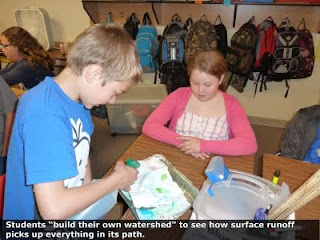
Students build their own watershedto see how surface runoff picks up everything in its path.


Students learn about cleanup methods for Hanford's 80 square miles of contaminated groundwater.


Students play Ecology's card game matching pictures of Hanford Site animals to their descriptions.


A few weeks ago, I received letters from 50 fifth graders at James McGee Elementary in Pasco. They’d been studying ecosystems, conservation and pollution, and they wanted answers about Hanford. Why is Hanford so contaminated? What is a Vit Plant? How can radiation be captured in glass?

So, on June 1st, I visited the classrooms of two teachers: Mrs. Palomarez and Mrs. Kopf. First, their students wowed me with what they’d learned about ecosystems and pollution. Too much fertilizer on lawns and crops can speed up algae growth in surface waters. Removing a species from an ecosystem impacts other life in that system. Only rain should go in the storm drain, and so on.

Then, I showed them a slideshow on the Columbia River watershed and Hanford history and cleanup. We finished our session playing Ecology’s card game matching descriptions of animals on the Hanford Site to their pictures, trying out Hanford groundwater cleanup methods on Ecology’s model, and playing Bechtel’s WTP 2020 educational video game about the Vit Plant (also known as the Waste Treatment Plant).

Continuing the conversationOne student commented that he couldn’t believe all he had to do was write a letter to get someone from Hanford to come to his class. Surprised by the power of his own words, he sincerely appreciated that someone heard his voice and took action. Some students asked if they could continue to write to me over the summer and have their parents drop off their letters on the way to work. Why not?

The Hanford community often feels like an echo chamber in which all the same voices are heard. Though a diverse chorus, we’re always hoping to get more people in on the conversation. The genuine interest these kids showed in Hanford and the health of our environment demonstrated to me that youth can engage, and intelligently at that.

Some DO stay engagedAs I was writing this, I checked Ecology’s Hanford Education & Outreach Facebook page and discovered 5 new “likes,” two of which were University of Washington students whom I met through service-learning projects. Both promoted a public meeting to fellow students and one went on to write a glossary of terms related to Hanford’s underground tank waste (I’ll be posting it soon).

Some question the ongoing benefits of educational outreach and service learning, claiming it’s a waste of time and money. But Hanford cleanup needs funding for at least another 41 years, and we need informed people to continue working on and caring about it until then and beyond. Educating today’s youth prepares them to be tomorrow’s leaders (McGee fifth graders, that means you!).

For more pictures of my visit to McGee, see our Facebook page.


Wednesday, March 16, 2011

Closing Hanford tanks: How long will they last?

By Jeff Lyon, Tank Waste Storage Project, Nuclear Waste Program

While we retrieve the waste from Hanford’s 149 single-shell waste storage tanks, one of our concerns is how long these tanks can last. We know they were built tough, but we also know they have been stretched to their limits. The tanks were constructed as part of the Manhattan Project during World War II, when knowledge of the temperature of high-level waste (HLW) was unknown. And because it was war time, there may have been a shortage of stainless steel, which would affect the construction of these tanks.

We are about ready to wrap up the planning efforts to core, sample, and test a single-shell tank concrete wall. This will help determine the current integrity of the sampled tank and give us clues about the other tanks and their ability to continue safely storing HLW.

When we complete our planning meetings, the US Department of Energy will write a Data Quality Objectives report and a Sampling and Analysis Plan. After these documents are finished, they will be available on the Tri-Party Agreement (TPA) Administrative Record and Public Information Repository.

Then the field planning, drilling, sample collection, and analyses will begin. Check out our TPA changes (number M-045-10-01) to see what other work we have planned to ensure SST structural and leak integrity. As we complete these milestones, this information will help us ensure that these tanks are still able to hold waste until they are emptied (presently planned to be completed by January 2043).

Regardless of the integrity of the tanks, our near-term focus is for closing tanks one farm at a time. Our first is Tank Farm C (C-Farm). Much planning is required for retrieving the radioactive and dangerous HLW, investigating spills, and closing the tank farms. We continue to plan soil cleanup and are deciding which tanks to retrieve next.

Wednesday, March 9, 2011

Ecology skeptical of alternate waste form for Hanford

By Suzanne Dahl, Tank Waste Treatment manager, Nuclear Waste Program

For the last 16 years, Washingtonians have expected that Hanford’s low-activity waste will be immobilized in glass (vitrified). The 2010 settlement agreement between the Tri-Party agencies also requires vitrification of some type. This stable waste form is so important to us because low-activity waste is destined to stay onsite in a landfill—above the groundwater that feeds the Columbia River. Vitrified glass is proven to successfully capture the contaminants and protect human health and the environment. For these reasons, I believe this is the best solution for low-activity waste disposal at Hanford.

The U.S. Department of Energy (USDOE) is considering a new technology called steam reforming to treat a portion of the low-activity waste. Steam reforming uses super-heated steam and charcoal to bind liquid radioactive wastes into clay. USDOE hopes the process will save money.

Although steam reforming is used commercially and is planned at USDOE’s Idaho site, neither of these scenarios compare to Hanford. Commercial processes don’t produce mineral waste, as is proposed for Hanford, and Idaho’s steam reforming non-mineral waste will go to a deep geologic repository, not an onsite landfill.

Between 2003 and 2006, USDOE tested a variety of other waste forms. Ultimately, nothing proved to be as durable and protective as glass, and none of the technologies were cheaper or faster. All of the options considered would cost as much and have similar implementation schedules as vitrification.

In the news recently, USDOE admitted they would abandon the idea if it could not be proven in the next 1 to 3 years. We question the ability to complete all the necessary testing and demonstrate that it is as protective a waste form as vitrified glass in 3 years.

Let’s keep our commitment to glass for the waste staying in Washington. Continuing to look at new technology is important, but, with limited resources, we should focus on solutions for existing problems, perhaps exploring melter technologies or vitrification advancements.

Wednesday, February 9, 2011

Tank waste, robots and waxing… Recipe for a viral video?

By Erika Bronson, Community Outreach & Environmental Education Specialist, Nuclear Waste Program

Check out this new video about removing the dangerous radioactive and chemical waste from Hanford’s underground tanks (“closing” the tanks). Then, please forward it to your friends, family, neighbors, colleagues, acquaintances, etc.

As Part 1 of the series The Scoop on Hanford Tanks, this video, The Tanks are Out There, begins explaining the process and risks associated with tank closure.


Currently, we’re in the process of making decisions about how to close the 16 single-shell tanks in Waste Management Area C (WMA-C), with 2019 being the deadline for completing this task. Before we make any decisions, Ecology and the U.S. Department of Energy will hold a public comment period for the proposed WMA-C Closure Plan. This Closure Plan will be developed in the next 1-2 years. Some of the questions surrounding this issue are:
  • Do we dig up the tanks after they’ve been emptied? Or do we stabilize them and leave them in the ground?
  • What does “empty” really mean?
  • What do we do about the potentially contaminated soil around the tanks?
We want your input before we draft the Closure Plan. Please comment here, email Hanford@ecy.wa.gov, or call 800-321-2008. For more information, see our Tank Waste Storage Project page.
We’re currently working on more videos in this series, so stay tuned…

Thursday, November 4, 2010

Massive melters on the move

By Suzanne Dahl, Tank Waste Treatment manager, Nuclear Waste Program

I can hardly contain my excitement about the arrival of the first melter for the Low-Activity Waste treatment facility at Hanford’s Waste Treatment Plant (WTP). For many years, we have celebrated events like the new cross site transfer line, the ground breaking at WTP, and the installation of the first big tank. Each time, we said, “This gets us closer to vitrifying the waste.”

Well, this time, we really have something to cheer about! This is one of two melters that will receive the chemical and radioactive waste after it’s been mixed with glass formers. Then, the melters will heat the mixture to 2,100 degrees Fahrenheit (1,150 degrees Celcius). Finally, the molten liquid will be poured into stainless steel storage containers where it will cool into solid, robust glass — which will protect human health and the environment for thousands of years to come. Simply said, this mechanism will make the waste safe.

Leading up to this momentous occasion, numerous tests in pilot melters on surrogate waste helped to improve the design of these truly unique melters by increasing waste throughput. These melters are engineering marvels able to treat 15 metric tons of glass a day each, which is at least three times more than other melters in the world. They will be the heart and soul of the LAW facility and will vitrify the low-activity portion of the waste, which will stay on the Hanford Site for disposal.

So this equipment is extremely important to Tri-Cities residents and all Columbia River users, because it will help to keep Hanford’s toxic legacy out of the river and our groundwater.

For more on melters, visit Bechtel’s LAW melter blog.

Monday, October 25, 2010

Closing Hanford Tanks: What's the big deal?

By Jeff Lyon, Tank Waste Storage Project, Nuclear Waste Program

On October 14, 2010, at the Hanford Advisory Board’s Tank Waste Committee meeting, we began discussing the communication process for closing the first tank farm at Hanford.

This is a really big deal, and here’s why:
  • Weapon production days are gone, and cleanup decisions are being made.

  • Hanford cleanup is expected to be completed in about 40 years at a cost of about $2 billion every year. About $ 300 million (15% of the total) is expected to be spent on the tank farms.

  • About half of the radioactive and hazardous waste at Hanford is stored in tanks that are up to 60 years old. The other half of the waste is in contaminated soil, some of which is in the tank farms.

  • Public input and involvement in the process will help guide our cleanup decisions. This is where you come in.
The first tank farm we hope to close is C-Farm, which has 16 of the 177 tanks. We hope to be finished with this in 2019. We will get as much of the waste out of the tanks as possible, do the necessary soil cleanup, and make sure final closure decisions protect human health and the environment.

Eight years may seem like a long time to get to closure. But to have the steps in place to prepare for that, we must have a closure decision by 2013. That’s just a little more than two years from now!

The Tri-Party Agreement (TPA) milestone for cleanup is there for us to stay on schedule. We don’t want to let it slide past. Other major milestones are shown on the TPA Timeline. That’s why we’re making such a big deal.

As always, I welcome your thoughts.

Thursday, October 14, 2010

College students analyze Hanford documents for credit

By Erika Bronson, Community Outreach & Environmental Education Specialist, Nuclear Waste Program

As part of an effort to extend our outreach to higher education, I recently visited two English classes at Columbia Basin College in Pasco. The 54 students who are participating are reading and analyzing three documents about a public comment period affecting Hanford’s Waste Treatment Plant (also commonly called the Vit Plant, short for “vitrification”). In doing so, they’ll practice their critical thinking and analysis skills. They’ll also be learning about important issues right in their backyard and the public’s right to be educated about and involved in cleanup decisions.

A cutting-edge facility

Since 2002, contractors of the U.S. Department of Energy have been busy constructing the $12 billion Waste Treatment Plant, which consists of four buildings that will work in tandem to complete the vitrification process. The Pretreatment Facility will separate out the two different waste streams: low-activity waste and high-level waste. Then the waste will be transferred for processing to the Low-Activity Waste and High-Level Waste facilities. The fourth building is an Analytical Laboratory that will be used for testing and research.

What is vitrification?

Vitrification is the process by which a substance is turned into glass. The 53 million gallons of tank waste currently in aging underground storage tanks will be mixed with molten glass and poured into stainless steel containers for cooling and storage. The waste will be safely stored in glass form while the radioactivity levels decrease over hundreds to thousands of years.

We want your input, too!

If you’re curious about the current public comment period involving the design of waste sampling systems in the Waste Treatment Plant, I encourage you to access the documents the students are reading:
If you’re a college instructor who would like to bring Hanford to life in the classroom, I’d love to brainstorm ideas with you (Erika.Holmes@ecy.wa.gov, 509-372-7880). Elementary and high school teachers can contact Ginger Wireman (509-372-7935) to discuss classroom outreach opportunities.

Monday, September 27, 2010

Waste Mixing Issues in Hanford’s Waste Treatment Plant

By Suzanne Dahl, Tank Waste Treatment Manager, Nuclear Waste Program

The M3 mixing issue at Hanford’s Waste Treatment Plant (WTP) has been in the news lately, and I want to explain the issue and our position. Many of the vessels in WTP use pulse jet mixers (PJMs), air-driven devices with no moving parts that will be used to suspend solids in the liquid waste. This waste is from the 177 underground storage tanks at Hanford. The concern surrounding the PJMs is that they will not produce enough energy to keep the waste properly mixed.

As early as 2006, we were aware of the mixing challenges. Since then, the project has received many reviews. Project managers and engineers at our office have been closely monitoring the WTP’s design and construction and studying the mixing concerns. In addition, the External Flowsheet Review Team (EFRT), composed of 50 independent experts, reviewed this project’s flowsheet — a description of the sequence of operations in the WTP — and provided a list of concerns. We also attended these EFRT briefings.

Due to the EFRT concerns, an extensive, ongoing testing program was launched to determine the adequacy of the mixing components in WTP vessels. That program included building a scaled-down test platform with a small open-top vessel, evaluating different PJM configurations, and analyzing the mixing capabilities. The United States Department of Energy (USDOE) provided test results and initial analyses to Ecology from late June through August 2010. Those results revealed a need to change the way many vessels perform, vessel configuration, mixing velocity, and the number of PJMs needed for each vessel. Results also showed that sediment could potentially accumulate in the bottoms of some vessels.

Ecology, the Defense Nuclear Facilities Safety Board (DNFSB), Bechtel, USDOE, and stakeholder groups are aware of these technical challenges. We expect the problems to be resolved in a way that ensures WTP construction and operation will proceed safely and efficiently, resulting in a fully capable WTP. To this end, we review permit submissions for the scope of changes and must approve those changes before construction can continue in the WTP.

If you are interested in this issue, DNFSB has a public hearing scheduled for October 8, 2010.


Wednesday, September 8, 2010

Closing 16 Hanford Tanks: Caution, Tough Decisions Ahead!


by Jeff Lyon, Tank Waste Storage Project, Nuclear Waste Program

Hopefully, you read my first blog last month. It was about our efforts to oversee closure of the 177 tanks at Hanford. The next step for closure is getting the first group of tanks, or tank farm, closed. That will be the hardest part of our job.

Waste Management Area C (WMA-C or C-Farm) is scheduled for closure in 2019, and we haven’t even decided what closure will look like. The tanks are underground. Twelve of the tanks have a capacity of about 530,000 gallons each, and four of the tanks are 55,000 gallons each. Some of the tanks may have leaked. In addition, about 10 miles of pipelines running throughout C-Farm may have had a few leaks. Right now, the US Dept. of Energy (USDOE) is doing a “Facility Investigation” (RCRA [Resource Conservation and Recovery Act] Facility Investigation and Corrective Measures Study – RFI/CMS). Ecology has reviewed and approved this Work Plan.

Also, USDOE is removing waste from the tanks and safely storing it in the double-shell tanks (DSTs). They have finished getting waste out of six of the tanks: the four smaller ones (200-series tanks) and two of the larger ones (C-103 and C-106). All of the remaining tank waste must be retrieved by September 2014. That’s more than a million gallons of radioactive and dangerous waste (mixed waste) that will be moved into the DSTs.

Our first real decision will be whether to close the tank farm as clean closure or to leave waste in place and close the tank farm as landfill closure. Ecology has commented on USDOE's "Draft Tank Closure and Waste Management Environmental Impact Statement" (TC &WM EIS). When the TC & WM EIS is finalized, it will provide some of the information we will use for this decision.

This is where you come in. We are developing a FAQ (Frequently Asked Question) publication for the Tank Farm Closure project at Hanford. We would love to add your question to our list. If we can answer the question in a timely manner, we will answer it on the blog. Regardless, we will consider all of the questions for our FAQ.

So, got questions? Please comment on the blog.

Thursday, August 19, 2010

Closing 177 Hanford Tanks: A Tough Task

By Jeff Lyon, Tank Waste Storage Project, Nuclear Waste Program

The Ecology Nuclear Waste Program provides oversight for cleanup of Hanford, a federal government site covering more than 500 square miles! About ten percent of it is contaminated with dangerous radioactive or chemical waste, and sometimes both. One part of the cleanup is treating the waste stored in large underground tanks. To treat the waste, the U.S. Department of Energy (USDOE) is building a Waste Treatment Plant (WTP).

The WTP is the biggest of its kind, incorporating thousands of miles of rebar and wiring and hundreds of thousands of tons of concrete. The unique facility will permanently combine the most radioactive waste with glass, immobilizing it and keeping it out of the environment. USDOE plans to start using the WTP in about 10 years.

Where to Start?
The first step in preparing the waste for treatment and meeting the Washington Dangerous Waste Requirements is to retrieve the waste from the older tanks and put it into newer tanks. There are 177 underground tanks grouped together in “Farms” or “Waste Management Areas” (WMAs). Many of the tanks (149) are old and no longer reliable. There are 28 newer tanks that we consider fit for use.

Closing the Farm
The first farm to be retrieved and closed is WMA-C or C-Farm. C-Farm has 16 tanks, and we hope to retrieve waste from all of them by September 2014. Our goal is to close C-Farm by 2019. We will be monitoring progress and approving the actions that will complete tank farm closure. We plan to have all of the older tank farms (7 total) closed by 2043 and all of the tanks closed by 2052.

We Need Your Input
This is a complex project, so communication with the public and tribal nations is important. We are issuing periodic C-Farm Updates describing tank-related cleanup work. We also developed Tank Closure 101 and Retrieving Tank Wastes at Hanford: The Basics to explain some of the general complexities of closing the tank farms.

I plan to post regular updates on progress at the tank farms, so let’s start a conversation. Take a look at our tank farm publications and send me your thoughts, opinions, and questions about this part of the cleanup. Hearing from the public will help the agencies make the best decisions possible.