Showing posts with label Boots on the Ground. Show all posts

Thursday, January 23, 2020

Boots on the ground: Members clean, pack, and plant to honor Rev. Dr. Martin Luther King Jr.

Every year, our Washington Conservation Corps (WCC) members join AmeriCorps programs across the country to make Martin Luther King Jr. Day a “day on” rather than a “day off.” On MLK Day of Service, members transform Dr. King's life and teachings into community service that empowers individuals and helps solve social problems. Let's take a look at some projects our members arranged this year!

Five young adults wear dark blue shirts and stand in a line carrying yellow and white plastic bags full of food.
Left to right: Members Raechal Burke, Jordan Billheimer, Presley Barbo, Emma Mobley, and Allie Trister spent MLK Day serving the non-profit organization Homeless Backpacks, in Lacey, packing bags of food for youth experiencing homelessness. Photo contributed by Raechal Burke.


Packing bags for food assistance  

One of our field crews in Tumwater took a break from planting trees and shrubs to help make sure youth experiencing homelessness had food for the following weekend. Members packed bags of food with Homeless Backpacks in Thurston County, an organization that provides free bags of food for middle and high school youth for the weekend, when government-supported meals are not available.

Members also served food or conducted inventory at 13 different food pantries or shelters across the state, including FISH Community Food Bank in Kittitas County, Everett Food Bank in Snohomish County, and Helping Hands Food Bank in Skagit County.

Mailing books to support education

Another field crew in Tumwater supported enrichment and educational opportunities for incarcerated people across the country through the nonprofit Books to Prisoners Olympia in Thurston County.

“It was a heartwarming and rewarding experience,” said WCC AmeriCorps member Grace McLarty. “We got to choose books based on letters we received, and write letters to incarcerated people.” The crew rounded out their day leading volunteers in invasive species removal with Capitol Land Trust. “We had an amazing day and are grateful to have been able to serve our communities,” Grace said.

Three young adults wearing blue sweatshirts sit at an indoor table with envelopes and books on the table.
Left to right: Members Julie Pick, Mason Haynes, and Rainer Connelly select books for specific prisoners based on hand-written letters. Photo by Grace McLarty.


Building and painting walls for accessible housing 

WCC members built homes, assembled furniture, and improved facilities at 15 different affordable housing or senior housing organizations across the state. In Jefferson, Pierce, and Skagit counties, members assisted with painting and construction activities with the global nonprofit housing organization Habitat for Humanity.

One of our crews cleaned rooms and facilities at Admiral House in King County, one of Plymouth Healing Communities’ apartment buildings. Plymouth Healing Communities provides housing and companionship to people living with housing instability and mental illness. Staff and residents invited our WCC members to enjoy food and conversation together after they wrapped up cleaning tasks, and our members shared that turned out to be a highlight of the day.

“My favorite and most challenging aspect of my MLK day of service experience was that it required me to exercise a completely different set of skills than the ones we use in our usual line of project work,” said AmeriCorps member Jon Simo. “Socializing with the residents is a skill that comes the least naturally to me than any other. However, that was precisely what made it so rewarding for me. I got to meet and help people from very different walks of life from my own.”

Planting trees for healthy ecosystems


A group of seven young adults stand in a field. They are all wearing dark blue sweatshirts.
Left to right: Members Bryan Sibrian, Ben Papadopoulos, Malise Yun, Abby Jackson, Lilya Jaeren, Tyler Ransier,
and Gabby Alampay. Photo contributed by Lilya Jaeren.

Seven Individual Placement AmeriCorps members opted to serve outdoors for their MLK Day of Service with Nisqually Land Trust in Thurston County. Together with community volunteers, they planted more than 1,000 native trees and shrubs.

“All seven of us do monitoring for our everyday projects so it was nice to do some environmental restoration, and good exercise digging holes and hammering stakes into the ground,” said Lilya Jaeren, who serves on the state Department of Natural Resources' Aquatic Reserves Team. “It was nice to know that our efforts will have a positive impact on the Nisqually River Watershed.”

In addition, a handful of crew members honed their leadership skills by teaching community volunteers about safety and planting techniques for a restoration event at Whatcom Falls Park in Skagit County, with Nooksack Salmon Enhancement Association, City of Bellingham, and Washington Trails Association. In total, volunteers planted 592 native shrubs, ferns, and trees, re-planted more than 2,000 feet of social trails, spread almost 50 cubic yards of mulch, and removed almost 10 cubic yards of invasive Himalayan blackberry, English holly, and English ivy!

These activities will help improve habitat for salmon and octher wildlife along Whatcom Creek, and hopefully inspire local residents to continue getting their hands dirty and building community by attending future volunteer events.

Honoring Dr. King's legacy all year

Our WCC joins thousands of AmeriCorps members, community members, and organizations across the nation in striving to honor Dr. King's legacy every day. As an AmeriCorps program focusing on environmental stewardship, WCC commits to continuing conversations about justice and service, creating a service atmosphere where all can thrive, and working to ensure service opportunities are available to everyone.

Thursday, January 9, 2020

Boots on the ground: AmeriCorps members embark on environmental projects statewide

Our 300 Washington Conservation Corps AmeriCorps members are three months into their 11-month service terms, gaining valuable hands-on field skills and supporting critical restoration and trail enhancement projects. Join us for a tour across the state to learn about a few of their accomplishments so far!

Three AmeriCorps members wearing yellow hard hats kneel behind a log.
 Part of our Kirkland crew gathers around the nurse log they created. Photo by Kelli Sheldon.

Simulated nurse log boosts educational accessibility in King County

City of Kirkland is a new year-long partner for WCC and members are supporting the city’s Green Kirkland Partnership during their 11-month term. The program features collaboration between City of Kirkland, nonprofit partners, businesses, and the community to work toward restoring and maintaining more than 500 acres of urban parks and green spaces across the city.

Among our Kirkland crew’s first projects was a unique chance to support both education and physical accessibility efforts in the city’s McAuliffe Park. AmeriCorps members created a simulated nurse log in a more accessible space to educate the public about traditional old growth forest elements.

“A nurse log is a fallen tree that creates a nutrient rich habitat for young seedlings as it decays,” said crew supervisor Kelli Sheldon. Having a nurse log labeled in a public park affords people the opportunity to learn about ecosystem benefits they provide without requiring visitors hike on technical or uneven trail terrain.

AmeriCorps members started the project with a large poplar tree log. Members used handsaws, circular saws, and Pulaskis (a hand tool used to fight wildfires) to form a small trench on the top of the log. Then they planted a hemlock tree and red huckleberry bush. Finally, they covered the log with a thick coating of moss that grows naturally on nurse logs and provided moisture for the freshly planted vegetation.
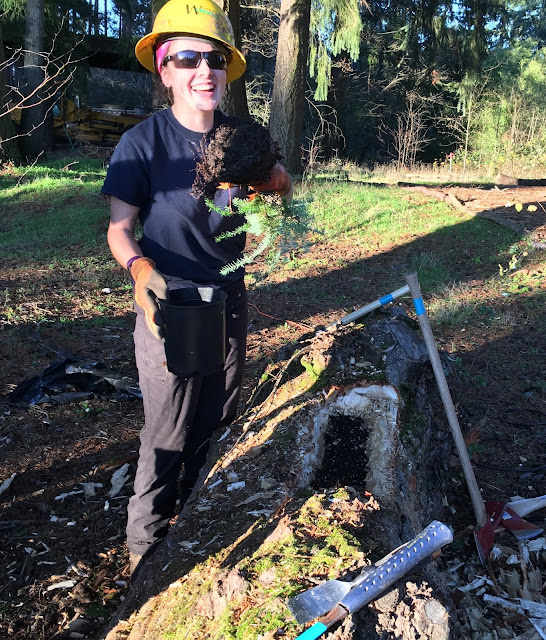
An AmeriCorps member wearing a yellow hard hat laughs in the sunshine as she holds a native conifer, getting ready to plant it.
A WCC AmeriCorps member enjoys the sunshine as she plants the tree sapling. Photo by Kelli Sheldon
“The crew had a great time constructing the nurse log. It was a great opportunity for us to try out some new hand tools and get creative,” Sheldon said. The AmeriCorps members supporting City of Kirkland shared they value the variety of projects and learning opportunities the city has offered.

“We served at one restoration site early in the year that was less than half an acre in size, yet we discovered and removed more than 10 different types of invasive species from that single site,” said AmeriCorps member Celia Thurman. “Not only was this a huge learning opportunity for the crew and me to learn how to identify these species, but I got to know how to manage each differently as well.”

This fall, members have supported restoration efforts at seven different Kirkland public parks,  improving 1.5 acres for to benefit the public while planting 292 native trees and shrubs.


Isthmus Trail gets a lift in Kilisut Harbor

In November, AmeriCorps members serving North Olympic Salmon Coalition (NOSC) spent a week improving the Isthmus Trail at Kilisut Harbor in Jefferson County. Members improved 88 feet of the trail leading to the beach, including building more stairs and adding a railing to ensure public safety and accessibility for community members.

“The crew groomed the remainder of the pathway leading to the beach so it was more clearly-defined and easier to traverse,” said AmeriCorps member Torin Blake.
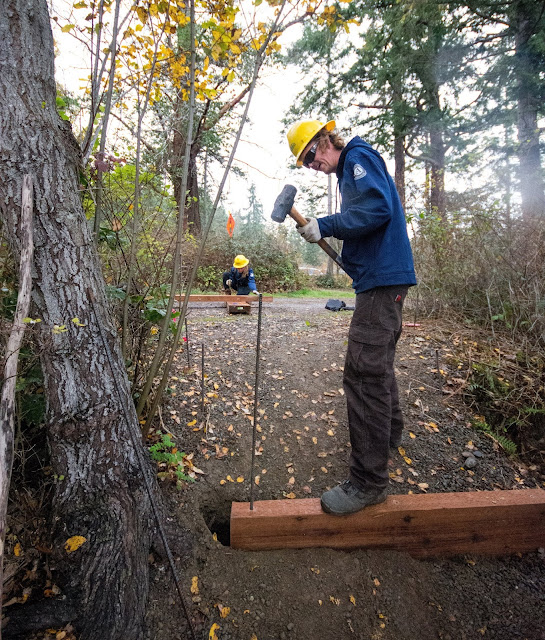
A WCC AmeriCorps member wearing a yellow hard hat pounds rebar into a piece of wood stretching across a trail.
AmeriCorps member Christian Akers installs rebar as part of the trail construction project.
Photo contributed by Owen French.
Finally, the crew planted 25 native shrubs around the staircase to prevent erosion and increase wildlife habitat. The trail improvements are part of the larger Kilisut Harbor Restoration Project, led by NOSC, that will create intertidal habitat by restoring the tidal connection between south Kilisut Harbor and Oak Bay.


Members support salmon recovery along upper Yakima basin

WCC AmeriCorps members serving the Yakama Nation collaborated with Mid-Columbia Fisheries Enhancement Group (MFEG) in mid-October to plant native trees and shrubs along a section of the North Fork Teanaway River in Kittitas County. Since the area was first designated for restoration in 2011, the final phases of this restoration project are long time coming.

In summer 2019, MFEG contracted to have several carefully engineered large woody debris structures installed in the river. The structures support salmon habitat by slowing water flow and creating small rearing pools ideal for juvenile salmon.

AmeriCorps member Isabel Casillas puts the finishing touches on a native tree along the North Fork Teanaway River. Photo by Laura Schlabach.

To restore the spaces affected by heavy log-installation equipment, AmeriCorps members led nine volunteers from Trout Unlimited who served 54 hours planting native trees and shrubs. The native plants will help secure the soil and protect the river from erosion.

In nearby Cle Elum, members also planted 4,500 native trees and shrubs along the Yakima River in six days. The vegetation will prevent erosion and eventually improve salmon habitat by shading and cooling the water, making it more conducive for spawning.

Padilla Bay visitors learn about salmon life-cycle

In addition to field crew opportunities, WCC offers an internship program called the Individual Placement (IP) program. IP Izzi Lavallee serves as an education coordinator at the Padilla Bay National Estuarine Research Reserve in Skagit County. She is part of a team that teaches free monthly educational programs for Mini Explorers (ages 3 to 5) and Junior Ecologists (ages 6 to 9).

AmeriCorps member Izzi Lavvallee wears a tan headband and carries a large salmon puppet in her right hand.
AmeriCorps member Izzi Lavallee.
Photo contributed by Izzi. 
"Each month we cover a host of different estuary related topics including curriculum like 'Awesome Eagles,' 'Marvelous Mammals,' 'Camouflage Critters,' or 'Elegant Eelgrass,'" Izzi said.  She describes an inspiring moment during a recent Junior Ecologist program.

“We learned about the importance of salmon ecologically and culturally, their role in the ecosystem, and the stages of their lifecycle. At the end of the class, I read ‘Salmon Creek’ by Annette LeBox and Karen Reczuch. It is a sonorous story about the lifecycle of salmon, told through the intimate lens of a particular Pacific wild salmon named Sumi,” she said.


The story concludes with Sumi completing her lifecycle and spawning her very own nest of eggs – known as redds. Izzi describes illustrations that beautifully capture eagles, otters, and bears feasting on the sea’s bounty, and poetic words that detail the creek’s fresh, earthy smell imprinting on Sumi’s eggs (the next generation of salmon who will return to spawn near the nest someday).

“The author leaves space for the audience to infer that Sumi has died,” Izzi said.  “A little girl with a sad and concerned look on her face asked, ‘Did Sumi die?’”

Izzi responded by gesturing to the salmon life cycle they had all drawn on the board, and it dawned on the children that Sumi’s life ended.

Izzi asked the youngsters, “Who else was able to live on in the story?”

Many small faces turned hopeful, especially after a little girl replied, “The bear and the eagle and her babies got to live because of her sacrifice” while a young boy chimed in confidently, “The cycle continues forever and ever!”

“It made me tear up a bit,” Izzi reflected. “This is why we do place-based environmental education. These kids are making connections, developing an understanding of ecology, finding love and meaning in these ecosystems. These kids are our future. Given access to rich, nourishing education, these kiddos will grow into strong advocates, stewards and protectors for our salmon creeks, for our home.”

Members distribute salmon carcasses in Chiwawa River

Our Wenatchee Spike Crew spent the first half of October adding marine-derived nutrients to the Chiwawa River using a method many likely would deem too stinky for their liking: tossing in dead salmon carcasses.

WCC partner Cascade Columbia Fisheries Enhancement Group (CFEG) is leading the five-year Chiwawa River Nutrient Enhancement Project to give the local waterway a nutrient boost.  Our AmeriCorps members quite literally carried the project in year two. During two back-to-back weeks, members carried 50-pound bags of condensed salmon carcasses (known as analogs or pellets) to dump into the beautiful Chiwawa River.

Three people wearing hip waders carry large white bags over their shoulders as they start to wade through a river.
WCC AmeriCorps members carry heavy bags of salmon analogs
to distribute in the Chiwawa River. Photo contributed by CFEG.
CFEG timed the project to mimic the nutrients that would naturally occur after returning Chinook and Coho salmon spawn. The analogs will decompose and return nutrients to the river, which will in turn provide a food source for insects juvenile salmon eat.  By the end of the second week, members had dispersed 42,000 pounds of salmon analogs to the river.

Wildlife are not the only ones who benefit from nutrient enhancement; the project afforded new AmeriCorps members  an opportunity  to get to know one another. Before hauling each 50-pound bag of salmon analog through a mile-long trek to the river, they cheered “for the fish!” to one another before lifting a bag.

AmeriCorps member Kevin Wooldridge reflected on his first spike experience. "For me, there was so much more to the project than just dumping pellets into the river," he said. "This was an opportunity to spend quality time with the members of my crew. Being able to share the experience together was one of the best parts of the Chiwawa River Nutrient Enhancement Project!"


Wednesday, December 4, 2019

Boots on the Ground: Salmon carcasses make a splash in Chiwawa River

This is my first year as an AmeriCorps member with the Washington Conservation Corps (WCC). I serve on a “spike crew” – or travel assignment crew –  based out of Wenatchee.

WCC AmeriCorps member Kevin Wooldridge*
I grew up in the Pacific Northwest and recently lived in New York City. I moved back to Washington this summer to be closer to family. I enjoy working outdoors and even once operated a smolt trap, so I knew WCC would be a good fit. Now, I’m just one month into the position but I believe the networking opportunities and hands-on experiences with our state, federal, and non-profit partners will help me decide if I want to pursue a career in the environmental field.

Day one: meeting my new crew

I met my fellow AmeriCorps members in Wenatchee on our first day of service, and we prepared for our first project on the Chiwawa River. Kelly Gilchrist, my crew supervisor,  and fellow crew members Khalil English, Rilea Dills, Chance Smith, and Bailey Haller are all awesome people with unique personalities. I look forward to serving alongside them. Since our first project was a spike, WCC provides food and lodging. So we got to stop along the way to purchase groceries. Then we headed out to meet the team from Cascade Columbia Fisheries Enhancement Group (CFEG), our partner organization for our first project.

Project orientation: Chiwawa River gets a nutrient boost

Our task during the first half of October was adding marine-derived nutrients into the Chiwawa River. This meant tossing in thousands of pounds of salmon carcasses compressed into pellets (also called analogs)! As the analogs decompose, they return nutrients to the river. As insects move in to eat the pellets, they in turn become an excellent food source for juvenile salmon. Before we started unloading bags of stinky salmon pellets from a trailer into several truck beds, CFEG Executive Director Jason Lundgren gave us a brief introduction into what we would be doing and why. As we drove to the five-mile reach of the upper Chiwawa River where we would be applying the salmon analogs, I was impressed by the breathtaking mountains, crisp air, and fall colors. I had never been to the area before and even in the cold and rain it was easy to get distracted by all the sheer beauty that surrounded us.

“For the fish!” we all chimed in before hauling the 50-pound pound salmon pellet bags through a mile-long obstacle course of thick brush and fallen trees to access the riverside. We made trip after trip, stacking bags near the river until the trucks were empty. We then donned waders and made our way to different spots in the river, being careful to avoid areas with salmon egg nests – or redds. Some of the treatment spots required we wade long distances up or downstream, which was tiring but so much fun! The last step was cutting open the bags and pouring the nutrients evenly into the Chiwawa.

CCFEG and WCC carry heavy bags of salmon analogs through the Chiwawa River before dumping them in.*

Prioritizing safety on the daily

Although we did not know exactly what to expect on our first project, we knew what precautions to take along the way. It was important to wear enough layers and have extra socks handy on rainy, cold days to keep warm. Our strenuous activities also meant it was crucial to drink enough water and consume plenty of calories. To prevent accidents, we also had to be extremely careful how we placed our feet in the river. Although these seem like basic safety measures, being mindful of them was important to successfully complete the project.

By the second week, we were experts in hauling those stinky bags around. We learned the best way to carry them, cut them open, and effectively dump the pellets in the water. We knew all the trails to the river by heart and were prepared to face any weather. We dispersed a total of 42,000 pounds of salmon analogs into the Chiwawa River!  Because we were ahead of schedule, some of us got the opportunity to help Washington Department of Fish and Wildlife with electrofishing, a fun learning experience. Electrofishing is a common technique used to sample fish populations. Biologists deliver an electrical charge into a body of water to temporarily stun and collect the fish, record data, then release the unharmed fish back into the water.

L to R: Kelly Gilchrist, Bailey Haller, Kevin Wooldridge,
Rilea Dills, Chance Smith (not pictured Khalil English).*

Inspiration and bonding

I was inspired by CFEG staff members’ passion, drive, and ability to face adversity head on every day. The life of an environmentalist can be uncertain, and it is admirable these people are doing all they can to help save local wildlife. Everyone seemed to love the work, and their passion was contagious. The feeling of being part of something larger than myself kept me going when the cold or fatigue hit. I want to give a huge “thank you” to CFEG for their hard work, and making our first project experience memorable.

This project was so much more than just dumping pellets into the river. I got the opportunity to spend quality time with my fellow AmeriCorps members! Making communal dinners, playing cards and video games, and sharing stories next to the warm fireplace after a long day outdoors made everything so much better. Being able to share the experience together was one of the best parts of the Chiwawa River Nutrient Enhancement Project.

By Kevin Wooldridge, WCC AmeriCorps member, Wenatchee Spike Crew 
*Photos contributed by Kelly Gilchrist (1, 3) and Cascade Columbia Fisheries Enhancement Group (2).

Friday, October 4, 2019

Giving back: WCC Director Bridget Talebi earns national leadership award

On Sept. 19, Bridget Talebi, director for our Washington Conservation Corps (WCC), was named 2019 Outstanding Service Program Staff Member by America’s Service Commissions. The national nonprofit, nonpartisan association represents 52 state service commissions from across the United States and its territories.

For nearly two decades, Bridget has selflessly served the residents of Washington, first as a member of our WCC starting in 2001, then in multiple roles serving the WCC including operations manager and now director of the 350-position strong statewide service program.

Bridget Talebi (WCC Director, pictured center) with Amber Martin-Jahn (Executive Director of the Serve Washington Commission, pictured right) and Jenny Benson (Program Officer for Serve Washington Commission, pictured left).*

Every year, America’s Service Commissions recognizes the leadership and accomplishments of state service commissions and their commissioners, staff, service programs, and legislative champions around the nation.

The organization’s 2019 national leadership award recognizes Bridget for her long-standing commitment to give back to her community while also strengthening the WCC, the national AmeriCorps program, and other programs in Washington providing national service to the public. Bridget is the first recipient for this new award category.

“I’m so proud to see Bridget Talebi of Washington Conservation Corps receive this national honor,” said Amber Martin-Jahn, Executive Director of the Serve Washington Commission, who nominated Talebi for the award. “Bridget is the epitome of a team player and has been a remarkable change agent for AmeriCorps culture in the state of Washington. Most recently, Bridget has done incredible work to make sure AmeriCorps recruitment and staff hiring practices are as inclusive and equitable as possible.”

WCC offers young adults and military veterans hands-on opportunities to gain experience in environmental restoration, monitoring and research, local and national disaster response services, and education projects.

Bridget’s tireless efforts on behalf of the WCC have been instrumental in helping restore and preserve hundreds of acres of riparian habitat as well as improving water quality and salmon habitat across the state.

In words of colleague Gordon White, who oversees our statewide shoreline protection and environmental review activities, “Bridget is WCC at her core. There are countless examples of Bridget digging in through difficult times. Whenever there is difficult work needing done, she is the first to volunteer.”

WCC also responds around the state and across the country to help recovery efforts in communities affected by wildfires, floods, mudslides, hurricanes, tornadoes and other disasters.

Her work has touched the lives of thousands of Washington residents, including hundreds of current and former WCC members—many of whom chose to work in environmental careers after their service.

“We are delighted to recognize Bridget Talebi as this year’s Outstanding Service Program Staff Member,” said Kaira Esgate, CEO of America’s Service Commissions. “This is the first year we have given an award in this category, and we feel that Bridget’s commitment to excellence and innovation at the Washington Conservation Corps is the perfect representation of what a great AmeriCorps program staff member can be.”

*Photo by Laura Schlabach

Friday, September 13, 2019

Boots on the ground: Serving in Shenandoah, Iowa

Our WCC AmeriCorps members serve for 11-month terms restoring habitat for salmon and wildlife, building and enhancing trails, and assisting communities after local or national disasters. Below, a member reflects on her recent experience on a disaster response deployment to Iowa.

My name is Olivia Sohn, and I serve as an AmeriCorps member and assistant supervisor on a Washington Conservation Corps field crew based out of Issaquah. With our crew supervisor Chelsea Krimme, we complete a variety of habitat restoration and trail enhancement projects across Western Washington.

My crew and I spent most of July on a disaster response deployment to Iowa, supporting communities affected by severe flooding in Spring 2019. The timing of disaster response deployments can be unpredictable; this opportunity came right as my family was visiting me in Washington from my home state of New Jersey. Just when I thought I would be driving around the Pacific Northwest with my family, showing them where I have been living for the last year and a half, I was instead packing for a 30-day deployment.

Four AmeriCorps members, wearing shirts with AmeriCorps logos, stand in front of a blue truck crossing their arms.
L to R: AmeriCorps members Tyler Ambrose, Olivia Sohn, Melanie McMillan, and Joe Merrill in Shenandoah, Iowa.*


Iowa recovers from major flooding 

Iowa experienced more snowfall than usual this past winter. In March 2019, the combination of warm temperatures and heavy rainfall caused snowmelt and rainwater to run off the already-saturated soils into the Missouri River. The river swelled to more than 30 feet near the city of Council Bluffs and breached more than 40 levees in Western Iowa. In July, the WCC sent two field crews and three crew supervisors to help suppress mold, remove debris, and muck and gut homes in Mills and Fremont Counties.

Anticipation builds

My first deployment was to Florida in December 2018, responding to the aftermath of Hurricane Michael. It took time for me to adhere to the level of flexibility that deployments demand. We moved to three different living spaces in the span of two weeks, and I learned that the combination of tackling unfamiliar projects in a new state while adjusting to new living spaces was overwhelming for me. I felt nervous on the plane ride to Iowa, anticipating my second deployment. I also felt motivated to overcome the stress I felt on my last deployment and to keep our mission at the center of my thoughts.

We stayed in the beautiful town of Shenandoah — or “The Shan” as people from surrounding towns called it. Our housing facility was a spacious, amenable community center called The Armory. I would be a strike team lead, and Chelsea was Chief of Operations and Logistics. After a couple of days of classroom training on mold suppression and field training led by WCC supervisors, my crew headed to our first house.

Six people gather for a photo in front of a house with a large blue tarp installed on the roof. Five are AmeriCorps members wearing blue shirts, and one is the crew supervisor wearing a purple sweatshirt.
The crew gathers for a photo after installing a tarp on a home in Florida.*


Serving as a strike team lead

In Florida, we spent most of the time installing blue tarps on homeowners’ roofs. I had no prior experience with muck and gut or mold suppression — our primary activities in Iowa — so I relied on my more experienced teammates when I had questions. Fellow WCC AmeriCorps member Sammy Craven co-led field teams and brought valuable knowledge and leadership skills. Each day, we suited up in protective Tyvek suits and respirators and served in two teams for 30-minute shifts at a time, suppressing mold in water-damaged homes. The weather was hot and humid, so it was critical to take breaks often.

Being a strike team lead when you are not the most technically experienced person on the team is a good lesson in leadership. Because I did not have all of the answers, it was important to consider the skills and knowledge of my teammates and strategically break them up into strong groups to enter the house for each shift. I think it is easy to feel flustered when you do not have all the answers, but utilizing available resources, including my teammates, the Incident Command Staff, and our crew supervisors, helped us succeed. 

Two AmeriCorps members are wearing full bodied, white, Tyvek protective suits and yellow hard hats while removing water-damaged material from a home.
Tyler Ambrose and Ryan Grate muck and gut a home in Percival, Iowa.*


Collaboration, inspiration, and motivation 

We were fortunate to serve with other AmeriCorps programs, including Habitat for Humanity and the National Civilian Conservation Corps. The Habitat for Humanity crew was very knowledgeable in construction and enthusiastic to help those in need. 

The energy of everyone around me was the most inspiring part of this deployment. The Incident Command Staff was dedicated to making the biggest impact that we could in our thirty days. Every morning and afternoon, the crews all worked together to load and unload trucks. It was exciting at the end of the day to hear about what the other crews and assessment teams accomplished. WCC staff and members took turns cooking dinner for the group. All this effort and energy made it feel like we were functioning as one large, multi-faceted team.

Moments of celebration amidst recovery

It was rewarding to interact and connect with homeowners on deployment. Disaster response brings you right into people’s homes and lives — it has an unavoidably personal nature. One day, we helped a kind woman named Sally sort through her personal items in her home after the water level came down. Deciding which items could stay and which should go was an emotional process. Sally was happy to share pictures of her son and late husband with us as we found them. One of my favorite moments was when we found a key to her safe that she thought she had lost. My fellow AmeriCorps member Tyler, Sally, and I all raised our arms into the air and cheered. Similar to the moments when we looked at pictures with Sally, it was a lighthearted, exciting moment on a difficult, emotionally tolling day.  

Two AmeriCorps members carry a water-damaged dryer across a lawn. They are wearing white Tyvek protectives suits and yellow hard hats.
Tyler Ambrose and Olivia Sohn remove a dryer from Sally's home in Iowa.*

Returning home to Washington state after living with this high-energy hive mentality for weeks was difficult. It was hard to leave Iowa with so much work left unfinished. On the plane ride home, I thought back to a moment from the flight to Iowa when the pilot announced the presence of our AmeriCorps Disaster Response Team on the plane. After being a part of the disaster response deployment in Iowa, I feel very proud to have served side by side with everyone. 

By: Olivia Sohn, WCC AmeriCorps member 
*Photos contributed by Olivia Sohn

Join WCC

We are currently accepting applications for 11-month members! Learn more and apply on our website. Ecology's Washington Conservation Corps, an AmeriCorps program, provides hands-on experience, field skills, and training opportunities to young adults between 18 and 25 and military veterans. WCC consists of three subprograms: the original WCC, Veteran Conservation Corps and Puget SoundCorps. 


Monday, July 29, 2019

Boots on the ground: WCC as a stepping-stone to disaster management career

A decade ago, Nina Rubenstein was swinging a pick-mattock on a Washington Conservation Corps restoration crew. Today she serves as the emergency manager for Providence St. Joseph Health’s Oregon region. It all started with saying “yes” to some exciting – and challenging – opportunities as an AmeriCorps member.

Nina grew up in the world of land conservation. Her father’s experience in the legal arena exposed her to the environmental field, and Nina joined our WCC in 2009 to gain hands-on experience. But she was further enticed by a new angle: the prospect of disaster response deployments.

Nina served on a restoration crew during her
WCC AmeriCorps member days. Photo
contributed by Nina Rubenstein.
During her first year as a WCC AmeriCorps member, Nina deployed to Mississippi to assist communities after devastating tornadoes. The deployment call arrived just before a major stand-up comedy show she was set to open, in front of an audience that included Bill Gates. “I had five minutes to decide whether to deploy, and I weighed what I would have to miss back home,” she said. “I decided to pass up the show, and disaster response turned out to be a calling. That’s pretty cool.”

A formative first - and second - deployment

She removed debris from land where homes had once stood, and led weekly safety meetings. Survivors who owned a crawfish business hosted a full crawfish boil for members at the camp where members were staying during deployment.

“I remember it being my first immersive experience in the South,” she said. Its lasting impact made her want to continue serving on disaster responses. “I decided I would not only do a second year in the WCC, but I would deploy again at any opportunity,” she said.

That opportunity arose when 360 confirmed tornadoes tore across the Southern, Midwestern, and Northeastern regions of the United States in just three days. Nina and WCC’s disaster response teams arrived in northern Alabama a month later, charged with managing a volunteer resource center.

The disaster response teams also needed a logistics coordinator. Already serving as an assistant supervisor and ready for more responsibility, Nina jumped at the chance. Leading the administrative and logistical side of the deployment meant making many phone calls to match field projects with the skill level of the volunteers.

“It was really gratifying to spend time on the phone with people who felt like they had been forgotten,” she said.

Disaster response in a new setting: a classroom

The second deployment to Alabama helped solidify her calling to disaster response. “I saw that the logistical side of things could be a much broader path, and I realized ‘I want to know what path that is,’” she said.

After returning from Alabama, Nina researched options for finishing her undergraduate degree and landed on the Homeland Security Studies program at Tulane University in New Orleans. A few months later, she finished her second service term in the WCC and headed off to Tulane University.

Nina poses at Department of Homeland Security's Center
for Domestic Preparedness in Anniston, Ala. She has visited
the training facility for healthcare emergency management
twice for different courses. Photo contributed by Nina Rubenstein.
After a deep dive into emergency management curriculum—including an in-depth study of the effects of Hurricane Katrina—Nina moved back to the West Coast and secured an emergency management coordinator position with PeaceHealth, a hospital system based in Vancouver, Wash.

She put her experience and new degree to use, building an emergency management program for the two hospitals in southwest Washington. A year and a half later, a colleague from the hospital emergency management field contacted her about a management position at Providence Health & Services in Portland. She hopped on the phone to learn more, and a month later, started her emergency manager position.


Expanding her skills, with a nod to AmeriCorps service

Nina’s team at Providence St. Joseph Health is in charge of emergency management plans for six hospitals and more than 100 clinics and acute care centers. Typical projects include developing full-scale exercises to demonstrate preparedness, including staff training, and building a disaster equipment cache for the region she serves.

She also develops protocols regarding how hospitals manage medical and trauma surge capacity—when patients occupy all beds and services might need to be scaled up to meet the demand. To prepare for mass casualty incidents, Nina designs and leads exercises like “15 ‘till 50,” where the hospital has 15 minutes to prepare to receive 50 incoming patients.

Looking back, the days of waking up at 6 a.m. to meet her WCC restoration crew in Renton provided pivotal experience along her vocational journey.

“In school, and more so now, I found that I knew what I was talking about because I had done it. Applying for jobs and school, I could say I had two years’ work experience in this field, in a supervisory role,” she said. “That was absolutely a leg up in the job market.”


Fast forward to 2019: WCC deploys to Iowa

On July 8, 2019, 10 WCC AmeriCorps members and three crew supervisors deployed to Fremont and Mills Counties in Iowa, to support communities after devastating flooding in spring 2019. Members are spending the month assisting homeowners and operating a disaster response center. Keeping safety a top priority in summer heat, teams are taking turns hydrating and resting, and donning protective Tyvek suits to conduct mold suppression and remove water-damaged material from affected homes.

 Five of our WCC crews are designated disaster response crews, though any crew has the potential to deploy. Our Washington Conservation Corps (WCC) provides disaster services in Washington and beyond, assisting communities after fires, floods, hurricanes, tornados, oil spills, and more.

WCC AmeriCorps members remove invasive species at Camp Murray.
Photo by Taylor Belisle.

Apply to WCC today

Do you want to gain hands-on environmental experience, build your résumé, and make a difference in your community? WCC is currently recruiting for the 2019-2020 AmeriCorps service year! Learn more and apply online: www.ecology.wa.gov/wcc.


Monday, April 22, 2019

Boots on the ground: Restoring habitat through partnerships in Bellingham

On Earth Day 2019, Washington Conservation Corps is thrilled to highlight nearly two decades of close partnership with City of Bellingham. The City began sponsoring WCC field crews after the tragic 1999 Olympic Pipe Line explosion in Whatcom Creek. Our AmeriCorps members’ activities along Whatcom County’s rivers and streams have helped restore more than 160 acres of critical habitat on 70 properties throughout the City and Lake Whatcom watershed. Our members serving with City of Bellingham are continuing to improve habitat along these riparian corridors to help restore local salmon runs that have suffered due to increased urbanization.

Donning waders and counting fish

Three WCC members stand around a smolt trap, a device set up in the middle of a stream. They are each holding a clip board and smiling.
WCC AmeriCorps members record smolt trap data.
Photo contributed by Paul Argites and Nick Saling.
Sometimes, a day of service on these crews means donning hip waders and counting fish! Recently, AmeriCorps members helped build the City’s first smolt trap in Padden Creek. Smolt are juvenile salmon getting ready to migrate from fresh water to the ocean. Smolt traps temporarily and safely trap any fish migrating through a water passage. Our members learned the ins and outs of smolt trap construction, and continue to help monitor these traps. In Spring 2018, members recorded more than 3,689 juvenile fish in the Padden Creek trap in a single day! 

Evaluating how fish are using a creek after habitat enhancement plays an important role in efforts to recover salmon.  “This documentation benefits these species by informing future restoration designs as well as providing data to support funding future enhancement projects,” said Sara Brooke Benjamin, coordinator for Bellingham’s environmental monitoring program.

Daylighting Padden Creek

A close-up photo of someone planting a bare-root plant. A gloved left hand is holding the stem in place while the right hand holds a dirt clump.
Our members installed more than 15,000
native plants as part of the Padden Creek
Daylight project. Photo by WCC/Ecology.

The smolt trap in Padden Creek help researchers learn about the effectiveness of the Padden Creek “daylighting” project. City of Bellingham re-routed a large section of the creek that had flowed through a concrete tunnel since the 1890s. The City constructed a nearly mile-long creek channel to replace the tunnel. Members kicked off the planting phase of the project, installing more than 15,000 native plants and ensuring freshly installed plants survived their first spring. The project has helped restore fish passage, improve water quality, and reduce flood risks for nearby residents.
WCC crews also conducted surveys for spawning salmon and their nests, called “redds.” During spring 2016, crew members walked about two miles of Padden Creek, searching for salmon and redds and recording data. Those surveys revealed that chum salmon can now access and are spawning in parts of the creek previously inaccessible to them!


Engaging the community

In addition to the restoration activities, community engagement plays an important role in project success. “The crews facilitated greater community understanding and participation by helping host three community work parties along our City streams,” said Analiese Burns, habitat restoration manager for City of Bellingham. “These crew members have contributed to our quality of life and in return, they leave with the skills necessary to continue their career of service.”

Watch a smolt trap in action

Visit City of Bellingham’s website to watch a short video on how smolt traps work, and visit Ecology's website to learn more about riparian restoration efforts in Whatcom County and statewide.

This could be your office! WCC AmeriCorps members serving in Skagit County
take a lunch break. Photo contributed by Josh Boswell.


Join WCC

We are currently accepting applications for 3-month member positions! Learn more and apply on our website. Ecology's Washington Conservation Corps, an AmeriCorps program, provides hands-on experience, field skills, and training opportunities to young adults between 18 and 25 and military veterans. WCC consists of three subprograms: the original WCC, Veteran Conservation Corps and Puget SoundCorps.


Tuesday, April 16, 2019

Boots on the ground: Empowering leaders through environmental service

Climate in Washington matters. Ahead of Earth Day, our Washington Conservation Corps (WCC) is sharing how our AmeriCorps members are helping prepare for the future with solutions rooted in empowerment and environmental service.


Developing educational curriculum

What might “Sammy the Salmon” write to their friend “Reggie the Bald Eagle” on a postcard? AmeriCorps Individual Placement (IP) member Kelsey Chun developed a new Eagle Watcher’s program this winter to teach fourth-grade students about the life cycles of these important creatures. She serves as a Youth and Community Engagement Coordinator with Mount Baker-Snoqualmie National Forest. Kelsey uses the pen-pal storyline between the salmon and eagle to illustrate their migration journeys, and mutual dependence on the Skagit River - ancestral land of the Upper Skagit Indian Tribe. Climate change affects eagles’ survival in many ways, including the bodies of water upon which they rely for fish and other food.

A collage of three photos, with the top horizontal photo featuring a group of children looking over a river with binoculars. Bottom left is a photo of WCC IP Kelsey Chun, bottom right is a photo of salmon swimming in a river with sunlight shining through.
Kelsey serves as a Youth and Community Engagement
Coordinator for Mount Baker-Snoqualmie National Forest
through WCC's IP program. Photos from Kelsey Chun.
Many of our IP members educate adults and children about wildlife, our local landscape, and climate change. Making content accessible is a priority.

“Based on feedback from the teachers and their ideas for new content, I included information related to landforms and presented many of the key vocabulary terms in both Spanish and English,” Kelsey said. “Madison Elementary is a dual language school, and the students were excited about sharing their knowledge of words for animals and the land: la águila, el salmón, las migraciones, las montañas, los ríos.”

Collaboration in restoration projects

As a keystone species and a cornerstone of the cultural identity of Pacific Northwest Indian tribes, salmon are a big deal! From local non-profits to government entities, so many people are working to make sure salmon survive and thrive. As climate change increases water temperatures across Washington, collaborating to restore and preserve salmon habitat is even more important.

A prime example comes out of Port Hadlock, where North Olympic Salmon Coalition (NOSC) sponsors one of our restoration field crews. In December 2018, the crew added native trees and shrubs to Snow Creek-Salmon Creek Unit, a site where the two summer chum and coho-bearing streams converge to enter Discovery Bay in Jefferson County. The project is a 15-year effort to restore the riparian and nearshore habitat. Partnerships between NOSC, WCC, Washington Department of Fish and Wildlife, Jefferson Land Trust, Jefferson County Conservation District, and others, is a huge part of the project’s success. 

“This [site] was originally planted by a WCC crew I led in 2003,” said WCC Restoration Specialist and Crew Supervisor Owen French. “Since then, projects have extended out to the estuary and bay, and miles upstream on both public and private lands.” Habitats at the site include scrub-shrub, marsh, and forested wetland, wet upland meadows, and estuary.

Four WCC members, wearing dark blue sweatshirts and yellow hard hats, are wearing planting bags and getting ready to plant native trees and shrubs.
AmeriCorps members serving on our NOSC restoration crew
plant native trees and shrubs at Snow Creek-Salmon Creek unit.
Photo contributed by Owen French.
Members serving with our NOSC restoration crew contribute to restoration projects by planting thousands of native trees and shrubs. Through these experiences, our members gain an understanding of the importance of collaborative relationships in long-term restoration efforts.

"The relationships I have developed let me view ecological restoration as a holistic process…serving with NOSC lets me see the evolution of watershed recovery through multiple stages and seasons, talking with employees who bring their own specialties and perspectives to the table," said WCC member Jose Garrido.

Since October, the crew has planted nearly 15,000 trees for NOSC and partner organizations at sites across Clallam and Jefferson Counties!

Empowering leaders of all types

We believe successful solutions come from diverse perspectives, talents, and backgrounds. In the WCC, this means welcoming everyone to the table, or rather, welcoming everyone to the power tool, to the opportunity to try on a leadership role for size, and to spend a year of their lives improving our environment.

One leadership opportunity we offer members is the assistant supervisor role on field crews. Selected by the crew supervisor, the assistant leads their crew on select trail or restoration projects, and attends a dedicated leadership training with other assistants from crews across the state. 

WCC Supervisor in white hat holds a piece of metal steady while Olivia, in a yellow hard hat, uses a metal cutter to break up the piece of metal.
Assistant Supervisor Olivia Sohn uses a metal cutter to break up large metal debris found along the
Pickering Barn Trail in Issaquah. Photo by AmeriCorps member Ryan Grate. 

Olivia Sohn, a first-year member from Renton, is the assistant supervisor on an Issaquah- based crew completing trail and restoration projects across King County. “This year I've had the opportunity to build my confidence working with power tools and leading the crew. It feels great to improve these skills while restoring stream habitat in Washington,” said Olivia.

Mentoring the next generation of environmental leaders and providing a foundation of hands-on experience is the core of WCC’s mission. We are grateful for our many alum supporting and leading solutions-oriented projects within environmental organizations across the state. We look forward to seeing the creative solutions our members will go on to implement!

Join WCC

We are currently accepting applications for 3-month member positions! Learn more and apply on our website. Ecology's Washington Conservation Corps, an AmeriCorps program, provides hands-on experience, field skills, and training opportunities to young adults between 18 and 25 and military veterans. WCC consists of three subprograms: the original WCC, Veteran Conservation Corps and Puget SoundCorps. 

Wednesday, December 5, 2018

Boots on the ground: WCC answers deployment calls to the Carolinas and Florida


In addition to planting native trees and shrubs along rivers and streams, and building hiking trails, our Washington Conservation Corps (WCC) members provide disaster services in Washington and across the country. Our members and supervisors have assisted communities after fires, floods, hurricanes, tornadoes, oil spills, and more. So far this fall, our members have been deployed to South Carolina and Florida to assist families after devastating hurricanes. Learn more about our latest deployments below!


Last Sunday, Dec. 2, 36 AmeriCorps members and WCC staff departed for North Carolina and Florida to assist communities after Hurricanes Florence and Michael made landfall. Members will collaborate with AmeriCorps programs from around the nation to remove hazard trees, install roof tarps, muck and gut structures, and serve as command staff to help organize the overall response effort.  Learn more about current WCC community assistance and recovery activities in a recent blog.

Our AmeriCorps members install a tarp on a home in Florida.
Photo contributed by Chelsea Krimme.

Continuing response in Florida 

Our AmeriCorps members have been serving in Florida since mid-October. The first wave of AmeriCorps members helped set up response operations in Tallahassee, train additional AmeriCorps program members, and returned home to Washington Nov. 20.

Full of fresh energy, a second wave of 24 members and supervisors arrived in Florida this past weekend, ready to hit the ground running! They spent their first few days in Panama City training on how to install roof tarps, learning command staff roles, and getting ready to move into the field to assist people and communities impacted by Hurricane Michael. Primary field projects will include removing debris and hazard trees from homes, structures, and yards. They will also potentially be involved in stripping homes down to the bare studs to remove water-damaged material and prevent mold. This activity is called “mucking and gutting.”

Chelsea Krimme, a WCC crew supervisor, demonstrates
how to safely remove a hazard tree. Photo contributed
by Leo Arias.
As of Nov. 12, AmeriCorps Disaster Response Teams, also called A-DRTs, had removed 383 hazard trees and installed tarps or performed temporary repairs on 31 homes or structures in Florida.

Answering a call to North Carolina  

We have 12 WCC AmeriCorps members and supervisors teaming up with Utah Conservation Corps to assist communities in North Carolina, based out of the town of Willard. While several will hold command staff positions, the other 10 will serve as strike teams, assisting survivors with muck and gut projects. They are focusing on suppressing mold in homes and serving as a “mobile strike team unit” –  assisting prioritized homes and structures located farther away that have yet to receive assistance.


Support continues in South Carolina

Our second wave of members serving in South Carolina arrived in mid-November and they have already settled into their roles as part of command staff. AmeriCorps member Daja Curtis, serving as a media officer for AmeriCorps Disaster Response Team, was deeply affected by the effects of the storm immediately upon arrival.

Before moving out into the field, AmeriCorps members
receive training on tarp installation procedures.
Photo contributed by Chelsea Krimme.
“After only being here for three days, I have been touched by the stories and amazing spirits of the survivors,” Curtis said. “The homeowners I've been in contact with have been underserved and faced many hardships, but they stay hopeful doing everything they can to start their lives over with a smile on their face.”

As of Dec. 4, A-DRTs have cleared 3,539 cubic yards of debris and conducted mold suppression on 11 South Carolina homes.

Learn more about WCC

Ecology's Washington Conservation Corps, an AmeriCorps program, provides hands-on experience, field skills, and training opportunities to young adults between 18 and 25 and military veterans. WCC consists of three subprograms: the original WCC, Veteran Conservation Corps and Puget SoundCorps. Recruitment for 11-month positions in the 2018-19 year has wrapped up, but six-month positions will open in January 2019! See photos of the types of projects WCC members support during their service in our WCC Projects Flickr set and WCC Featured Projects Story Map. Learn more on our website. 


Monday, November 19, 2018

Boots on the ground: WCC assists communities after Hurricanes Florence, Michael

In addition to planting native trees and shrubs along rivers and streams, and creating and improving hiking trails, our Washington Conservation Corps (WCC) members provide disaster services in Washington and across the country. Our crews and supervisors have assisted communities after fires, floods, hurricanes, tornadoes, oil spills, and more. Join us for a closer look into our recent and ongoing deployments to South Carolina and Florida to assist communities after Hurricanes Florence and Michael made landfall.


Sixty-two AmeriCorps Disaster Response Team members gather in Bennettsville
in early November (about 60 percent of the entire team). Photo contributed
by Luke Wigle.

Starting off a new service year with disaster deployment


WCC’s 285 members kicked off a new year of AmeriCorps service on Oct. 1. And just two weeks later, 12 WCC AmeriCorps members and crew supervisors traded their shovels for deployment ID badges as they departed for South Carolina to assist communities after Hurricane Florence hit in September.

Our teams were charged with setting up operations for additional AmeriCorps Disaster Response Teams (A-DRTs), and leading training sessions, such as cultural awareness, and safety, upon their arrival. Other tasks included managing volunteers and donations, and supporting call centers to record homeowners and community members’ existing projects and needs. They also headed out to the field to lead “muck and gut” efforts – stripping a home down to the studs to remove water-damaged material.

As of Nov. 17, A-DRTs had cleared 2,800 cubic yards of debris from homes and yards, and mucked and gutted 70 structures among many other accomplishments!

WCC AmeriCorps member Seth Benish and supervisor Rob Crawford team
up on the first muck and gut project. Photo contributed by Kristine Solis.


Redirected to serve in Florida


After helping establish deployment operations in South Carolina, five of our 12 WCC AmeriCorps members and a supervisor traveled to Florida to start setting up similar operations in Tallahassee. Communities there also need assistance after the devastating effects of Hurricane Michael, especially on projects like hazard tree removal and roof tarp installation.

Our teams also welcomed incoming A-DRTs from six more AmeriCorps programs from other parts of the country, and provided initial training including how to install roof tarps effectively. 

As of Nov. 12, A-DRTs also had removed 383 hazard trees and installed tarps or performed 
temporary repairs on 31 homes or structures.

WCC AmeriCorps members remove debris from
a home in Florida. Photo contributed by Paolo Rosen.

 Fresh energy in South Carolina


Members serving the initial deployment to South Carolina returned home to Washington on Nov. 15, and our members serving in Florida will return home on Nov. 20. On Friday, Nov. 16, five additional WCC AmeriCorps members departed for South Carolina to continue serving communities affected by Hurricane Florence.

Learn more about what happens leading up to and during a disaster response assignment on our latest blog. If federal authorities request and our resources allow, WCC also stands poised to help other communities in other U.S. states and territories recover from recent natural disasters.


Learn more about WCC


Ecology's Washington Conservation Corps, an AmeriCorps program, provides hands-on experience, field skills, and training opportunities to young adults between 18 and 25 and military veterans. WCC consists of three subprograms: the original WCC, Veteran Conservation Corps and Puget SoundCorps. Six-month positions will open in January 2019! See photos of the types of projects WCC members support during their service in our WCC Projects Flickr set and WCC Featured Projects Story Map. Learn more on our website

A WCC AmeriCorps member learns how to safely install a roof
tarp. Photo contributed by Paolo Rosen.


Tuesday, October 2, 2018

Boots on the ground: How does WCC respond to out-of-state disasters?

Our Washington Conservation Corps (WCC) provides disaster services in Washington and across the country. Our crews and supervisors have assisted communities after fires, floods, hurricanes, tornadoes, oil spills, and more. Join us for a closer look inside the process of how we implement out-of-state deployments and a disaster response roundup from the AmeriCorps service year that we just concluded!


A female WCC AmeriCorps member carries debris from a home in a wheelbarrow.
Our AmeriCorps members responded to severe flooding in Missouri in 2016.


WCC services requested at the federal level

The Federal Emergency Management Agency (FEMA) has a direct partnership with the Corporation for National and Community Service (CNCS), the federal agency that administers AmeriCorps. When a disaster strikes, FEMA can leverage AmeriCorps members—including our Washington Conservation Corps—to assist disaster response efforts by issuing a “mission assignment” dedicating funds for direct service in identified, underserved communities affected by the disaster. 

How do AmeriCorps members fit in?

Nationwide, 17 programs collectively respond to disaster mission assignments. Working together, they form AmeriCorps Disaster Response Teams or A-DRT. Many of these programs are similar to WCC, providing hands-on service opportunities to youth, young adults, and military veterans. 
A group of AmeriCorps members stand together holding an AmeriCorps banner.
A-DRT members gather for a photo during the third wave of
response efforts in Missouri in 2016.

‘How many crews can you send, and when can they arrive?’

When a disaster response assignment is likely, CNCS puts out a call for availability to all A-DRTs across the country. They report to FEMA how many A-DRT members are available, and when. 

In the WCC, our project coordinators manage our 52 crews and 19 individual placement AmeriCorps members. They work closely with WCC Program Director Nick Mott to determine if we are able to respond. WCC strives to respond as often as we can, while also prioritizing our habitat restoration and trail projects for our partners here in Washington. 

Upon finalizing the mission assignment, a flurry of travel plans and logistics begin. WCC staff and supervisors coordinate tools and supplies, order team identification badges, and make sure our AmeriCorps members have the information they need to pack for disaster deployments that can take them away from home for up to 30 days at a time.

WCC supervisors and members hold key leadership positions

With 15 years of disaster response experience, WCC often receives requests to take key leadership positions during disaster deployments. WCC supervisors often serve as incident commander, safety officer, or planning chief. From our experiences, WCC knows how to work in a formalized incident command structure. Their defined roles during deployments help ensure effective communication as well as smooth transitions between different waves of A-DRT members. While WCC deploys at least one of our five disaster response specialists each mission assignment, any WCC crew has the potential of deploying.

A WCC AmeriCorps member checks to make sure their fellow AmeriCorps member's respirator face mask fits properly.
Personal protective equipment such as Tyvek suits and respirators
help keep members safe during field assignments.
After A-DRTs arrive, our WCC supervisors and AmeriCorps members lead and participate in trainings. They also set up forward operating bases or primary “hubs” in identified communities. This means another wave of details and logistics: securing food distribution, laundry and shower facilities, tool and equipment storage, and more!

Then, members head out to assist communities in need in the form of “strike teams.” AmeriCorps members receive training to complete a variety of field tasks, including:
Removing hazard trees from homes and structures.
Installing blue tarps and making temporary roof repairs. 
“Mucking and “gutting” – a term for stripping a home to remove water-damaged material.
Removing debris from homes and yards.
Conducting mold suppression.

WCC’s training program also focuses on managing volunteers and volunteer reception centers as well as mental health, safety, and communications needs. 

Year-in-Review: 2017-2018 Disaster Response

In addition to restoring salmon habitat, planting native trees and shrubs, and building trails, the 2017-2018 AmeriCorps service year was a whirlwind of disaster response accomplishments! WCC embarked on the largest deployment in program history due to an unprecedented request from FEMA after Hurricanes Harvey, Irma, and Maria made landfall in September 2017.

In six months, WCC deployed two-thirds of program member and staff to Texas, Florida, U.S. Virgin Islands, and Puerto Rico to assist underserved communities after these devastating hurricanes.

In response to the hurricanes, WCC and A-DRT:
Mucked and gutted 611 structures.
Cleared 53,979 cubic yards of debris from homes and yards.
Temporarily repaired or installed tarps on 544 roofs.
Sorted 132,713 pounds of donations.
Removed 2,284 trees posing a hazard.

AmeriCorps members gather for a group photo behind pallets full of sandbags that they filled.
Our AmeriCorps members filled and placed sandbags in
three eastern Washington counties in May.
When local disasters occur, local and tribal government partners also request WCC assistance. In May, WCC deployed teams to fill and stack sandbags for residents in Ferry, Okanogan and Pend Oreille counties after severe flooding. We also responded to 12 wildfires, mostly in northwest Washington. In total, 258 members and staff provided nearly 120,000 hours to communities in need over the course of last year.

Learn more about WCC

Ecology's Washington Conservation Corps, an AmeriCorps program, provides hands-on experience, field skills, and training opportunities to young adults between 18 and 25 and military veterans. WCC consists of three subprograms: the original WCC, Veteran Conservation Corps and Puget SoundCorps. Recruitment for the 2018-19 year is just wrapping up, but six-month positions will open in January 2019! See photos of the types of projects WCC members support during their service in our WCC Projects Flickr set and WCC Featured Projects Story Map. Learn more on our website.

AmeriCorps members stand shoulder-to-shoulder along a trail they recently improved.
Our AmeriCorps members restore habitat for wildlife and salmon, and build and
maintain backcountry and urban trails across Washington.