Ecology’s Water Quality Program is offering more than $183 million in financial assistance for 106 high-priority clean water projects across the state. The funding includes $169 million for 105 new projects and $14 million to fully fund a project from last year’s list. Offers went out to the successful applicants on June 28 and the projects can start as soon as the agreements are finalized.
“Nearly 90 percent of our state’s water quality funding goes to local communities,” said Heather Bartlett, Ecology’s Water Quality Program Manager. “Clean water projects can be in communities big or small and anything from enhancing wastewater treatment systems to designing stormwater gardens to planting trees along rivers.”
Our Water Quality Combined Funding Program supports local communities by helping them upgrade sewage treatment systems, manage polluted stormwater runoff, and complete a variety of other projects to prevent and cleanup pollution. More than $100 million of our combined funding is for new projects that will help support Puget Sound recovery. These projects are a high priority, as they help improve water quality and create a healthy habitat for the endangered Southern Resident Orca, salmon, and the food web they rely on.
Clean water funding comes from a mix of state and federal funds for water quality improvements and protection. State financial managers calculate that 11 direct and indirect jobs are created in Washington for every $1 million spent on building clean water infrastructure.
Our
interactive map shows where the projects are located and provides additional details. Below you'll find a few of the project highlights.
Reducing stormwater pollution
 |
The South Fork of the Palouse River will benefit from a new
stormwater decant facility in Pullman.
|
Ecology is offering $33 million in grants to 38 communities to implement projects to treat and reduce stormwater pollution. More than $20.5 million of the stormwater grant funding is for Puget Sound recovery projects, as stormwater runoff is a leading pollution threat in urban areas. The highest-priority stormwater projects include:
- The City of Pullman in Whitman County was offered a $525 thousand grant to design and build a new stormwater decant facility. The City’s current facility is undersized and not connected to the City’s sewer system. The new facility will help improve water quality in the South Fork Palouse River, as untreated stormwater has been identified as an important source of pollutants to the river.
- The City of Bremerton in Kitsap County was offered a grant of more than $800 thousand to construct a system to treat runoff from 6.31 acres of urban roads and parking lots and 8.32 acres of other surfaces to improve the water quality of Ostrich Creek. The creek is considered to be the most polluted stream in Kitsap County, with restrictions on contact due to pollution. The project was the highest rated stormwater project among this year’s applications, and it is a high priority in the Puget Sound Action Agenda.
- The City of Tacoma in Pierce County was tagged to receive a $5 million grant and more than $2.7 million in loan to retrofit stormwater treatment on nearly 27 blocks of failed residential roadway in the Larchmont Neighborhood. The project will treat stormwater and reduce stormwater flows from 43 developed acres through infiltration, using permeable pavement and sidewalks. The project will help restore more natural hydrologic conditions to Flett Creek and Chambers Creek.
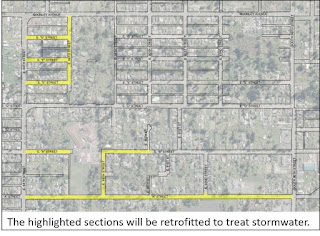 |
This planning map shows the blocks in Tacoma's Larchmont
Neighborhood that will receive stormwater retrofit.
|
Addressing nonpoint pollution
Nonpoint pollution comes from activities that are usually widespread across an area without a single pollution source. Nonpoint pollution is a serious pollution problem across the state, and one of the most difficult to solve. We are helping to address nonpoint pollution by funding 33 projects with $21.4 million in grants, forgivable loans that do not have to be repaid, and low interest rate loans.
- The projects offered funding include an expansion of the highly successful Regional Loan Program for repairing and replacing failing onsite septic systems at homes and small businesses. The program currently includes 15 counties, but with the new funding it is expanding to Pend Orielle, Stevens, Ferry, Skagit, Okanogan, Benton, and Franklin. It is expected that loans will be available in these new areas by September, 2019.
- The Underwood Conservation District in Klickitat County was offered a $250 thousand grant to conduct riparian planting, install cattle exclusion fencing, implement livestock best management practices, monitor water quality, and provide education and technical assistance in the White Salmon River Watershed. The primary areas of focus for the project are streamside agricultural areas in the Trout Lake Valley.
- The Cascadia Conservation District in Chelan County was offered a $245 thousand grant to implement a large-scale riparian restoration plan through a community-wide clean water outreach and education campaign and to provide technical assistance to landowners to take steps to reduce nonpoint source pollution and practice good stewardship. The project is consistent with actions recommended in locally-developed water quality improvement reports and management plans.
Supporting wastewater treatment projects
 |
A leaking, exposed outfall pipe that goes into
Olequa Creek could be replaced with new funding.
|
Ecology is offering $124 million for 35 wastewater treatment projects. Of this, $110 million is for new projects and $14 million is to fully fund a project from last year’s list. Nine of the projects qualified for hardship financial assistance due to their potential impact on residential sewer bills. These hardship projects may receive a combination of grants, forgivable loans that do not have to be repaid, and low interest rate loans. High priority wastewater hardship projects include:
- Yakima County was offered nearly $1.5 million in grant and $700 thousand in loan to design and construct critical repairs and improvements at the wastewater treatment facility in the community of Buena. The repairs and improvements are necessary to ensure proper treatment of the wastewater discharged from the facility. The project was the highest rated among all projects submitted for funding this year.
- The City of Vader in Lewis County was awarded $4.8 million in grant and loan to protect Olequa Creek by constructing significant improvements to its wastewater treatment facility. The funding for the project is approximately half grant and half loan.
Adequate funding in state budgets for the Centennial Clean Water Program is vital for helping small, financially challenged communities such as these to complete important wastewater projects. The program also provides funding for many nonpoint pollution control projects across the state.
More information
We’re looking forward to seeing these projects take off! In the coming months, we plan to share updates and clean water successes. If your
community is receiving funding for clean water projects and you’d like to share
your project’s progress, please let us know by emailing Emma Kluzniok at
emma.kluzniok@ecy.wa.gov.
Find out more about the Water Quality Combined Funding Program on
our website.
More information on this funding cycle, including a link to the funding offer list and an interactive map of our offered funding for projects can be found on our
funding cycles webpage.
A map of recent clean water projects across the state can be found on our
Ecology Grants and Loans map.
By Daniel Thompson and Colleen Keltz, Water Quality Program


