
 |
| The Washington state ferry "Salish." |
“Monitoring of Puget Sound is important because it helps us understand long-term trends and changes over time,” said Carol Maloy, Department of Ecology marine scientist. “Monitoring helps us separate if changes are natural or human-caused. If changes are human caused, perhaps there are steps we can take to reverse the problems.”
 |
| This poster will soon be hung inside the ferry for passengers to read. |
Scientists intentionally chose Admiralty Reach, the stretch of water across the mouth of Puget Sound, where the ocean water comes in and the fresh water moves out to sea. The narrow constriction point between the Strait of Juan de Fuca and Puget Sound is a relatively shallow bottleneck and makes it a good place to measure water exchange and circulation between Puget Sound and the Pacific Ocean.
The water velocity information will help scientists understand how much Puget Sound is influenced by the ocean. In particular, they hope it gives them a handle on how much low-oxygen water and corrosive water with very low pH may be coming into Puget Sound from the ocean.
Low-oxygen water is a problem because aquatic life needs oxygen to thrive. Aquatic life can also be sensitive to low pH. The information will also help scientists understand nutrients and algae blooms. This testing will increase understanding about the transport of toxic chemicals and ocean acidification.
Creative and cost effective
“This is a great example of a creative and cost-effective collaboration that will help us better understand the complex marine ecosystem of Puget Sound,” said Ken Dzinbal of the Puget Sound Partnership.Jim Thomson, principal oceanographer at the University of Washington Applied PhysicsLaboratory added, “The Port Townsend-Coupeville ferry makes multiple runs per day, so this gives us unprecedented, continuous monitoring data that we’ve never had before.
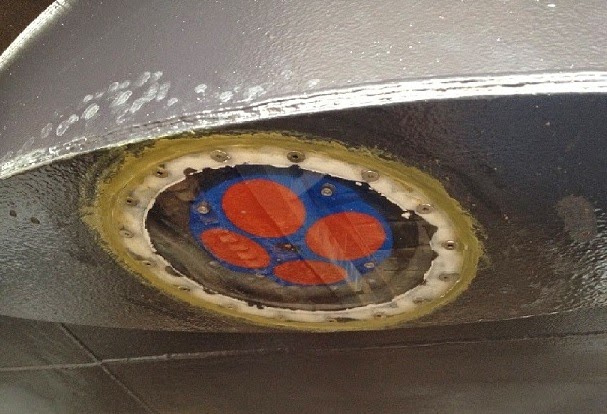 |
| The Acoustic Doppler Current Profiler as it looks installed in the hull of the Washington State Ferry "Salish." |
How do the sensors work?
The sensors are called Acoustic Doppler Current Profilers, or ADCPs. They send tiny sound waves (pings) down through the water column beneath the ferry as it is underway. The technology is very similar to the ‘depth sounders’ and ‘fish finders’ used on many recreational vessels.Particles in the water column reflect the sound back. The time it takes for the echoes to return to the ADCP is used to calculate the distance beneath the ship, and the Doppler shift of the ping is used to calculate speed and direction (velocity) of the water flowing under the ferry. Soon the sister ferry Kennewick will also be outfitted with the sensor.
Innovation began in 2009 with Clipper Navigation, Inc.
The state’s innovation began in 2009, when the Department of Ecology gained permission to install oceanographic sensors on the private passenger ferry Victoria Clipper IV that transits between Seattle and Victoria.
The sensors measure phytoplankton concentrations, turbidity, freshwater influence, salinity, and water temperatures during the ferry's twice-daily runs.
Now in the program’s fifth year, the Victoria Clipper monitoring program is helping us better understand algae blooms, plankton food web interactions, river plumes, and changes over time in Puget Sound. “We thank the operators of the Victoria Clipper for generously working with us – it’s been a great partnership that continues,” Maloy said.
 |
| Location on ferry of the acoustic doppler current profiler |
Project partners include the Washington Department of Ecology, the University of Washington Applied Physics Laboratory, Clipper Navigation, Inc., Washington State Ferries, the Puget Sound Partnership, the U.S. Environmental Protection Agency (EPA) and Integral Consulting, Inc.
View a video about the Washington State Ferries sensor and a poster of how the science works at http://www.apl.washington.edu/project/project.php?id=ferries_for_science.


