Showing posts with label #EyesUnderPugetSound. Show all posts

Wednesday, December 11, 2019

Brighten your holiday season with the northern opalescent nudibranch


Eyes Under Puget Sound — Critter of the Month

This month’s aquatic critter looks like a luminous holiday spirit carrying dozens of flickering candles. Definitely don’t try this at home, no matter how festive the effect might be!

Glow your own way

A translucent white and orange sea slug with tentacles extended crawls towards the camera across a pink and black background.

Hermissenda crassicornis from Hurst Island,
British Columbia. Photo courtesy
of Kevin Lee,
diverkevin.com.
The northern opalescent nudibranch has been called the most beautiful invertebrate in Puget Sound, and it’s easy to see why. Outshining its drab land slug cousins, this “sea slug” seems to radiate its own glowing light. With variable blue, orange, and snow-white markings, it’s ready for a holiday party! However, it’s more of a warm-weather fan, commonly found during spring and summer on intertidal and shallow subtidal habitats. These include mud flats, eelgrass, dock pilings, and rocky pools.

Mistaken identity

Kingdom Animalia, Phylum Mollusca, Class Gastropoda, Order Nudibranchia, Family Myrrhinidae, Genus Hermissenda, Species H. crassicornisThe northern opalescent nudibranch, or Hermissenda crassicornis, was once thought to occur all over the west coast. But in 2016, genetic analyses revealed that there were actually two west coast species: H. crassicornis, occurring from Alaska to northern California, and H. opalescens, occurring from northern California to Mexico. The southern species appears the same, but it doesn’t have white lines running down the cerata — those candle-like projections along the animal’s back, used for respiration.

To avoid confusion, the northern opalescent nudibranch is sometimes referred to as the “thick-horned nudibranch” in the area where the two species overlap. The “horns” are actually a pair of large tentacles, each with a tiny eye at the base. Behind the tentacles are a pair of sensory organs called rhinophores, used to “smell” prey. This species is so good at smelling that it can use the unique chemical signatures of its favorite prey species to pinpoint their locations — a skill known as chemotaxis.

Top view of a translucent white sea slug sitting atop a round patch of bright orange bryozoan encrusting a dark gray rock.

Photo of Hermissenda crassicornis
by
Minette Layne, Seattle, Washington.
This file was downloaded from Wikipedia
and is licensed under the Creative Commons
Attribution-Share Alike 2.0 Generic license.

Movable feast

A white slug with its tentacles and pointed tail extended. On one side, the rounded edge of the glass dish curves across the dark gray background.
Dorsal (top) view of a northern opalescent nudibranch crawling in a glass petri dish.
Photo courtesy of Dave Cowles,
wallawalla.edu
At a holiday buffet, this nudibranch would certainly be a member of the Clean Plate Club. In lab tests, it eats pretty much anything offered, including tunicates, worms, crustaceans, small clams, and even dead things. However, its prey items of choice are cnidarians such as hydroids, sea anemones, and sea pens (in Puget Sound, it is a main predator of the orange sea pen, Ptilosarcus gurneyi). These cnidarian prey contain a secret ingredient that is at the top of the nudibranch’s wish list — stinging cells called nematocysts. The nematocysts don’t hurt the sea slug, but pass directly through to its cerata, making it toxic and distasteful to potential predators. For this reason, it doesn’t have camouflage and doesn’t need it…the bright colors warn predators to nibble at their own risk!
Head-on view of a white and orange sea slug on a green and pink background.

A northern opalescent nudibranch crawls across
an encrusted rocky habitat amongst snails and chitons.
Photo by Kirt Onthank, August 2007,
wallawalla.edu.


Naughty or nice?

Beneath the northern opalescent nudibranch’s cheery exterior lies the heart of a true humbug. When one nudibranch touches another of the same species, a fight is imminent, complete with lunging and biting (including biting off chunks of the other’s head — ouch)! In some cases, the winner of the altercation eats the loser.

Despite their violent tendencies, these feisty critters can have a positive impact on human lives by sacrificing their own. They are easily reared in labs and have been used extensively for biomedical and behavioral research, including learning and memory studies and studies on lead toxicity. Maybe every grinch has a softer side after all.

By Dany Burgess, Taxonomist, Environmental Assessment Program

Friday, August 30, 2019

Our scientists contribute to “global biodiversity library”

Eyes Under Puget Sound

Video provided by www.hakai.org.

Last week I was in sunny Los Angeles for the third and final west coast invertebrate “bioblitz” of the summer — the LA Urban Ocean Expedition (LAUOE). While the LA scenery was certainly different from home, the work I did there was a continuation of my previous work helping other marine scientists catalog invertebrate biodiversity! This work is crucial for documenting species before they disappear. The event also gives us an opportunity to communicate to the public just how important invertebrates are to the healthy function of marine ecosystems.

Bioblitz selfie! I had just settled in at my microscope station.  Working alongside some of the West Coast’s expert taxonomists
for a week was an incredible experience.

Crack the code

Our marine scientists held a similar bioblitz this past spring, where we collected and identified as many live sediment-dwelling invertebrates as possible from Puget Sound. “DNA barcoding” events like these are happening all over the U.S. and worldwide. Washington, Oregon, and California are just the latest to join in the effort.

During a bioblitz, tiny pieces of tissue are taken from each animal collected. These tissue samples will be sent to the Smithsonian Institute, where DNA will be extracted and analyzed to determine a unique genetic sequence for each species. The resulting DNA barcodes will be added to a global biodiversity library that taxonomists like me can use to identify species and determine if species are new to science — including undescribed species from Puget Sound! We can use this information to better understand how invertebrate communities respond to environmental stressors, like those associated with climate change.


Under the microscope

Daily operations are continuing for the rest of this week at the AltaSea facility at the Port of LA, where a pop-up lab is staged with flow-through saltwater systems, microscope stations, and docks for dive boats to pull up with fresh specimens. Taxonomists from all over the country were invited to participate, so I felt very fortunate for the opportunity to learn from them about the intertidal invertebrates of Southern California. Some species were familiar, but many aren’t found as far north as Washington, so this gave me a bit of a challenge. One of the highlights was having a worm I identified — the Sandcastle Worm, Phragmatopoma californica — win a “Species of the Day” contest!

Los Angeles BioBlitz Critters

Reaching out


LAUOE is sponsored and organized by staff from the Natural History Museum of Los Angeles County. They invited school groups, community members, and business professionals to meet ocean scientists, tour the lab, and even touch and sort live critters.

Many people living in urban environments don’t realize how many amazing animals live right at their doorstep. Engaging the public in these types of events fosters an appreciation for the natural world that can later translate into more successful conservation efforts.


By: Dany Burgess, Environmental Assessment Program

Critter of the Month

Our benthic taxonomists, Dany and Angela, are scientists who identify and count the benthic (sediment-dwelling) organisms in our samples as part of our Marine Sediment Monitoring Program. We track the numbers and types of species we see in order to understand the health of Puget Sound and detect changes over time.

Dany and Angela share their discoveries by bringing us a Benthic Critter of the Month. These posts will give you a peek into the life of Puget Sound’s least-known inhabitants. We’ll share details on identification, habitat, life history, and the role each critter plays in the sediment community. Can't get enough benthos? See photos from our Eyes Under Puget Sound collection on Flickr.

Tuesday, July 30, 2019

The striped nudibranch: Don’t mess with this ferocious sea slug!

Eyes Under Puget Sound’s Critter of the Month


Microscope footage of the sea slug, Armina califorica.
A striped nudibranch, Armina californica,
collected from Nisqually Reach,
Washington, March 2019.
July’s critter may be cute as a button, but don’t let the squishy sea slug face fool you. This voracious hunter strikes fear into the hearts of tiny invertebrates everywhere!

Slug of the sea

Genus: Armina; Species: Armina californica.Nudibranchs, or sea slugs, are the more elegant, marine-dwelling cousins of the slimy brown slugs you find in your garden. The striped nudibranch can get fairly large (up to 8 cm) and should be easy to spot. You won’t find one on a beach walk or tidepooling session though. They prefer the sandy or muddy seafloor anywhere from the low intertidal zone to 80 meters deep. We collect them in our Puget Sound sediment samples from Nisqually Reach, Everett, and Sinclair Inlet … often co-occurring with their favorite food, sea pens.

The pen is NOT mightier than the slug

Striped nudibranchs feed primarily on colonial animals called sea pens. In Puget Sound, their two main prey species are the orange sea pen, Ptilosarcus gurneyi and the slender sea pen, Stylatula elongata. 

In the southern part of their range (California to Panama), they also feed on the sea pansy, Renilla koellikeri. These species can bioluminesce, or give off light, when disturbed, so munching by sea slugs can set off a tiny underwater fireworks display!

Night terrors

Four sea slugs eating an orange sea pen.
Striped nudibranchs swarm and consume an orange sea pen until
only the white skeletal rod remains (visible in upper right corner).
Photo by Neil McDaniel.* 
Striped nudibranchs cleverly let the routine of their prey determine their activity schedule. Instead of wasting time crawling around during the day when sea pens are buried in the sand, they stay buried too, with only their rhinophores, or sensory structures, protruding. 

The rhinophores help the nudibranchs “smell” chemicals in the water that indicate food is nearby, and they can detect changes in light with a pair of tiny eyes. When night falls they emerge, searching for fleshy victims to devour. The nudibranchs use suction to ingest pieces of the sea pen’s tender polyps, pulling the tissue off and leaving only the hard white rachis, or skeleton, behind.

Microscope image of sea slug.Pretty with poison

You would think plenty of animals would be happy to give the striped nudibranch a taste of its own medicine in the predation department, but even the ravenous sun star, which eats pretty much everything in its path, gives this little nudibranch a wide berth. In fact, the striped nudibranch has very few natural predators. So, what makes this slow-moving nudibranch so unappetizing? It can incorporate chemicals from the tissue of its sea pen prey into its own body, making it toxic to consume.
The underbelly of the sea slug.
This lateral (side) view shows the groove on the right side of
the animal, with the anus to the left (posterior) and the gonopore
(reproductive opening) to the right (anterior). Image courtesy of
Dave Cowles, wallawalla.edu.

In the groove

While the striped nudibranch may be the stuff of nightmares to a sea pen, it’s a daydream for a mollusk taxonomist. Most nudibranchs are difficult to identify, but the distinct long white ridges and dark background of this species are very distinct. It has no appendages on its top surface except for the rhinophores, which project out of a notch on its head; everything else is tucked away in a groove running down the side of the animal’s body. Hidden away in these folds are flap-like gills, the anus, and the reproductive opening.

Doing it all

Like other sea slugs, striped nudibranchs are hermaphroditic (possessing both male and female sex organs). Any two individuals can mate by connecting the reproductive “ports” on the right sides of their bodies. Eggs are laid in brownish spirals, and larvae hatch out into the water column to eventually settle and become tiny striped terrors in their own right!

By: Dany Burgess & Angela Eagleston, Environmental Assessment Program


Critter of the Month

Dany and Angela out on a research vessel. Our benthic taxonomists, Dany and Angela, are scientists who identify and count the benthic (sediment-dwelling) organisms in our samples as part of the Marine Sediment Monitoring Program. We track the numbers and types of species we see in order to understand the health of Puget Sound and detect changes over time.
Dany and Angela share their discoveries by bringing us a Benthic Critter of the Month. These posts will give you a peek into the life of Puget Sound’s least-known inhabitants. We’ll share details on identification, habitat, life history, and the role each critter plays in the sediment community. Can't get enough benthos? See photos from our Eyes Under Puget Sound collection on Flickr.

* This work is licensed under a Creative Commons Attribution-Noncommercial-Share Alike 4.0 License.

Thursday, June 27, 2019

Celebrate Pride! The Ornate Tube Worm sports all the colors of the rainbow

Eyes Under Puget Sound's "Critter of the Month"

June is LGBTQ+ Pride Month, and in the spirit of celebrating diversity—both invertebrate and human—we’re featuring a critter that wears its rainbow colors with pride every day of the year. Meet one of Puget Sound’s most beautiful creatures: the ornate tube worm, Diopatra ornata.

Ornate Tube Worm under the microscope.
Diopatra ornata collected from subtidal sediments at Nisqually Reach.

Breathe with me

Like many other species of polychaetes, or marine segmented worms, D. ornata has gill structures called branchiae on each segment, which help pull oxygen from the surrounding water and sediment. In D. ornata, the branchiae are distinctly spiraled and look like frilly trees or ferns running down either side of its iridescent body. The bright red color of the branchiae comes from the blood vessels inside—if you look closely at the live worm, you can see them expanding and contracting to help circulate blood throughout the body.

Family: Onuphidae, Genus: Diopatra, Species: Diopatra ornata.

Fancy digs

The “ornate” parchment-like tube of a Diopatra worm gets its name, and decorative appearance, from the bits of shells and algae attached to the hook-shaped top end, which projects from the sediment surface. Although only a few centimeters of tube are exposed above the sand, the buried portion may extend down as much as a meter!
Photo courtesy of Jeff Adams, Washington SeaGrant.

The tube’s adornments, which the worm sticks on with mucus, not only serve as camouflage from predators, but also encourage small animals to colonize the outside. In some parts of D. ornata’s range, especially off the central California coast, the tubes occur in great densities, forming mats that provide complex habitat for macroalgae (seaweed) and other animals. The little communities of organisms on the outside of the tubes may also serve as a built-in snack bar when the worms get hungry.

Left: Shell-covered tube worm protruding from the sand. Right: Shell-covered tube worm removed from the sand.

Left: A shell-covered Diopatra ornata tube protrudes from sandy sediment (photo courtesy of Kevin Lee, www.diverkevin.com). Right: This tube has been dug up, showing the bare end that stays buried in the sand (photo courtesy of Jeff Adams, Washington SeaGrant).

Jaw-dropping

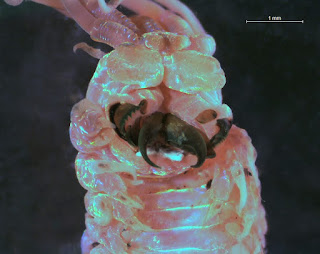
Close-up of the Ornate Tube Worm's jaws under a microscope.

Ventral (bottom) close-up of a preserved
Diopatra ornata specimen
with its jaws extended.
Scientists disagree on what D. ornata’s favorite food is—perhaps because it likes them all! It is perfectly happy munching on detritus (organic matter), but can also grab pieces of seaweed or small invertebrate prey in its rather fearsome black jaws. It has no eyes, but can sense the world with five long antennae attached to its head.

Diopatra like to build their tubes in sand rather than fine mud, so in Puget Sound, we see them most frequently where the sediment is coarse, such as around Nisqually Reach and East Anderson Island. So next time you’re walking on the beach at low tide and spot a large debris-covered tube sticking out of the sand, chances are you’ve encountered the home of one of these ornate beauties!

By Dany Burgess & Angela Eagleston, Environmental Assessment Program


Critter of the Month

Our benthic taxonomists, Dany and Angela, are scientists who identify and count the benthic (sediment-dwelling) organisms in our samples as part of our Marine Sediment Monitoring Program. We track the numbers and types of species we see in order to understand the health of Puget Sound and detect changes over time. 

Dany and Angela share their discoveries by bringing us a Benthic Critter of the Month. These posts will give you a peek into the life of Puget Sound’s least-known inhabitants. We’ll share details on identification, habitat, life history, and the role each critter plays in the sediment community. Can't get enough benthos? See photos from our Eyes Under Puget Sound collection on Flickr.

Thursday, November 1, 2018

Monitoring is essential to Puget Sound

Data focuses on climate impacts, nutrient pollution

The recent death of young orca J-50 sent a clear message: It’s more important than ever to dig in and understand what is happening in Puget Sound. It’s urgent. 

Since 1998, 40 orcas have been born and survived – but another 73 newborn orcas have gone missing or died. These are clearly not good odds. The numbers clearly support the recent formation of the Southern Resident Killer Whale Task Force.

While the Task Force considers immediate actions to address the decline of orca populations, science teams are refocusing their work, too. 


Emphasizing climate change and nutrient pollution 

Map of Puget Sound with dots plotted on the map that representation some monitoring stations.
Areas Ecology monitors sediments
and benthos.

A multitude of drivers affect Puget Sound’s ecosystem. And these drivers have changed over the past 30 years since Ecology began monitoring the seafloor. Warming temperatures, changing river flows, increased ocean acidity, and accumulating toxic substances can affect seafloor sediments and the sea creatures that live within them at the bottom of the food chain.  

We recently adapted our sediment monitoring program to collect data that will help better understand the effects of climate change and of nutrient pollution flowing into the sound. We took the best aspects of our former work and used it to develop the new program. The program consists of 50 sampling stations collected Puget Sound-wide, in addition to 30-36 sampling stations in each of the six largest urban bays.  

Findings from the new approach will be used to answer questions related to the effects of toxics, nutrients, and climate change pressures on Puget Sound’s sediments and benthos. 


Samples and data support many efforts

We’ve been monitoring Puget Sound seafloor sediments and the invertebrates (benthos) that live within them since 1989. We’ve gathered more than 1.5 million invertebrates and 3,000 sediment samples. We track the numbers and types of species we see in order to understand the health of Puget Sound and detect changes over time. The extensive collection supports researchers, state agencies, and local governments.

The most publicized results of our data are the Vital Sign Indicators for Puget Sound.  These high-level environmental indicators are used by the Puget Sound Partnership, a state agency that leads the region’s collective effort to restore and protect Puget Sound.

We partner with many researchers to leverage our sampling efforts to learn about other impacts to Puget Sound. For example, we collect sediment for University of Washington researchers who study foraminifera, small, shelled organisms that live in sediments.  Changes in communities of these organisms over time may be indicative of effects from ocean acidification in Puget Sound. UW scientists also examine our samples for microplastics that end up in the sediments, while another group studies a species of algal cysts in sediments that can cause harmful algal blooms. 


Looking to the seafloor for answers 

The seafloor might not be the first thing the average person thinks about when considering the health of Puget Sound. But to understand what is happening at the top of the food chain, scientists and researchers need to understand what is happening throughout the entire system, beginning with the bottom. The sediments of the seafloor.  Organisms that spend most of their lives in the sediments are easy to collect and are reliable indicators of sediment and water quality. 
Image of marine food web. It shows the small benthos at the bottom of the food chain on the seafloor, fish that eat the benthos and all the larger mamals in the food chain all the way to the orca whale at the top of the chain.
Marine food web diagram. Ecology monitors the tiny
creatures at the bottom of Puget Sound.


Sharing knowledge

Passing on knowledge is an important part of our work. Over the years the large collection of preserved invertebrates and many specimens have been loaned to the South Sound Estuarium where they are used to educate the public. To reach younger generations, our sediment monitoring specialists have worked with undergraduate and graduate students in regional colleges, and they participate in community outreach events, including the South Puget Sound Community College’s science, technology, engineering and math (STEM) camp for middle-school girls.

Today, we need to collect data about the quality of all elements of the Puget Sound ecosystem that can inform groups like the Southern Resident Killer Whale Task Force and decision-makers who are working to rehabilitate Puget Sound.

Visit our website to learn more about work related to Puget Sound.

By Camille St. Onge, communications

Monday, October 29, 2018

Eyes Under Puget Sound: critter of the month – the skeleton shrimp


Skeleton shrimp on sea grass
A female skeleton shrimp sways spookily with the ocean current.

This Halloween, we’d like to introduce you to one of the most bizarre groups of crustaceans in Puget Sound – the skeleton shrimp. From their spindly skeletal bodies to their creepy waving movements, these otherworldly critters are bound to make your skin crawl!

Skeleton crew

Kingdom: Animalia; Phylum: Athropoda; Class: Malacostraca; Order: Amphipoda; Family: Caprellidae.
If you can put aside their alien appearance, skeleton shrimp are fascinating creatures. Unlike most of their cousins in the order Amphipoda (which actually do resemble tiny shrimp), the skeleton shrimps (or “caprellids”) are specialized for clinging rather than swimming in marine habitats. If they want to move, they have to crawl along like inchworms. They also have adaptations for camouflage, changing colors to blend in with their surroundings. You can find them hiding among other invertebrate critters on docks and pilings, using their hook-like back legs to hang on to the plant-like fronds of colonial hydroids and bryozoans. They can also be found in beds of seaweed and eelgrass, their lanky bodies waving about in the water current.

Skeleton shrimp microscope images
Left: Caprella mendax.
Center: A female Tritella pilimana broods her eggs in a special pouch. Image courtesy of Dave Cowles, wallawalla.edu.
Right: Tritella pilimana.

Skeleton at the feast

Skeleton shrimp have varied feeding methods – some species are filter feeders that wait for food to come to them, while others are predators, hunting for worms and crustacean larvae. Some eat detritus (dead particulate material), and some species like to munch on tiny microalgae called diatoms. In fact, skeleton shrimp are so good at grazing on diatoms that their presence is thought to keep eelgrass beds healthier by removing diatoms that encrust the blades. Fish and larger invertebrates pass these nutrients up to the higher trophic levels when they eat the skeleton shrimp.


Poison punch

Gnathopod (claw) of the male skeleton shrimp

The male gnathopod of Caprella cf californica.
A skeleton shrimp’s unusually large claws, called gnathopods, play an important role in their mating behavior. In some species (including species of Caprella found in Puget Sound), the male’s gnathopods are armed with a poison-producing gland. The toxins they make aren’t harmful to humans, but when two males fight over a mate, the outcome can be deadly.


Naked truth

Mating can be tricky for these critters because their window of opportunity is short. Like all arthropods, they shed their exoskeletons to grow in a process called molting. The female is only able to mate right after molting, when her new exoskeleton is still soft. She carries her eggs in special flaps called brood pouches, and the young hatch out looking just like miniature adults, immediately inching away to find their own little branches to attach to.


Skeleton key

For taxonomists, the scariest thing about skeleton shrimp is identifying them! We encounter over half a dozen species in Puget Sound, and telling them apart can be quite the daunting task. We look for key features such as the length of the antennae, whether or not the animal has a spine on its head, and the shape of its gnathopods. Despite the taxonomic challenges, we do enjoy seeing these weird little beasts in our samples, although the swaying and claw-waving of the live ones can be a bit unnerving. So if you really want to get spooked on Halloween, head down to a dock, peer into the murky water, and hunt for tiny skeletons!

By: Dany Burgess & Angela Eagleston, Environmental Assessment Program


Dany Burgess and Angela Eagleston on Ecology's field research boat

Our benthic taxonomists, Dany and Angela, identify and count sediment-dwelling organisms as part of the Marine Sediment Monitoring Program. They track the numbers and types of species they see in order to understand the health of Puget Sound and detect changes over time.

Dany and Angela share their discoveries by bringing us a benthic
Critter of the Month. These posts will give you a peek into the life of Puget Sound’s least known inhabitants. Can't get enough benthos? See photos from our Eyes Under Puget Sound collection on Flickr.

Friday, August 31, 2018

Eyes Under Puget Sound: Critter of the Month—Bloodworms


Left: Dany identifies marine critters at the South Sound BioBlitz on August 11, 2018.
Center: Glycera americana, a species found on both the east and west coasts, has finger-like gills that shoot out from behind its feet.
Right: Our 2016–2017 WCC intern, Nicole Marks, holds a Glycera robusta specimen freshly collected from a benthic grab sample.

It’s a Bioblitz!

Recently I had the pleasure of volunteering at the South Sound BioBlitz, a community outreach event hosted by the Pacific Shellfish Institute. Participants spent a rainy Saturday morning working with local scientists conducting beach surveys to find intertidal invertebrates. Most species were catalogued in the field, but some specimens were brought back to the WET Science Center for closer examination. It was a great way for folks of all ages to get up close and personal with Puget Sound’s benthic (sediment-dwelling) invertebrates!
One of the most common finds at our survey location was a small, pink, wiggly worm with a pointy head. I immediately recognized it as a bloodworm because of its paper thin skin that reveals its red body fluid inside.
Bloodworms are a type of polychaete, or marine segmented worm, in the family Glyceridae. The intertidal species are only a couple of centimeters long, but we get a much larger version in our Puget Sound subtidal benthic grabs that can be over a foot long (see video below for one of these big beauties)!

In cold blood

I often get the question, “Do bloodworms bite?” Well, yes and no. The bloodworm is a voracious predator and has a long proboscis, or mouthpart, that can shoot out of its body like something in a horror movie. At the end are four black jaws that are connected to venom glands. Despite their sinister name, bloodworms typically save their venom for the tiny crustaceans they like to eat. They don’t usually harm humans intentionally, but if you did happen to put your finger near the worm’s mouth, you could end up with a minor bee-sting-like bite.
The bloodworm’s black jaws are especially strong because they contain a copper-based mineral that makes them almost as hard as human tooth enamel—an important quality when you are munching on sand grains with your food!

Blood in the water…and in the mud

When you take a bloodworm out of its habitat, it will thrash around like a fish out of water (see video below—watch for the proboscis shooting out). This makes them great for attracting actual fish, which is why fisherman commonly use them as bait. Don’t confuse them with the popular aquarium fish food; those small red freshwater bloodworms are actually midge fly larvae.

In addition to their usefulness to humans, bloodworms provide an important ecological service. They are highly mobile, burrowing into the sand or mud with their pointed snouts. This activity is called bioturbation, or mixing of the sediments, and it allows much needed oxygen and nutrients to penetrate into the deeper layers of sediment. The burrows made by the worms can also provide habitat for smaller critters, helping drive biodiversity. Bloodworms may not be beautiful, but Puget Sound sediments would certainly be a less productive and interesting place without them!  

By: Dany Burgess, Environmental Assessment Program
Our benthic taxonomists, Dany and Angela, are scientists who identify and count the benthic (sediment-dwelling) organisms in our samples as part of our Marine Sediment Monitoring Program. We are tracking the numbers and types of species we see in order to understand the health of Puget Sound and to detect any changes over time.
Dany and Angela share their discoveries by bringing us a Benthic Critter of the Month. These posts will give you a peek into the life of Puget Sound’s least-known inhabitants. We’ll share details on identification, habitat, life history, and the role each critter plays in the sediment community. Can't get enough benthos? See photos from our Eyes Under Puget Sound collection on Flickr.