Friday, May 31, 2013

Citizens take back Tri-City hills from illegal dumpers – earn environmental praise

By Joye Redfield-Wilder

Part of Jim Coleman’s job at the Benton-Franklin Health District is to respond to solid waste complaints such as illegal dumping. When he was asked to look into complaints of garbage accumulating in the Zintel Canyon area of State Route 397 near Kennewick, Wash., he found it wouldn’t be a routine investigation.

“I was amazed at the grassroots efforts already underway. They had an extensive e-mailing list of interested parties/volunteers, a Facebook page, and had already organized several clean-up parties, and made contacts with various public organizations and land owners,” Coleman said of citizens Mike Robinson, Al Potter and Russ Burtner, who had called in the complaint.

The trio got fed up with all the garbage being dumped in an area where they had been bicycling for many years. They organized more than 50 people – other cyclists, horsemen, hikers, Jeepers, law firms, Scouts and retirees – to clean up 20 tons of garbage at more than 40 dumpsites. They enlisted a local waste hauler to take the garbage and two area tire stores to dispose of more than 400 tires for free.

Volunteers hauled away everything from personal papers to TV sets, mattresses, construction debris, an above ground pool, electronics and furniture – scattered over several miles of landscape.

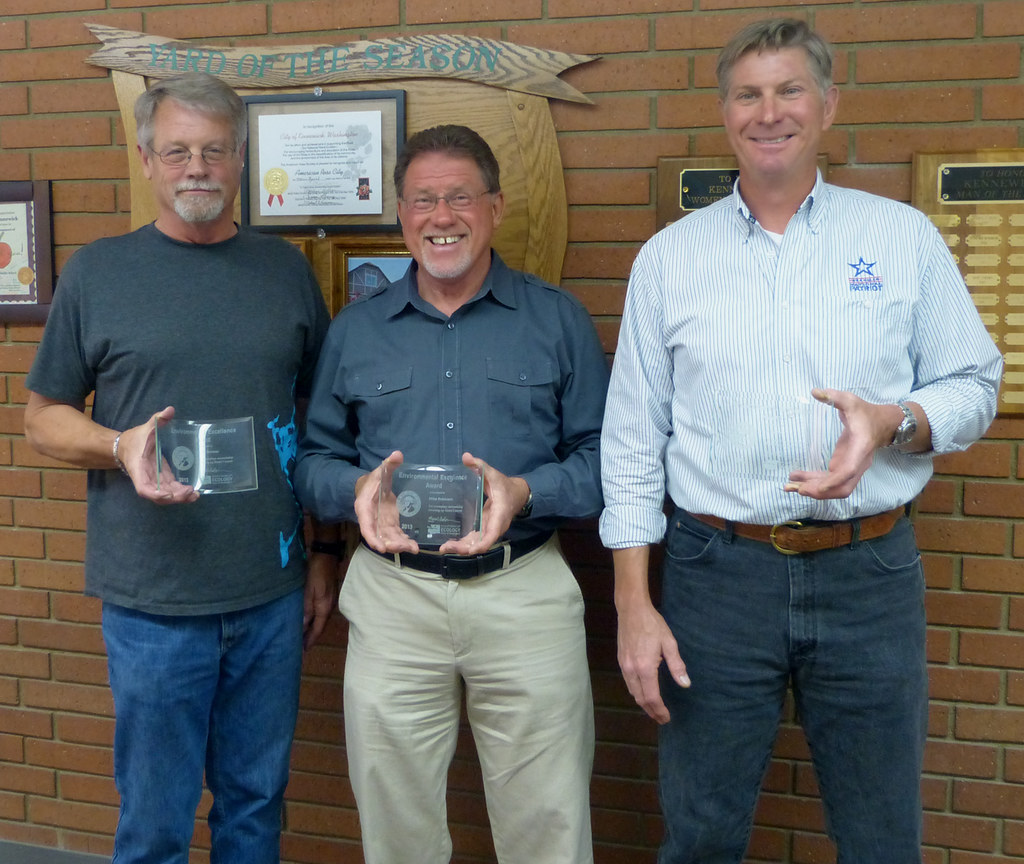
On Tuesday, May 21, Robinson, Potter, Burtner and the other volunteers were honored with Environmental Excellence Awards presented by the Washington Department of Ecology (Ecology), during a meeting of the Kennewick City Council.

“You didn’t just complain you did something about it,” Ecology’s Central Regional Director Tom Tebb told the volunteers. “You saw that the outdoors you enjoyed was a mess and you decided to make it beautiful again. Without your participation, the area might have been closed to everyone – because of a bunch of bad-actor illegal dumpers.”

Area property owners are taking action, too. Landowners have installed security cameras and are making improvements to restrict vehicle access. Sheriff’s patrols have increased in the area. And illegal dumpers caught on camera are facing prosecution.

This is particularly important now – money to pay for litter and illegal dumping cleanups are scarce. Funds to local governments have been cut already by 30 percent. And a proposal before the current legislature would cut it to 40 percent of what we had in the 2007 biennium.

Benton Franklin Health joined Ecology’s Waste 2 Resources Program in making the nomination. It is efforts like this – voluntary community involvement that will make the difference in these times of “smaller government.” Thanks to all the recipients and citizens involved! 

Environmental Excellence Awards were presented to: Mike Robinson, Al Potter, Russ Burtner, Tim Goodman; Les Schwab Tire Stores - Andy Walker/Clearwater; Les Schwab Tire Stores - Rick Giddings/Columbia Center; Windermere Real Estate - Dave Retter; Waste Management - Jeff Wheatle; Help U Move - Russ Pogue; Flynn, Merriman & McKennon Law Firm- Jay Flynn; and JMS Inspections - James Sexton.
See more photos in Flickr

Fecal Matters: Cummings Park and Les Davis Pier on Ruston Way Reopened in Tacoma, WA

BEACH Program Update

Tacoma, WA - Cummings Park and Les Davis Pier in Tacoma are open for water recreation. Beach closure signs were previously posted on May 24, 2013 due to high fecal bacteria in the water.

The Tacoma-Pierce County Health Department removed the closure signs May 30, 2013, after follow-up sampling indicated low bacteria levels. There is no longer a public health concern, but heath department is continuing to investigate the source of last week's pollution.

Visit the BEACH web site to find the latest results for these and other saltwater beaches: http://www.ecy.wa.gov/programs/eap/beach/

Stay updated about water quality at your beaches by keeping up with us on our blog Fecal Matters, on Facebook, or join our listserv.

Christopher Clinton is the interim BEACH Program Manager and can be reached at christopher.clinton@ecy.wa.gov


Wednesday, May 29, 2013

UPDATE: Power-outage will affect Ecology online applications (May 31 - June 2)

Ecology Notification

Maintenance work is planned for the Ecology building in Lacey, beginning Friday, May 31st at 7:00 PM through Sunday, June 2nd. During this time, the power will be turned off to our data center, temporarily shutting down many of Ecology's online applications.

Applications that will not be available include:
  • Areawide Remediation Environmental Information System (AREIS)
  • Children's Safe Product Act (CSPA) Reports
  • Cleanup Site Search
  • Cleanup Levels and Risk Calculations (CLARC)
  • Coastal Atlas
  • Columbia River Water Resources Explorer
  • Environmental Information Management (EIM) (Added 5/29/2013)
  • Environmental Permit Handbook
  • Facility/Site Identification (F/SID) System
  • Fertilizer Database (Wastes in Commercial Fertilizers)
  • Grade Level Expectations (GLE) Correlations to Environmental Education Resources
  • Hazardous Waste Services Directory
  • Industrial Permits
  • Integrated Site Information System (ISIS)
  • Laboratory Accreditation
  • Local Source Control (Added 5/30/2013)
  • Marine mooring data (Added 5/29/2013)
  • Polluted Waters - 303(d) Listing
  • Public Events Calendar
  • Publications and Forms
  • Recycling (1-800-RECYCLE)
  • Shoreline Aerial Photos
  • Smelter Search
  • Solid Waste Information Clearinghouse
  • Staff directory annd subject referral look up tools
  • Thermal stream surveys
  • Tier Two Online Reporting (Added 5/30/2013)
  • Tridex (Added 5/30/2013)
  • TurboWaste (Added 5/30/2013)
  • TurboPlan (Added 5/30/2013)
  • Water Quality Permit Databases
  • Water Resources Explorer
  • Well Construction and Licensing System (WCLS)
  • Well Logs look-up
While the applications are down, you will see this server error instead of getting access to the tool. For more information about these online applications, see Ecology's Databases.

The Ecology website will not be affected.

Around the Sound: Comments sought on Anacortes site

By Seth Preston, Communications Manager, Toxics Cleanup Program

We’re asking the public to comment on the final round of cleanup work planned at the Cap Sante Marine site on the Anacortes waterfront.

The Port of Anacortes owns the site on Fidalgo Bay. The port did some substantial cleanup work in 2007 – the photo at right captures some of that effort.

This last round will focus on two small pockets of contamination still remaining. Ecology will welcome comments from May 30 through June 30. Here are more details on the proposal and the comment period.

The Cap Sante Marine site is one of several in Anacortes that Ecology is helping to clean up under the Puget Sound Initiative.

Around the Sound: A Sound check on salmon, seal health

By Seth Preston, Communications Manager, Toxics Cleanup Program

Two newspapers offer their looks at Puget Sound’s health as measured through different creatures that live in the Sound’s waters.

Chris Dunagan of the Kitsap Sun has published his latest take the Sound’s health. This one focuses on salmon and other fish in the Sound’s waters.

Dunagan delves into “vital signs” collected by the Puget Sound Partnership. You also can check out his prior installments.

Also, Lynda V. Mapes of the Seattle Times explores the health of harbor seals throughout the Sound.

Tuesday, May 28, 2013

Ecology's Dam Safety Office Gets High Marks

But report says state’s aging dams need continual attention and funding


by Lynne D. Geller, Water Resources Communication & Education

When was the last time the importance of well-maintained dams came up in dinner conversation? For most of us, maybe never! Like so much of our state’s infrastructure, the safety of our state’s dams is taken for granted — unless one fails.

So it’s good to know that in the recently released 2013 Report Card for Wasington's Infrastructure, the American Society of Civil Engineers (ASCE) gave our dams the highest grade of the nine infrastructure areas studied and evaluated.

Ecology’s Dam Safety Office (DSO), part of the Water Resources Program, has regulatory authority for over 1,000 dams. The DSO oversees dams that store more than 10 acre-feet of water. (Picture a football field filled with eight feet of water.)

The ASCE gave our dams a “B”, the only grade above a “C” for Washington. (America’s overall GPA for dams was a “D.”) ASCE evaluates infrastructure for each U.S. state and generates a Report Card every four years. The report also looked at Aviation, Bridges, Drinking Water, Rail, Roads, Schools, Solid and Hazardous Waste, and Transit: the fundamental facilities and systems serving Washington.

But ASCE cautions: “Continued funding of dam safety programs is essential to maintain or improve upon the current level of dam safety in Washington. No funding programs are on the horizon for repairing private dams.” (The majority of regulated dams are privately owned.)

How the DSO helps ensure the prevention of safety problems

The DSO is made up of engineers with specialized expertise. Their three key areas of focus are:

Performing periodic inspections of dams where dam failure could result in loss of life downstream. Regulated dams are categorized by downstream risk: high, significant and low.

Monitoring the construction of new dams and modifications to existing ones. This is done through permitting, plan review and site inspections.

Making sure that dams have useful up-to-date Emergency Action Plans (EAPs), so people are prepared on the chance there is a problem.

Ongoing attention and funding is key to maintaining and improving Washington’s dams

Jerald LaVassar, DSO’s lead engineer, acknowledges the high mark, but reminds us that “keeping dams in good repair is a continuing challenge, especially as our understanding of storms and seismic threats evolves. We can’t take safety for granted. The stakes are high if things go wrong.

“A large proportion of dams in this state are over 50 years old. Ongoing attention and funding is necessary to continue protecting lives and property, both on our part and that of the owners.”

Let’s not wait for something to go wrong before we address continued and increased funding for the safety of dams throughout the state. You know what they say about an ounce of prevention. . . investing in dam safety is an investment that pays off exponentially.

For more information

Ecology’s Dam Safety website: http://www.ecy.wa.gov/programs/wr/dams/dss.html

Association of State Dam Safety Officials website and booklet “Living with Dams: Know Your Risks” — (for people living, working or playing in areas near dams) www.livingneardams.org.

James DeMay, Ecology DSO section manager, 360-407-6603

Sharing the magic of green chemistry with high school teachers

By Saskia van Bergen, green chemistry scientist, Hazardous Waste Toxic Reduction Program

When I was a student in a lab, I knew very little of the chemical and safety hazards of the experiments we did. From my perspective, the materials magically appeared and disappeared. I didn’t know what went on behind the scenes. I thought very little about the health risks of chemicals we used. This continued into college where I majored in chemistry. Even though I took a class in environmental chemistry, it wasn’t until I worked on my senior thesis that I started learning more about the potential hazards of chemicals. Some toxic chemicals pose an immediate health threat. Others can gradually build up in the environment and in our bodies, causing harm to the environment and disease long after first use.

Benign by Design

One of the reasons I love my job here at Ecology is that we are helping to improve products and our quality of life by using the principles of Green Chemistry. These principles help Washington State businesses be more profitable and competitive while protecting human health and the environment. Green chemistry is the design of chemical products and processes that reduce or eliminate the use and generation of hazardous substances. Some people call this “Benign by Design” or pollution prevention at the most basic level.

We think educating the next generation of scientists in green chemistry is a necessary first step toward preventing pollution through safer, greener chemical products and processes. Unless the future scientists first learn about green chemistry in school, it won’t enter widespread practice.

Ecology is partnering with Beyond Benign to share a Green Chemistry Webinar Series for high school science teachers. Join us for one, two or all three webinars dedicated to providing useful tools and resources for integrating green chemistry into the high school classroom and laboratory. Find out why and how green chemistry can be used to teach core chemistry concepts while at the same time inspiring students to create the next generation of sustainable products and processes.

Green Chemistry Webinar Series:

May 30th - Introducing Green Chemistry into the High School Webinar:
This webinar will focus on green chemistry basics with a short introduction to the 12 key principles. Highlighted in this webinar will be multi-disciplinary lessons for introducing green chemistry and teachers’ personal experiences of how they have introduced green chemistry to their students.

June 6th - Connecting Chemistry Concepts to Cutting-Edge Science Innovations Webinar: This webinar will focus on lessons and units designed to highlight and connect chemistry concepts with current chemistry-related inventions and discoveries over the past 20 years. Review Presidential Green Chemistry Challenge Award-Winning Case Studies and units linking chemistry concepts to cosmetics, solar energy and biomimicry.

June 13th - Safer Chemistry: Drop-In Replacement Labs Webinar: This webinar will focus on labs that cover the same content as traditional labs, but use more environmentally friendly materials. The focus will be on labs that reduce the risk in the laboratory setting by targeting the hazard rather than the exposure. Replacement labs that will be highlighted will be: reactions: single, double, composition & decomposition; equilibrium and flame test.


Register Now

To register, go to https://attendee.gotowebinar.com/rt/6390260775939252992

For more information visit our Green Chemistry website

Friday, May 24, 2013

Fecal Matters: No Contact Advisory for Cummings Park and Les Davis Pier on Ruston Way, Tacoma, WA

BEACH Program Update

On May 24, 2013, the Tacoma-Pierce County Health Department issued a no contact advisory for Cummings Park and Les Davis Pier on Ruston Way in Tacoma, WA. The closure was issued due to high fecal bacteria counts in the water. The public is warned not to make contact with the water until further notice. The Health Department will continue to collect water samples weekly and is investigating the pollution source.

Contact with fecal contaminated waters can result in gastroenteritis, skin rashes, upper respiratory infections and other illnesses. Children and the elderly may be more vulnerable to waterborne illnesses.

Stay updated about water quality at your beaches by keeping up with us on our blog Fecal Matters, on Facebook, or join our listserv.

Christopher Clinton is the interim BEACH Program Manager and is available at 360-407-6154 or christopher.clinton@ecy.wa.gov for questions.

Power-outage will affect Ecology online applications (May 31 - June 2)

Ecology Notification

Maintenance work is planned for the Ecology building in Lacey, beginning Friday, May 31st at 5:00 PM through Sunday, June 2nd. During this time, the power will be turned off to our data center, temporarily shutting down many of Ecology's online applications.

Applications that will not be available include:
  • Areawide Remediation Environmental Information System (AREIS)
  • Children's Safe Product Act (CSPA) Reports
  • Cleanup Site Search
  • Cleanup Levels and Risk Calculations (CLARC)
  • Coastal Atlas
  • Columbia River Water Resources Explorer
  • Environmental Permit Handbook
  • Facility/Site Identification (F/SID) System
  • Fertilizer Database (Wastes in Commercial Fertilizers)
  • Grade Level Expectations (GLE) Correlations to Environmental Education Resources
  • Hazardous Waste Services Directory
  • Industrial Permits
  • Integrated Site Information System (ISIS)
  • Laboratory Accreditation
  • Polluted Waters - 303(d) Listing
  • Public Events Calendar
  • Publications and Forms
  • Recycling (1-800-RECYCLE)
  • Shoreline Aerial Photos
  • Smelter Search
  • Solid Waste Information Clearinghouse
  • Staff directory annd subject referral look up tools
  • Thermal stream surveys
  • Water Quality Permit Databases
  • Water Resources Explorer
  • Well Construction and Licensing System (WCLS)
  • Well Logs look-up
While the applications are down, you will see this server error instead of getting access to the tool. For more information about these online applications, see Ecology's Databases.

The Ecology website will not be affected.

Thursday, May 23, 2013

Around the Sound: Work underway at the K Ply cleanup site

By Connie Groven, Site Manager, Toxics Cleanup Program


Here the K Ply smokestack is being covered so that asbestos can be scraped from the surfaces the port could reach. January 29, 3013

The past few weeks have seen a lot of activity at the K Ply cleanup site (also known as PenPly or Peninsula Plywood). You can see pictures of the April 9 smokestack demolition here and the whole demolition process here.

The Port of Port Angeles is nearly finished tearing down former mill structures, except for the concrete floor slabs. Interim action fact sheet.

Why is the smokestack rubble contaminated with dioxins?

Before toppling the smokestack, the port removed asbestos from the outside of the smokestack (see photo to the right). They also removed residues from other parts of the smokestack that they could reach.

However, over the years, more ash than expected got trapped inside the walls of the smokestack. The port was able to reach the ash after the smokestack was on the ground.

The port sampled the residues inside of the smokestack walls after toppling it. They also sampled the ash trapped between the walls and inside the liners in the lower part of the stack (see diagram to the right). This confirmed that the ash was contaminated with higher levels of dioxin than expected.

What is happening to the smokestack rubble?

Because of the dioxins in the residues on the concrete and bricks, the port removed the smokestack rubble with the ash. They have taken the debris to a landfill in Roosevelt, WA that can accept this type of waste.

The port also looked at cleaning the ash off the smokestack rubble. This would have allowed them to send the ash to a special landfill and recycle the rubble on the site. However, they found that ash had contaminated too much of the rubble and the cleaning process would be very difficult, so this was not be feasible.

How will the port investigate site contamination?

The port is taking soil samples from the property to confirm areas that need to be stabilized or covered while they finish investigating the site. You can read more about plans for sampling and stabilizing the site in the interim action work plan and the responsiveness summary.

The port is also developing a plan to finish investigating the type and extent of contamination on the site. This sampling will start in the summer. Then they will develop a remedial investigation and feasibility study report, and a draft cleanup action plan.

See "Eyes Over Puget Sound" for May 20

By Sandy Howard, communications manager, Environmental Assessment Program

It’s just a click away — Eyes Over Puget Sound for May 20.

Phytoplankton blooms are notable, with extensive harmless, red-orange Noctiluca blooms showing up early following a period of high freshwater inputs and milder weather conditions.

As you can see in our cover photo, the Fraser River sediment influence is strong north of the San Juan Islands. We are having warm, fresh water entering Central Puget Sound from Whidbey Basin.

In the past few weeks river flows and air temperatures have been higher than normal and are now decreasing.

"Eyes Over Puget Sound” combines high-resolution photo observations with satellite images, en route ferry data between Seattle and Victoria BC, and measurements from our moored instruments.

Learn more about Ecology's marine water quality monitoring program and see more Eyes Over Puget Sound reports.

Sign up to receive email notifications about the latest “Eyes Over Puget Sound” by subscribing to Ecology’s email listserv here.

Wednesday, May 15, 2013

Voices For The Yakima Basin: "The Future We Want"

By Tim Hill, Office of Columbia River

We asked Michael Garrity of American Rivers and Trout Unlimited's Lisa Pelly to share their thoughts about the Yakima Basin Integrated Water Resource Management Plan (YBIP). Here's what they had to say:
First returning sockeye from the Yakama Nation's reintroduction project spawning in the Cle Elum River. The Plan's fish passage element is essential to restoring this run that was lost a century ago.The Yakima Basin Integrated Plan is a big deal. For farmers and river flows, certainly, ensuring water reliability as the climate warms and snowpack shrinks and as what’s left of it melts off sooner. For fish, definitely, bringing back what may be the largest sockeye run outside of Canada and Alaska. And for families, without a doubt, the wild places that we love so well will be enjoyed and protected by future generations.

Both of us have explored, hiked, camped, bird watched, rafted and fished the rivers and streams of the upper Yakima basin for most of our lives. We’ve also put a lot of blood, sweat and tears into the negotiations that will, we hope, bring the YBIP to fruition. So today, as the prospects for an initial round of funding look good, what really gets us excited is imaging the upper Yakima Basin ten years from today, when the plan is well underway.

In the beautiful Cooper and Waptus river watersheds, we have spent hours watching sockeye salmon spawning for the first time in nearly a century. With permanent fish passage constructed at the Cle Elum dam, we’ll be seeing a lot more of them making their way back to high valleys of the north central Cascades.  We’ll also see happier, fatter trout in those rivers, and both of us are looking forward to hooking them on a fly. And its not just a fish story – salmon will serve as food for other fish and wildlife.  Spawning salmon will help trees and forests grow stronger, taller and older as the fish bring fresh nutrients up river again. 

Then there’s the crown jewel – the Teanaway Valley – the largest single public land acquisition in 45 years in Washington, that the YBIP will make possible. Wolves and wolverines have already returned, but the restoration of a robust salmon run and restored meadows and floodplains will create a wilder ecosystem there than has been seen in decades, if not a century. Instead of worrying about future development there, we’ll be able to camp, hike and fish to our hearts’ content.  

The YBIP’s benefits are profound, and will stretch from the Cascades to the Columbia – we’ve only mentioned a few here, focusing just on the upper Yakima. We both feel very blessed to be part of helping to shape a more sustainable Yakima Basin in the coming years, and are looking forward to many more adventures up and down its rivers and streams.
...

Michael Garrity is the Washington State Conservation Director for American Rivers. Lisa Pelly is the Director of the Washington Water Project for Trout Unlimited.

In future posts, we'll ask farmers, municipal water managers, and members of the Yakama Nation to share their thoughts about the Integrated Plan.


Monday, May 6, 2013

Around the Sound: Fresh start for 'Puget Sound Starts Here'

By Seth Preston, Communications Manager, Toxics Cleanup Program

The “Puget Sound Starts Here” education campaign has a fresh look.

“Puget Sound Starts Here” is an effort by a partnership of cities, counties, state and federal agencies, nonprofit groups, and local organizations that focuses on improving waters and aquatic habitat in the Puget Sound region.

The Puget Sound Partnership has updated the campaign’s website (and provided the photo at left of the Deception Pass area on Whidbey Island).

Check out the campaign and take an opportunity to learn how can you help clean up and protect the Sound and its surrounding waters.

Air Time: Wildfires heat up, bring toxic smoke

By Seth Preston, Communications Manager, Toxics Cleanup Program

Wildfires are burning already in several locations in Washington, just months after the nation watched as fires consumed vast tracts of central and eastern Washington, overwhelming local communities with hazardous, choking smoke.It was a stark, brutal lesson about the destructive power of wildfires. The air quality in some central Washington communities was so unhealthy for so long that many residents were compelled to evacuate their homes just so they could find clean air to breathe.

The photo on the right from the Daily Record in Ellensburg gives just a snapshot of what happened last summer and fall.

The current fires are a potential reminder of that – and a possible harbinger of the wildfire season ahead, which began this year in Washington on April 15, according to the Department of Natural Resources (DNR).

This week (May 5-11) is Wildfire Awareness Week. You can learn more wildfire awareness and activities, resources and learning opportunities in local communities by checking out this DNR news release.

All wildfires have the potential to unleash large amounts of unhealthy smoke. Here are wildfire-related questions and answers that the Washington Department of Health, Ecology and other state and federal agencies developed during last year’s devastating wildfires.

Thursday, May 2, 2013

Fecal Matters: No Contact Advisory for Irondale Beach, Jefferson County, WA

BEACH Program Update

On May 1, 2013, Jefferson County Public Health issued a no contact advisory for Irondale Beach near Port Hadlock, WA. The advisory was issued due to high E. coli bacteria counts in a creek which empties onto the beach.

Contact with fecal contaminated waters can result in gastroenteritis, skin rashes, upper respiratory infections and other illnesses. Children and the elderly may be more vulnerable to waterborne illnesses.

Stay updated about water quality at your beaches by keeping up with us on Facebook, checking beach status on Coastal Atlas, or joining our listserv. Christopher Clinton is the interim BEACH Program Manager and is available at 360-407-6154 or christopher.clinton@ecy.wa.gov for questions.


Wednesday, May 1, 2013

Boots on the Ground: Puget SoundCorps to remove creosote at Kitsap beaches

By Stephanie Jackson, WCC Project Coordinator, and Jasmine Davis, WCC Outreach Assistant, Ecology Washington Conservation Corps


Member Alex Stowe stages creosote debris for airlift, 2011


Member Shawn Montgomery removes marine


Puget SoundCorps crew clearing a derelict dock at Maury Island, 2012
Through a partnership between the Washington departments of Natural Resources (DNR) and Ecology (Ecology), Washington Conservation Corps’ (WCC) Puget SoundCorps crews, have been cleaning up Puget Sound beaches since 2011.

The most recent round of beach cleanup focuses on removing toxic creosote through a partnership with Kitsap County Parks and Recreation. This project started on April 29 and will continue through May 3, 2013.

WCC’s Puget SoundCorps provides practical work experience for young adults and recently returning military veterans through a partnership with Ecology, DNR, State Parks and the state Department of Veterans Affairs. The crews cleaning up Washington's beaches consist of both veteran and non-veteran members. In exchange for their efforts, members earn the state minimum wage and an education award (scholarship) through AmeriCorps.

SoundCorps removing toxic threats

SoundCorps crews work with DNR staff to identify and remove creosote treated pilings, old docks, and other debris that have washed ashore. Creosote is a toxic compound that includes many chemicals, including polycyclic aromatic hydrocarbons (PAHs) which are harmful to marine life.

PAHs were identified as a toxic chemical of concern in Ecology’s Puget Sound Toxics Assessment. The study found that when PAHs leach into the bottom sediments of Puget Sound, the pollutant can cause tumors in marine flatfish. PAHs from oil and fuel spills in water also can cause heart defects in the developing embryos of herring and other fish species.

Getting contaminated debris ready for airlift

Puget SoundCorps crews have grown adept at creosote removal through their efforts in other parts of Washington. During some projects, crews work alongside helicopter pilots for removal of larger pieces, allowing them to practice rigging techniques learned within the WCC program. The crew members enjoy the beautiful surroundings and the satisfaction of putting their training to use while helping the environment. In January 2013, the SoundCorps crew led by supervisor, Darrell Borden, spent a week working along the Dungeness Spit in Sequim. In that short time, they removed 13 tons of creosote material from the beach preventing future pollution from leaching into the environment.

Puget SoundCorps crews perform other beach cleanup including surveys, marine debris removal, and litter removal. Crews also report derelict ships, if found. By performing beach cleanup, crews feel a part of the big picture and consider their work to be an important contribution and an exciting adventure.

Learn more about the Washington Conservation Corps.